The local solver
Realizing an edit: one success test for every realizer, the mode-scheduled quasi-static realizer, re-planning and failure diagnostics, and the MPPI baseline.
The mode-scheduled realizer Λqs realizes 23 of 24 chain edits from canonical and perturbed starts (GPU), including the pivot that no MPPI cost realized; MPPI-E realizes 15. Receding-horizon re-planning does not raise success (22–23 of 24) but halves the tracking deviation at a 0.2 s interval. Every remaining failure is a break(gv) whose quasi-static hold needs more disk friction than the tracker uses: the gate and the plan count on μ = 0.99 at the disk, the tracker on 0.35. Choices for Aykut: Issues.
What the solver must do
The local solver Λ gets an edit σ → σ′ that passed the hold gate, the current pose χ₀, and the transition pose χtr the gate found. It returns a simulated record, and the edit is accepted only if the record passes one success test, shared by every realizer:
- persistence: every kept contact is on at every sample; for a transfer c → d, one of c and d is on at every sample;
- departure: a contact dropped outright ends above εon;
- dwell: the recognized formation equals σ′ for the last samples, with no tie;
- overlap: no gap below −εpen;
- the manipulator’s time limit, support while the disk lets go, and progress toward the goal for transport.
The mode-scheduled realizer Λqs (step 3b)
The edit names the contacts before and after, and the gate’s sweep gives χtr, so Λqs plans on known contacts and tracks the plan in MuJoCo:
- plan: knots on the contact constraints (Gauss–Newton projection of an interpolation); phase I from χ₀ to χtr keeping σ; phase II by edit kind: a relaxing edit ends at the nearest pose recognized exactly as σ′ with σ′ holding; a constraining edit ends at χtr projected onto σ′ and pressed 2 mm past the closure; transport moves up to 0.05 toward the goal;
- feed-forward: a quasi-static force at each knot (nonnegative least squares over the gate’s friction-cone rays);
- tracking: while the disk touches, a PD force along the box’s free directions, mapped through the contact and kept inside the disk’s friction cone (μ = 0.35, below the simulator’s 0.99, so the contact sticks) and the ±1 N motor box; otherwise PD on the planned disk positions.
Re-planning and failure diagnostics (step 3c)
Re-planning (RHk). Every k steps (20, 40, 80: every 0.2, 0.4, 0.8 s) the plan is rebuilt from the current simulated state and its first segment tracked. The phase comes from the recognized formation: still σ, re-plan phase I toward the same χtr; already σ′, a path to the previous end pose; in between, or past χtr on the schedule but not yet σ′, the previous plan continues. Each phase keeps its scheduled end. The record stops early if a contact that must persist is lost. The first version gave every new plan the time that was left and restarted the change at each re-plan, and was worse than open loop (issue); the table is after the fix.
Ablations. F1: a release must lift the dropped contact at least 4 mm (phase II goes farther past χtr). F2: the feed-forward ramps in from the start’s equilibrium force instead of from zero. RH40r re-sweeps χtr at each re-plan.
Diagnostics for every run (time series kept for failed ones): planned vs executed box and disk, the deviation; recognized vs planned formation and the first unexpected loss or gain; the edit’s gaps; MuJoCo’s contact forces (replayed), friction-cone ratios and slip; motor commands against the limits; the box’s kinetic energy; the re-plan log; a one-line diagnosis and a failure mode.
Cases. The chain’s 8 edits from a canonical and 2 perturbed starts (24 calls) and a hard set of 6: break(gv) from 30°, 35°, 40° with the disk 40 or 20 mm low. After a success the next chain edit is tried from where the record ended.
| Variant | Chain (of 24) | Hard (of 6) | Canonical (of 8) | Next edit | Deepest overlap | Median max deviation | Time per call |
|---|---|---|---|---|---|---|---|
| open loop (3b) | 23 | 0 | 8 | 12 of 20 | 4.2 mm | 37 mm | 2.7 s |
| open + F1, F2 | 22 | 0 | 7 | 10 of 19 | 5.5 mm | 39 mm | 2.8 s |
| RH20 | 22 | 0 | 8 | 12 of 19 | 2.9 mm | 19 mm | 8.8 s |
| RH40 | 22 | 0 | 8 | 12 of 19 | 4.2 mm | 42 mm | 7.5 s |
| RH80 | 22* | 0 | 8 | 12 of 20 | 4.2 mm* | 42 mm | 5.7 s |
| RH20 + F | 21 | 0 | 7 | 11 of 18 | 5.5 mm | 19 mm | 10.4 s |
| RH40 + F | 21 | 0 | 7 | 11 of 18 | 5.5 mm | 41 mm | 7.5 s |
| RH80 + F | 21 | 0 | 7 | 11 of 18 | 5.5 mm | 40 mm | 5.7 s |
| RH40r (χtr re-swept) | 20 | 0 | 7 | 9 of 17 | 4.2 mm | 35 mm | 9.8 s |
| MPPI-E | 15 | 0 | 5 | 6 of 15 | 4.6 mm | — | 40 s |
GPU (RTX 5080). * One transport run fails on a single sample whose gap has the wrong sign (−96 mm for +96 mm; issue); without it RH80 is 23 of 24.
| Variant | Chain (of 24) | Hard (of 6) | Canonical (of 8) | Next edit | Deepest overlap | Median max deviation | Time per call |
|---|---|---|---|---|---|---|---|
| open loop | 22 | 0 | 7 | 12 of 19 | 3.4 mm | 43 mm | 0.16 s |
| open + F1, F2 | 22 | 0 | 7 | 11 of 19 | 4.5 mm | 23 mm | 0.16 s |
| RH20 | 22 | 0 | 7 | 11 of 19 | 3.4 mm | 21 mm | 1.5 s |
| RH40 | 21 | 0 | 7 | 11 of 18 | 3.4 mm | 43 mm | 1.1 s |
| RH80 | 22 | 0 | 7 | 12 of 19 | 3.4 mm | 43 mm | 0.9 s |
| RH20 + F | 23 | 0 | 7 | 11 of 20 | 4.8 mm | 21 mm | 1.5 s |
| RH40 + F | 23 | 0 | 7 | 11 of 20 | 4.5 mm | 24 mm | 1.1 s |
| RH80 + F | 23 | 0 | 7 | 10 of 20 | 4.5 mm | 24 mm | 0.9 s |
| RH40r | 19 | 0 | 6 | 8 of 16 | 3.4 mm | 27 mm | 1.3 s |
Python 3.14; MPPI-E not run (120 s per call on the CPU). Failures: corner not released 4–6 and slump in ramp-in 3 for every variant, plus 3 overshoots for RH40r.
Failure modes (failed runs per variant, GPU):
| Variant | Corner not released | Late change | Slump in ramp-in | Persistence loss | Overshoot | Slip, disk | Slip, environment |
|---|---|---|---|---|---|---|---|
| open loop | 4 | 0 | 3 | 0 | 0 | 0 | 0 |
| open + F | 4 | 0 | 3 | 1 | 0 | 0 | 0 |
| RH20 | 5 | 0 | 3 | 0 | 0 | 0 | 0 |
| RH40 | 3 | 2 | 3 | 0 | 0 | 0 | 0 |
| RH80* | 3 | 1 | 3 | 0 | 0 | 0 | 0 |
| RH20 + F | 4 | 1 | 3 | 1 | 0 | 0 | 0 |
| RH40 + F | 5 | 0 | 3 | 1 | 0 | 0 | 0 |
| RH80 + F | 5 | 0 | 3 | 1 | 0 | 0 | 0 |
| RH40r | 4 | 0 | 3 | 0 | 3 | 0 | 0 |
| MPPI-E | 6 | 0 | 0 | 2 | 3 | 2 | 2 |
Why the remaining runs fail
All are break(gv): the hard set and one or two perturbed chain starts.
- Slump during ramp-in (disk 40 mm low, every quasi-static variant). The riser contact sv is lost within 9–21 steps; from 30° the box falls flat in 0.2 s. The motors are not saturated then and the disk barely slides. At that start the plan asks the disk for (0.33, 0.09) N, a tangential/normal ratio of 0.99 at the disk–box contact, which the simulator’s μ = 0.99 allows and the gate counts on. The tracker keeps the disk’s force inside μ = 0.35 and applies (0.16, −0.03) N, the same with and without F2 (both ramps are projected onto the same point of the cone, so F2 changes nothing here).
- Corner not released (disk 20 mm low, and the failing chain starts). The box tilts, but the riser contact runs at its friction limit (ratio 1.00, the environment’s μ = 0.2) and the box chatters between riser and floor, so the floor corner never opens past εon, or opens and falls back in the dwell when the disk’s force drops. The lift the plan gives to disk friction lands on the riser contact, which cannot carry it.
- Late change (RH40, RH80): σ′ is reached in the last 0.2 s, fewer than the 20 dwell samples.
The check. With the plan’s forces computed with the disk’s friction capped at 0.35, the quasi-static residual of every failing break rises from about 0.015 to 0.22–0.27: no disk force inside the tracker’s cone holds the box through these breaks. Raising the tracker’s μ to 0.6 removes the slump at 30° and 40° but the corner still stays down (5 of 12 probe cases instead of 4); at 0.9 the disk slides on the soft contact (2 of 12). So the gate passes edits that this realizer cannot do, and the fix starts with giving the gate and the plan the friction the realizer can use.
F1 and F2. No consistent effect: on the GPU they cost a transfer(sv → t) start (the full equilibrium force at the first step overshoots the soft contact), on the CPU they gain a break(gv) start with re-planning. F1 cannot help the remaining failures: the corner does not follow the planned lift at all.
Re-planning before the fix realized 1–2 hard starts per variant (all with the disk 20 mm low) while failing the chain’s constraining edits: its compressed, faster phase II lifted the corner where the quasi-static schedule does not. That points at quasi-dynamic motion for these breaks, after the friction question.
Each figure: box tilt planned and executed with the deviation; the edit’s gaps; contact normal forces (MuJoCo replay) and the planned disk force; friction-cone ratios; motor commands and limits; slip speeds and the box’s kinetic energy; the one-line diagnosis at the bottom.
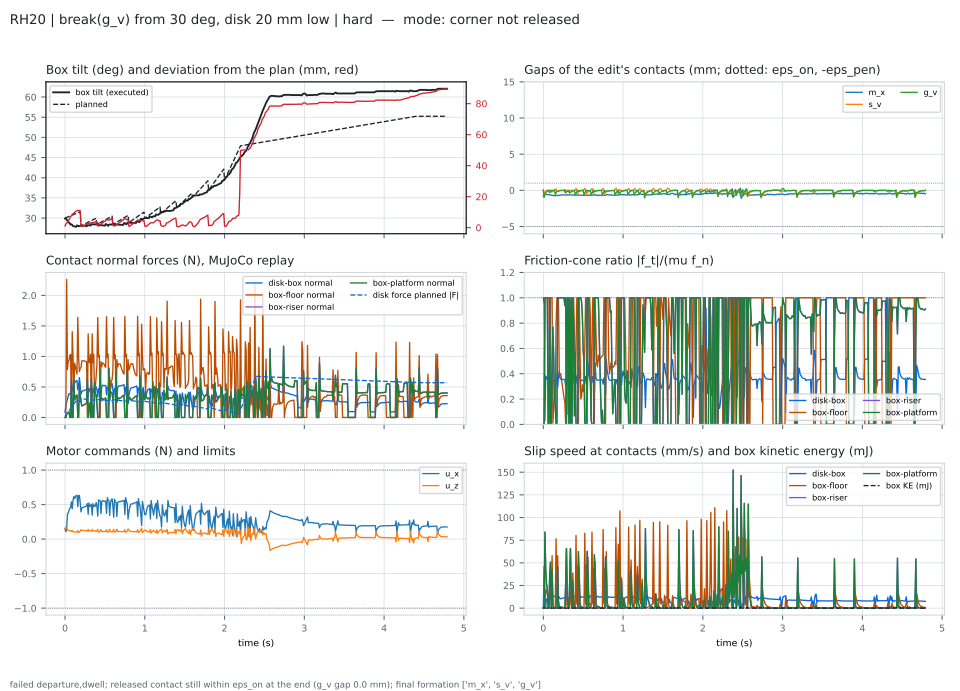
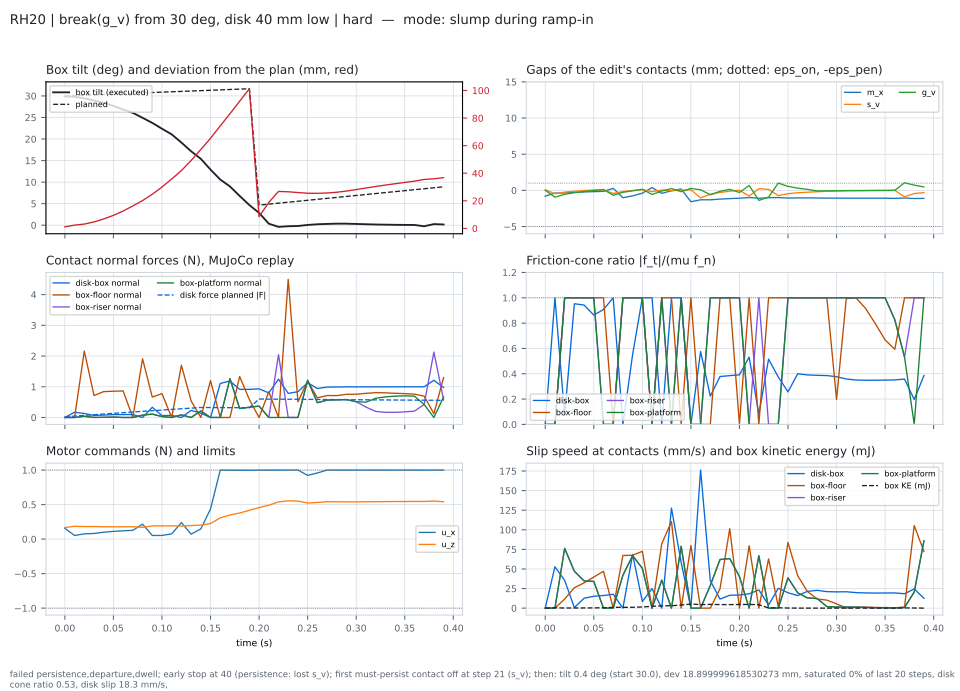
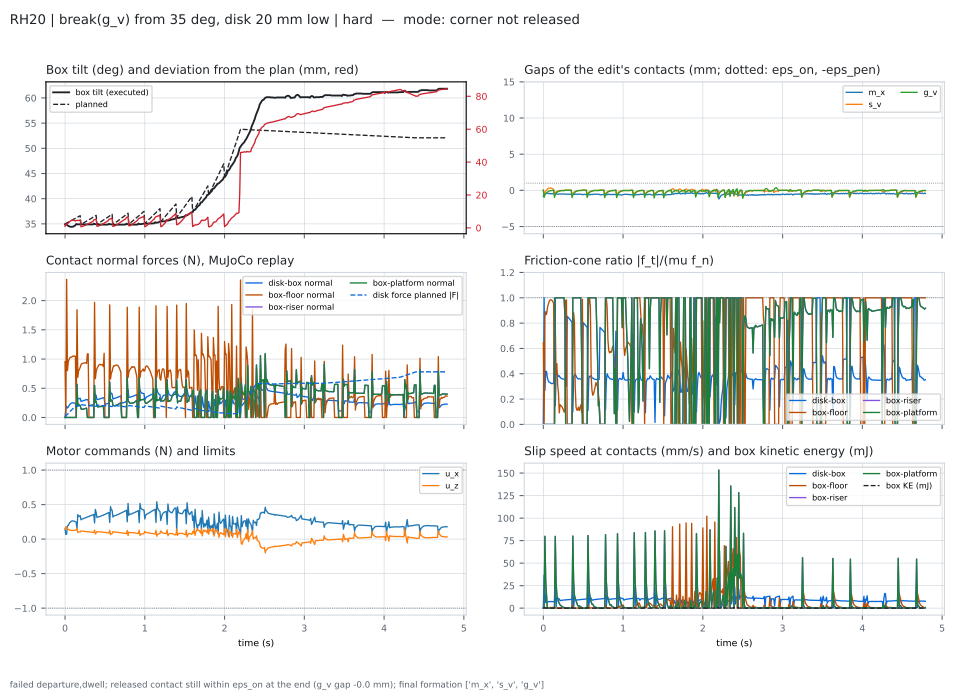
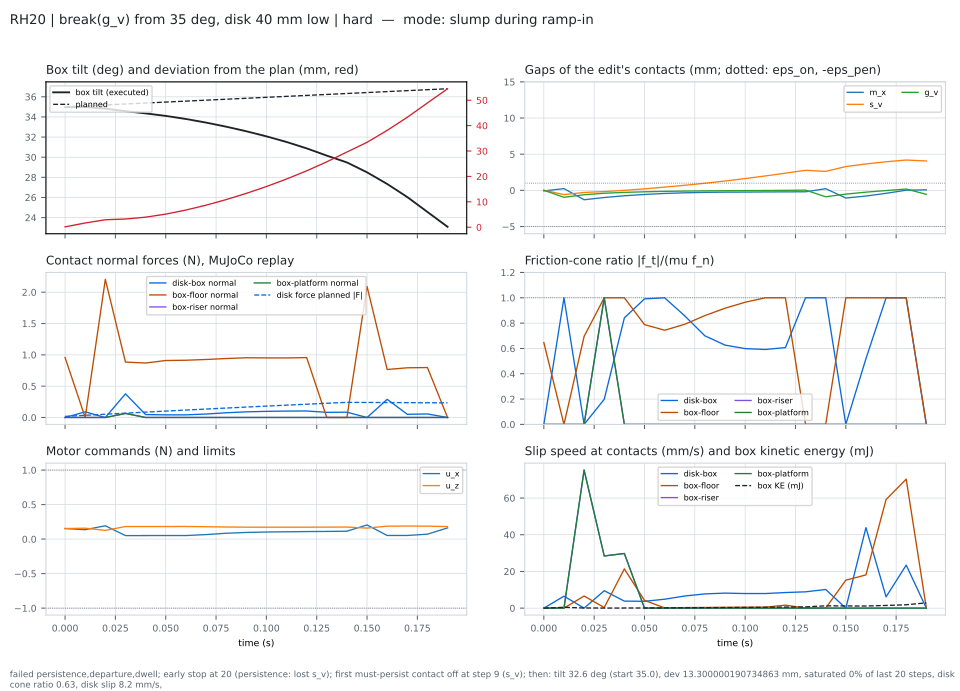
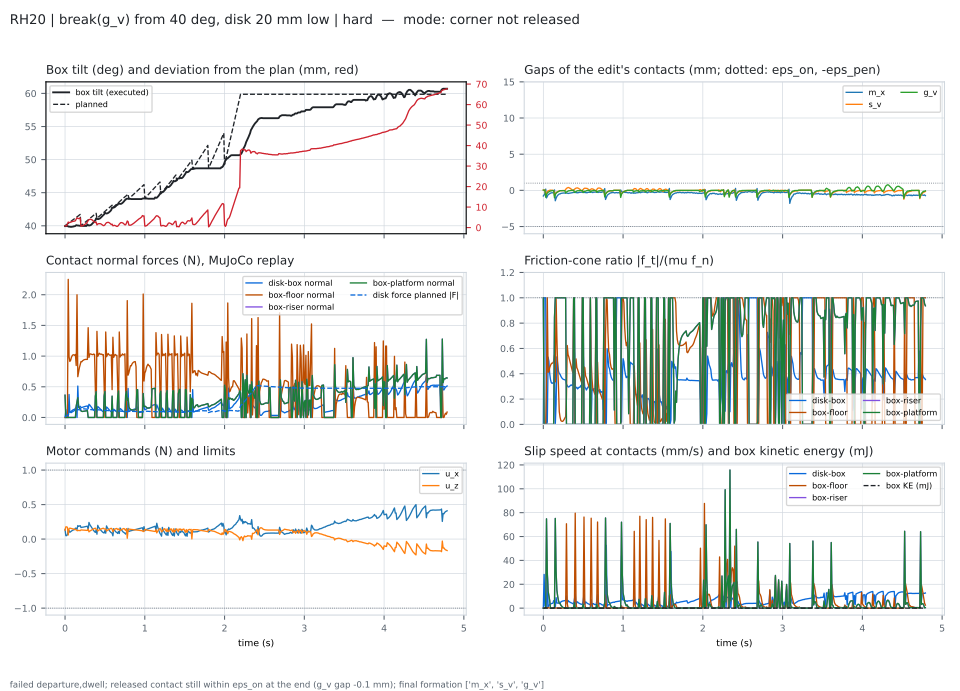
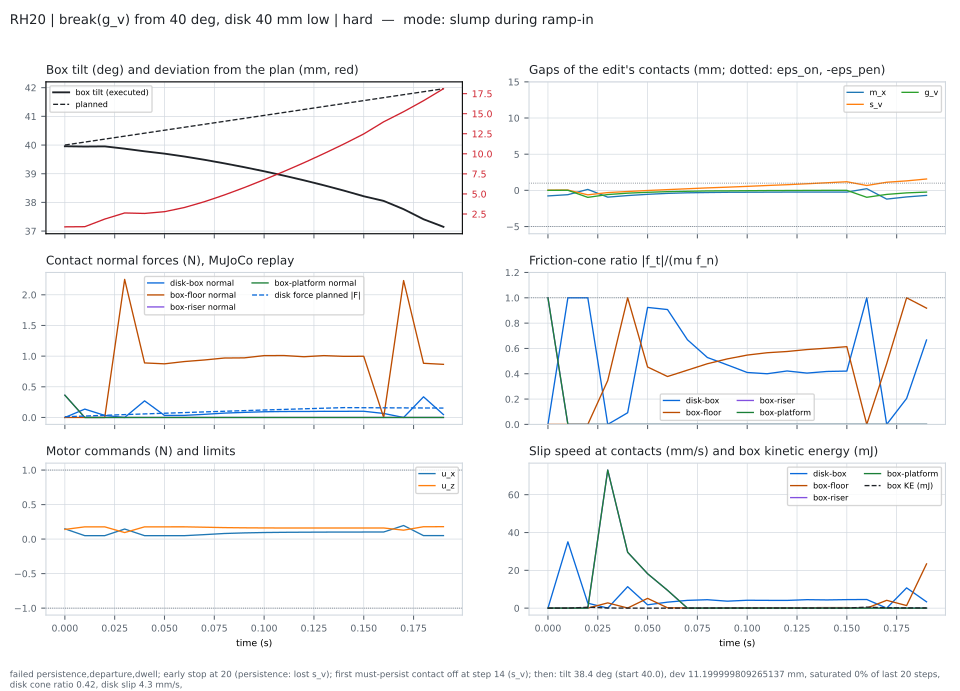
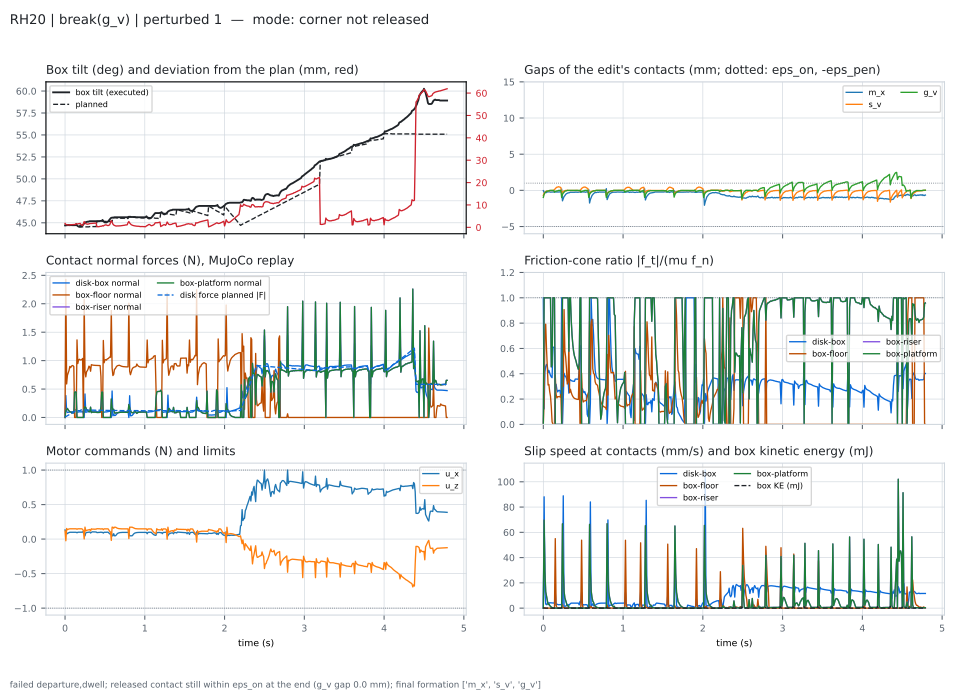
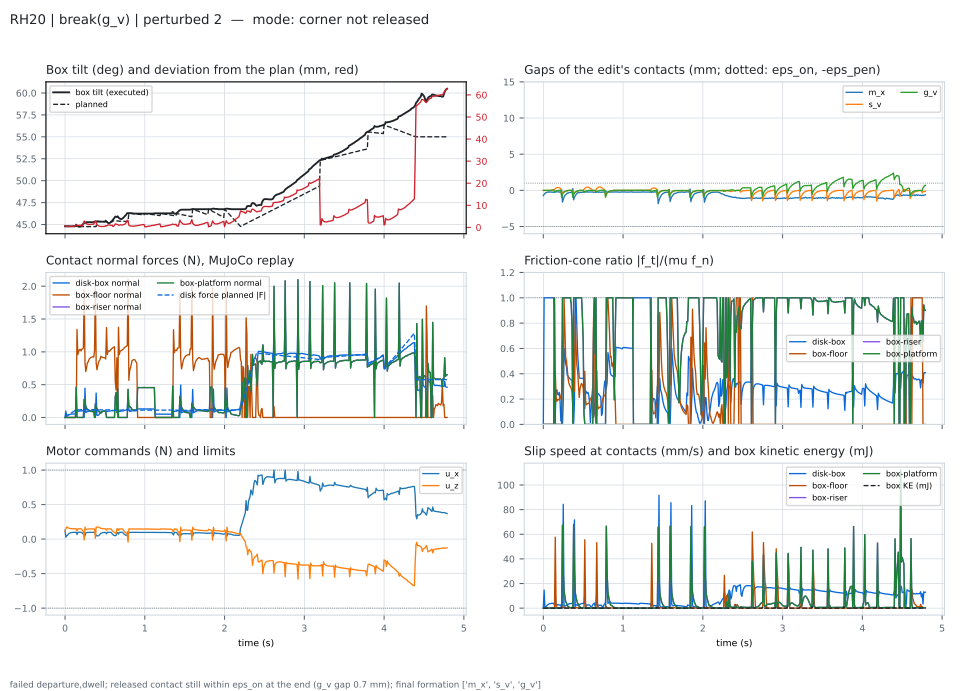
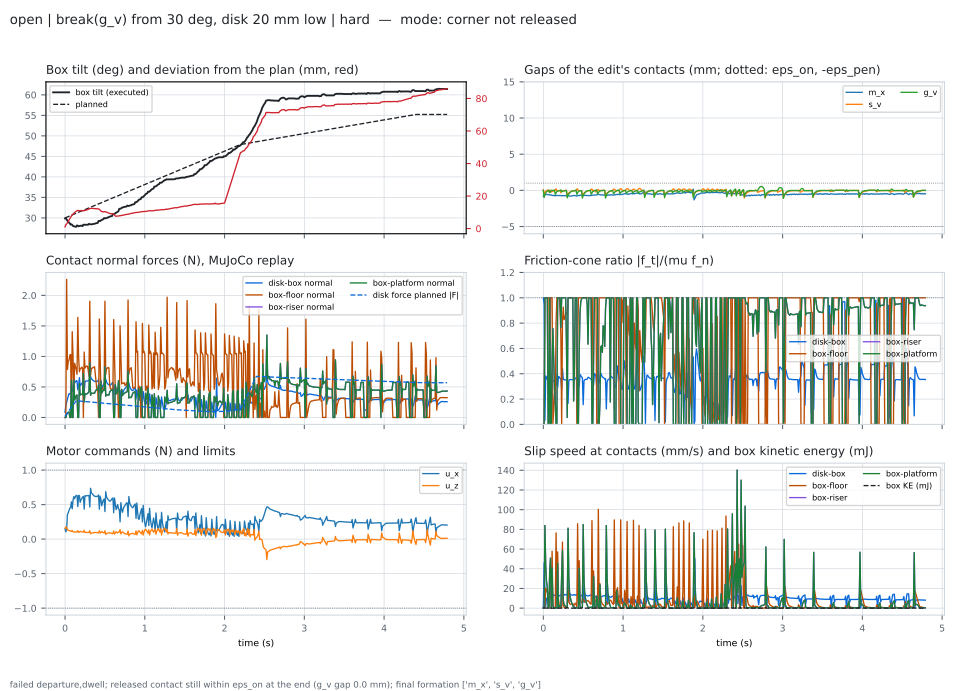
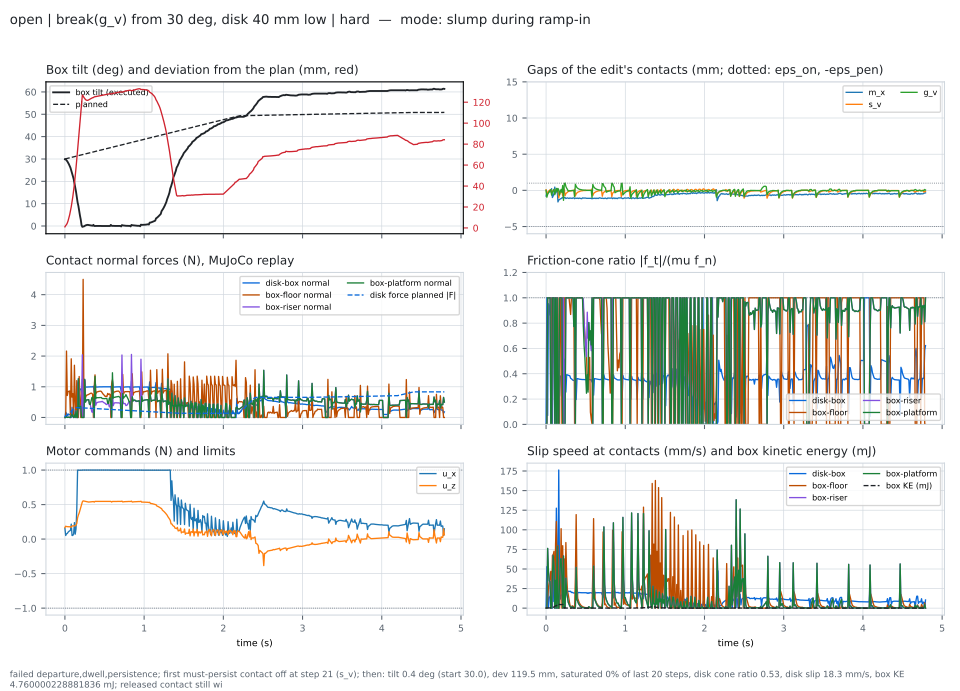
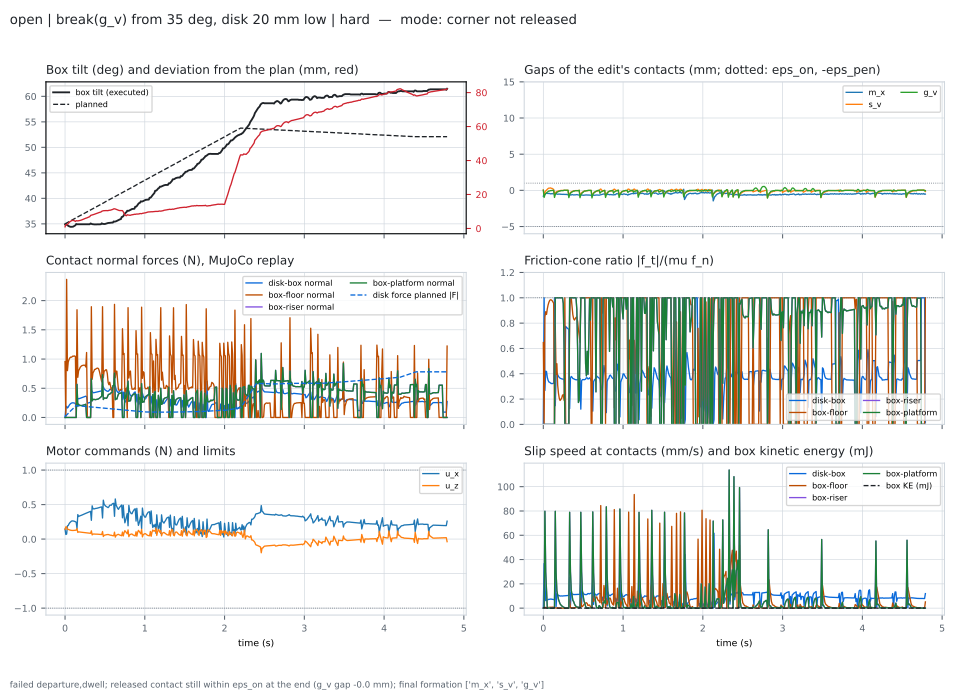
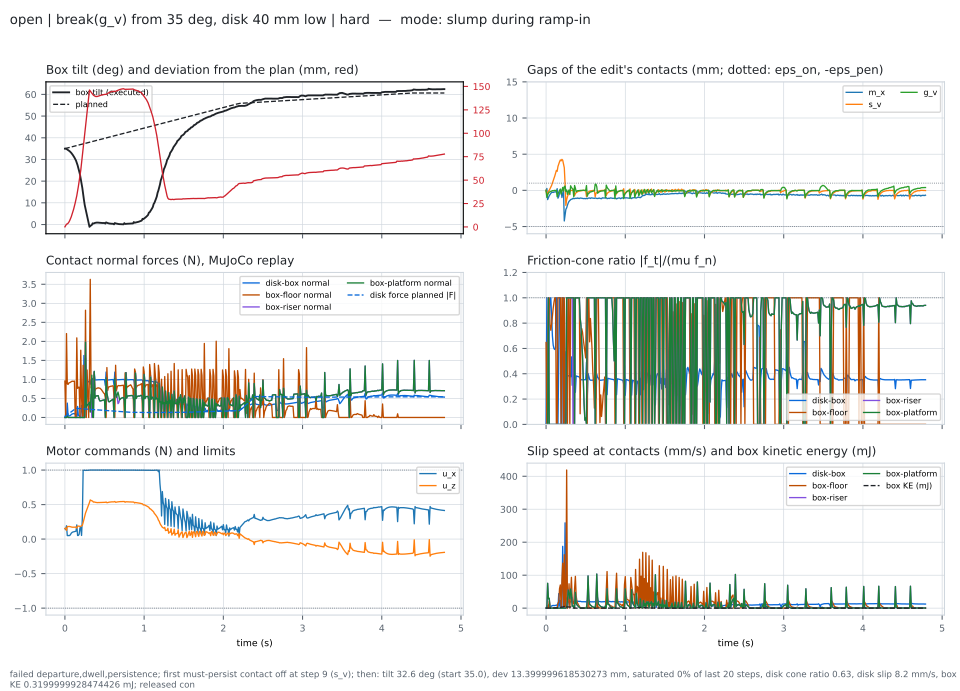
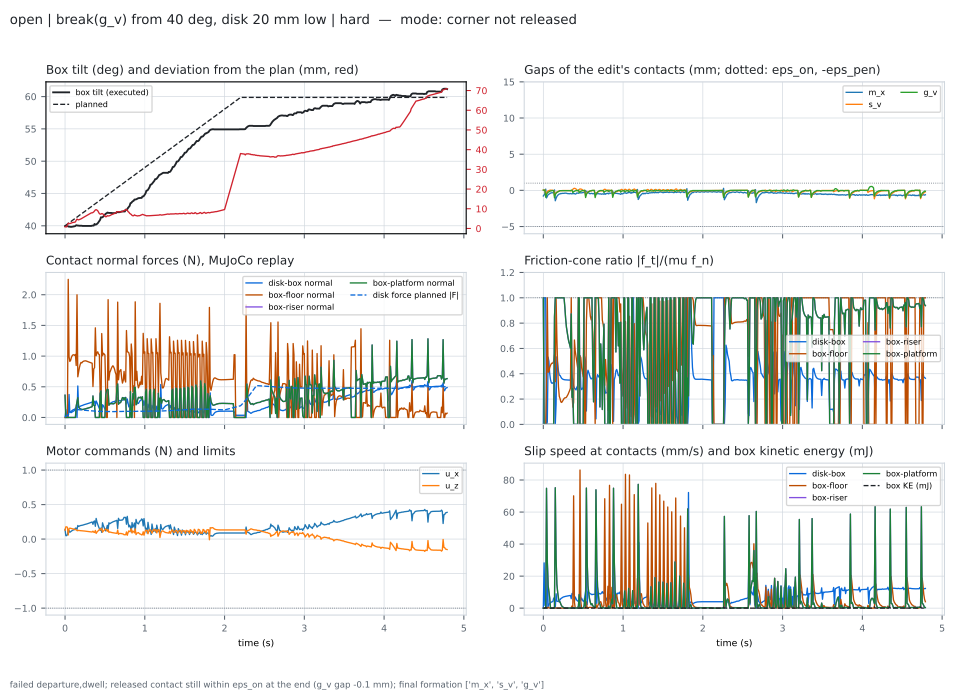
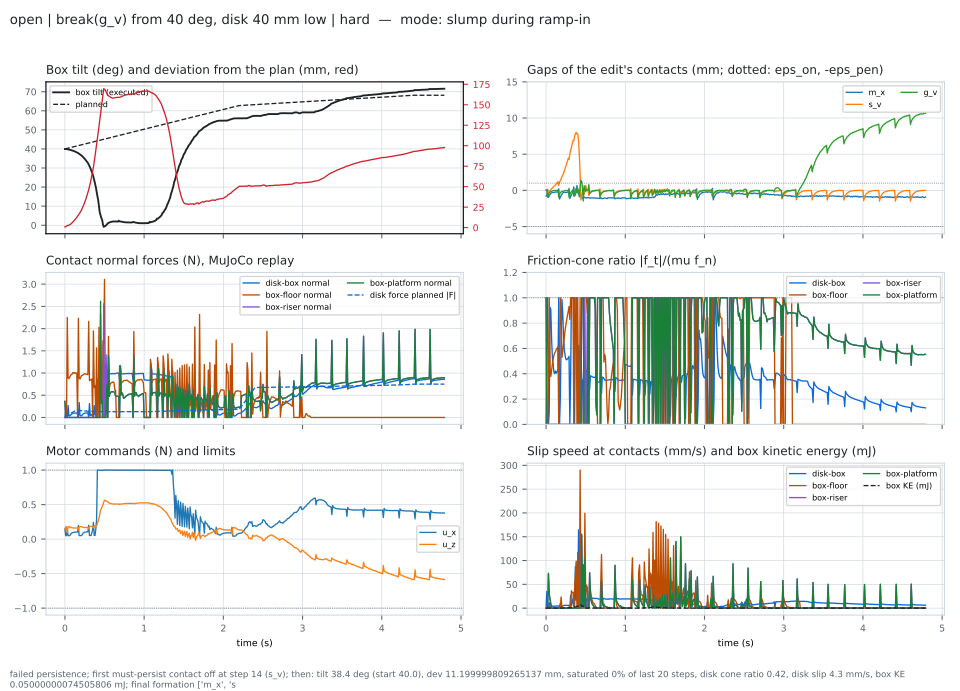
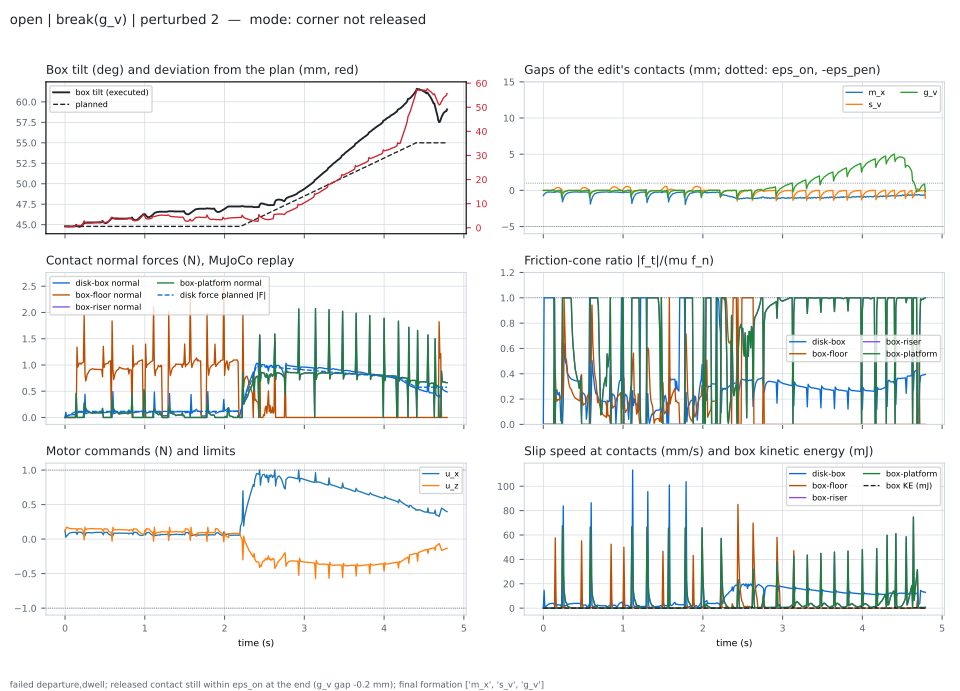
Checkpoint 2: does Λ realize the edits that pass the gate? On the chain, 96% on the GPU (open loop, 23 of 24; 92% for RH20 and RH40; MPPI-E 63%), 92% on the CPU. With the hard set, all of which pass the gate, 77% (23 of 30). What the gate passes and Λqs cannot realize is now one class: breaks that hold the box on a corner with more disk friction than the tracker uses.
The friction match (step 3d)
Decided Nov 8 (compendium, Decision 15): give the gate and the plan the disk–box friction the tracker uses (0.35) instead of the simulator’s 0.99, so the gate rejects the breaks Λqs cannot realize. Built as a scene parameter, manipulator_friction, and measured. It does not do what it was meant to, and it is left unset pending Aykut’s choice.
A defect found first: the gate’s sweep depended on the backend. The sweep lays a 5 × 5 grid along the free directions of the more-constrained formation. Those were the SVD’s null vectors, and when two directions are free (the pivot’s tilt and the disk along −xB) any rotation of them is an equally valid answer. The CPU and the GPU returned different rotations, so they probed different poses. At μ = 0.99 the feasible region hid this; at 0.35 it decided the verdict (the chain’s break(gv): refused on the CPU, margin 0.29 on the GPU). Fixed: a basis that depends on the subspace only. The backends now agree to 10⁻³, and checkpoint 1 at the simulator’s friction is unchanged.
What the gate says at μ = 0.35 (sweep margin; start = tilt / disk depth below the corner):
| sweep | 45° / 40 mm (chain) | 30° / 40 | 35° / 40 | 40° / 40 | 30° / 20 | 35° / 20 | 40° / 20 |
|---|---|---|---|---|---|---|---|
| μ = 0.99, 5 points | 0.12 | 0.28 | 0.31 | 0.45 | 0.44 | ||
| 0.35, 5 points (decided grid) | refused | 0.06 | 0.10 | 0.01 | 0.06 | 0.05 | 0.34 |
| 0.35, 9 points | 0.18 | 0.06 | 0.10 | 0.07 | 0.14 | 0.21 | 0.13 |
With the decided grid, 0.35 refuses the chain’s own break, which the realizer does: a false refusal. With a 9-point grid it passes every start, including the six the realizer fails.
What the realizer does with friction-matched plans (GPU, open loop, 9-point sweep): the chain’s break(gv) 3 of 3 (step 3c: 2 of 3); the hard starts 0 of 6, with the same failure modes as before (slump during ramp-in with the disk 40 mm low, corner not released with it 20 mm low). The disk’s contact now stays inside its cone (ratio at most 0.37). The box’s floor and riser corners reach ratio 1.0 and slide, while the tracker’s correction adds up to twice the planned disk force. So the hard breaks fail dynamically, not for lack of a quasi-static transition, and no friction setting in the gate will reject them. Checkpoint 1 barely moves (chain 32.4% → 33.8% rejected with the sweep; demo 39.5% either way).
Choices (compendium, Step 3d): keep the friction cap unset; refine the sweep (9 points, or adaptive around the best pose) before the teacher search; for the hard breaks, a tracker that also keeps the environment contacts inside their cones, then a quasi-dynamic method.
Decided (Nov 8, Decision 16): the cap stays unset; the hard breaks wait for an environment-aware tracker, then a quasi-dynamic method; the sweep’s resolution was settled by measurement (next section).
The sweep’s resolution, measured (step 3d follow-up)
Every candidate edit that is an edge and passes Near, on the chain’s starts, the six hard break(gv) starts and the 205 demo nodes (1,797 candidates), was swept with several grids and compared with a dense reference (65 × 65 poses for two free directions, up to 4,913 poses), at the simulator’s friction and at the stress case μ = 0.35. The cube grid is the old one (5 or 9 values on all three directions; unused directions repeat poses). The dim grid puts about N poses on the directions that are actually free (8 × 8 for two directions at N = 64). Refinement adds a 3 × 3 × 3 grid at half spacing around the recognized pose of largest margin, twice.
| grid | poses | CPU ms per candidate | false refusals, μsim | false refusals, μ = 0.35 |
|---|---|---|---|---|
| cube 5 (until now) | 125 | 13.7 | 0 | 1 |
| cube 9 | 729 | 96.8 | 0 | 0 |
| dim 125 | 125 | 13.8 | 0 | 2 |
| dim 64 + 2 levels (now the default) | 118 | 12.1 | 0 | 0 |
| cube 5 + 2 levels | 179 | 18.8 | 0 | 0 |
| reference | ≤ 4,913 | 767 | (1,112 pass) | (1,112 pass) |
No grid ever passes an edit the reference refuses. At the default friction the resolution changes no verdict; at 0.35 the 5-point grid refuses the chain’s realizable break(gv) from 45°, and the adaptive grid does not. It costs what the old grid cost, a seventh of 9 points.
What the gate costs in a search. Per expanded node: one Λ call (0.16 s on CPU, open loop) and one gate evaluation (0.75 s on CPU; 0.33 s at χ₀, 0.42 s for the sweep). So the gate is about 82% of a node’s time; 9 points would make it 95% and a node 4× slower. The gate is 13× faster on CPU than on a GPU (the LPs’ iterations batch poorly). Two cheaper levers remain: sizing the sweep’s slots to a node’s candidates (32 slots for 8.6 candidates on average; 8 slots: 0.43 s per node), and evaluating the gate once per key (Decision 18): the demo nodes fall into about 8 keys, about 26 nodes each, which would bring the gate’s share to about 16% if a per-key gate cost about one node’s.
The compiled cost (step 3, MPPI)
The first Λ is MPPI, a sampling-based model-predictive controller running the MuJoCo simulation. The paper’s compiled cost is dimensionless: band, leave and overlap terms on the gaps, a control term, and a terminal barrier on the destination formation. It extends to Xiao and Ji’s edits through the point-contact view:
- a transfer keeps the contained contact and moves the released end: for g → gv the other bottom corner lifts until the tilt passes 2θe; for the disk going round a box corner, the contact point slides past the vertex; a constraining transfer (sv → t) lays the edge flat;
- a compound edge adds up its parts;
- options: a margin term at the end, a dwell term, the two-phase subgoal (reach χtr, then change), and scaling the contact terms by εon instead of the box size.
The cost experiment (step 3, MPPI)
Setup. MPPI with 256 samples, 5 updates, controls held 3 steps and a 30-step look-ahead; executed records of 60 + 20 steps (0.8 s). Each edit of the chain is tried from its canonical start and from 2 perturbed starts, plus break(gv) from 30°, which needs the sweep. The variants:
- A: the current MPPI cost (hand-set weights; a signed linear arrival term);
- B: the paper’s compiled cost;
- C: B plus the terminal margin and dwell terms;
- D: C plus the transition subgoal;
- E: D with the contact terms divided by εon instead of the box size, a smooth terminal cost, and a barrier of 100.
After a success, the next chain edit is attempted from where the record ended.
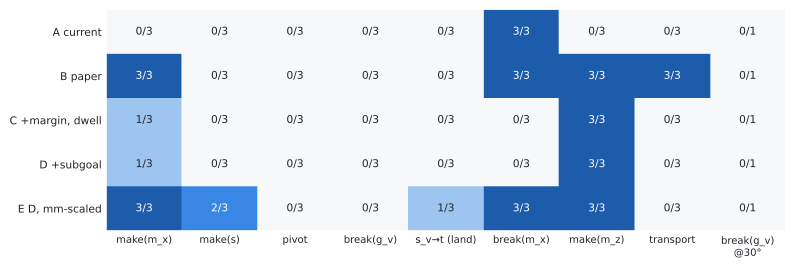
| Variant | Successes (of 25) | Canonical (of 9) | Reached σ′ at some sample | Deepest overlap | 95th percentile | Next edit succeeds | Time per call |
|---|---|---|---|---|---|---|---|
| A, current | 3 | 1 | 24 | 14.1 mm | 12.5 mm | 0 of 3 | 22.8 s |
| B, paper | 12 | 4 | 24 | 8.1 mm | 5.4 mm | 4 of 9 | 24.3 s |
| C, + margin, dwell | 4 | 1 | 24 | 8.2 mm | 5.0 mm | 0 of 4 | 23.5 s |
| D, + subgoal | 4 | 1 | 25 | 8.2 mm | 5.0 mm | 0 of 4 | 23.5 s |
| E, D scaled by εon | 12 | 4 | 24 | 4.7 mm | 4.0 mm | 6 of 12 | 23.4 s |
GPU (RTX 5080). On the CPU the canonical starts give A 1 of 9 and E 4 of 9, as on the GPU, at 196 s and 120 s per call. The experiment ran before the code’s pose distance was aligned with the paper’s (angles weighted by a/2 instead of a), which affects only which held pose the sweep calls nearest and the goal distance’s angle term, zero during transport.
What the table says
- The current cost overlaps. A reaches σ′ in 24 of 25 records but succeeds in 3: its linear arrival term pushes contacts up to 14 mm deep.
- The paper’s cost is badly scaled for millimetre contacts. With the box size as the unit, a 1 mm gap costs (1/125)² ≈ 6·10⁻⁵, so the barrier decides almost everything. C and D are worse than B, probably because their margin term outweighs those tiny contact terms (the run does not isolate the cause). E, the same terms over εon, matches B’s success rate with half the overlap and the best follow-on rate.
- The subgoal changed nothing on the chain: from every canonical start the gate passes at χ₀, so χtr = χ₀. Where it matters (break(gv) from 30°), D also fails.
- What no variant does: the pivot (B tilts the box to about 30° and reaches σ′ but fails another clause; E never tilts it); break(gv) from 45° (B’s box topples onto the platform; E’s stays on its corner at 62–65° and never lifts); break(gv) from 30°. These are the edits where the disk must hold the box on a corner through an unstable motion, and a 0.3 s look-ahead with 1 N motors does not find that motion.
- Transport succeeds with B (3 of 3) but not with E (0 of 3, still moving about 20 mm in the dwell window).
Checkpoint 2 with MPPI: does Λ realize the edits that pass the gate? Not reliably: 12 of 25 (48%) at best, and never the pivot or break(gv). (With Λqs: step 3c.) (Checkpoint 1, whether the gate prunes, is on the hold gate.)
εpen and ties
The recognizer’s overlap tolerance was 10 mm at step 3; since step 3b it is 5 mm (provisional). Ties on the 4,000 jittered demo poses, with εpen replaced:
| εpen | 1.5 mm | 2 mm | 3 mm | 4 mm | 5 mm | 10 mm (today) |
|---|---|---|---|---|---|---|
| Tied poses | 25 | 44 | 98 | 168 | 257 | 475 |
E’s rollouts overlap at most 4.7 mm (95th percentile 4.0 mm); an εpen below that would fail E’s successes on the overlap clause.
Reproduce
Steps 3b–3c (in cmg/; every heavy run in a memory-capped scope):
cd ~/repos/research/c-gnn && git switch phase1/planar && git pull && cd cmg
JAX_PLATFORMS=cpu PYTHONPATH=tests .venv314/bin/python -m pytest -q tests/test_modesched.py tests/test_receding.py
R=scripts/step3c/results
scripts/step3c/capped.sh 16G .venv314/bin/python scripts/step3c/experiment.py --out $R/gpu.json --log $R/gpu.log \
    --variants open,open+F,RH20,RH40,RH80,RH20+F,RH40+F,RH80+F,RH40r,E      # about 3 h on GPU
.venv314/bin/python scripts/step3c/eta.py $R/gpu.log                                 # progress and time left
.venv314/bin/python scripts/step3c/plots.py $R/gpu.json <out dir> --variants open,RH20      # failure plots and tables
JAX_PLATFORMS=cpu .venv314/bin/python scripts/step3c/friction_probe.py 0.35,0.6,0.9 "break(g_v);hard" [--plan-mu]
Step 3 (MPPI and the compiled cost):
cd ~/repos/research/c-gnn && git switch phase1/planar && git pull && cd cmg
JAX_PLATFORMS=cpu PYTHONPATH=tests .venv314/bin/python -m pytest -q tests/test_step3.py
.venv314/bin/python <website>/research/nonprehensile/planar-build/scripts/03_local_solver.py <out dir>     # the experiment (about 70 min on GPU)
JAX_PLATFORMS=cpu .venv314/bin/python <website>/research/nonprehensile/planar-build/scripts/03_ties_eps_pen.py <out dir>