The hold gate
Before any motion is computed: can the contacts that persist through an edit hold the box, and where can the edit happen?
What the gate asks
Each edit links a formation to one it contains (or the reverse). At the instant a contact is made or broken it carries no force, so the box must be held by the less-constrained end of the edit alone: the new formation for a break, the current one for a make. Multi-contact planners use the same rule. Hauser et al. (IJRR 2008): at a transition the robot “can support itself only with forces applied at the contact in [σ]”, because “the applied force is zero at the instant of time when the contact is made or broken”. Escande et al. (RAS 2013) require “the geometric constraints of the biggest (for the inclusion) of the two sets and the stability constraints of the smallest one”.
The gate H answers two questions before the local solver is called:
- Does the less-constrained end hold the box? A linear program over contact forces, with the disk’s motor limits, answered with a witness or a certificate and a margin.
- Where? If not at the current pose χ₀, then at a nearby pose where the edit could happen: the transition sweep.
Holding against gravity
A formation holds the box if contact forces in their Coulomb cones cancel gravity, force and moment, and the disk’s motors can supply the disk’s share. In the plane:
- each friction cone has two edge rays, so a contact force is a nonnegative mix of two vectors (μ = 0.2 for the box on E; 0.99 for the disk);
- a contact along a segment acts through its two endpoints (the moment is linear in the point of application), so each contact contributes at most four generators;
- the disk is held still by two slide motors of ±1 N, which must supply its push on the box plus its own weight (0.196 N). Its push is therefore bounded, and the disk alone cannot hold the box up: lifting box and disk takes 1.18 N.
The margin is how large a disturbance the contacts can absorb: the largest r such that the needed wrench plus r·D is still supported, with D the ℓ₁ unit ball of pushes and twists (forces in units of the box’s weight mg, moments in mg·a/2). Negative margins measure how far from holding. A box flat on the floor has margin 0.2 = μ: the smallest pure sideways push that makes it slide.
The test is a set of small linear programs, solved in float32 inside JAX and batched over poses. Background: deciding support derives it from first principles, starting from the exact cone test that still serves as a cross-check.
Where the edit happens: the transition sweep
The gate does not have to pass at χ₀ itself: the solver may first move the box within the current contacts and then change them. So H searches near χ₀ for a transition pose χtr:
- It takes the more-constrained end’s contacts as constraints (one point constraint per vertex or disk contact, two per edge–edge contact) and finds their free directions (the null space of the constraints’ Jacobian; at most three, the smallest singular directions).
- It lays a grid along those directions (5 points each, ±0.05 in metres, angles scaled by the box’s half-size a/2) and projects each grid pose back onto the constraints.
- It keeps the poses the recognizer labels exactly as the more-constrained end, with no tie, and runs the hold test on the less-constrained end at each.
H passes if the test passes at χ₀ or at any kept grid pose. The pose handed to the solver is χ₀ if it passes; otherwise the nearest grid pose with margin at least 0.02; otherwise the passing pose of largest margin. The acceptance threshold is margin ≥ 0; both thresholds are open choices (Issues).
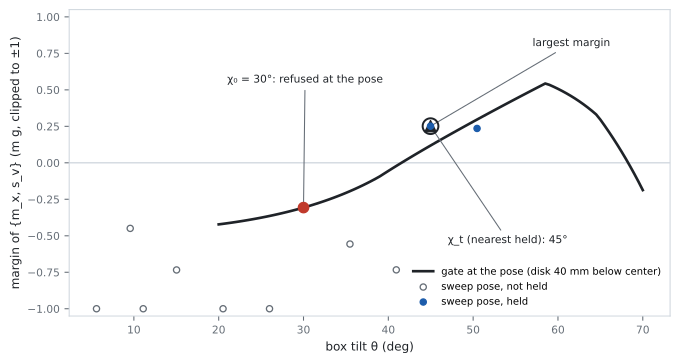
| From χ₀ = 30°, disk 40 mm low | Result |
|---|---|
| Gate at χ₀ | refused, margin −0.31 |
| First tilt that holds | 42° |
| Sweep, 5 points (default) | 2 free directions, 11 recognized poses, 2 held; χtr at 45.0°, margin 0.25 |
| Sweep, 9 points, same range | 39 recognized, 8 held; nearest 45.0° (0.25), largest margin 55.2° (0.48) |
| Sweep, 9 points, range 0.08 | 24 recognized, 8 held; nearest 42.0° (0.15), largest margin 62.7° (0.61) |
The paper proves that the exact, continuous sweep never refuses an edit a quasi-static motion could realize, under stated hypotheses; the grid version holds above a margin band that depends on the grid’s covering distance.
The pivot needs the disk low
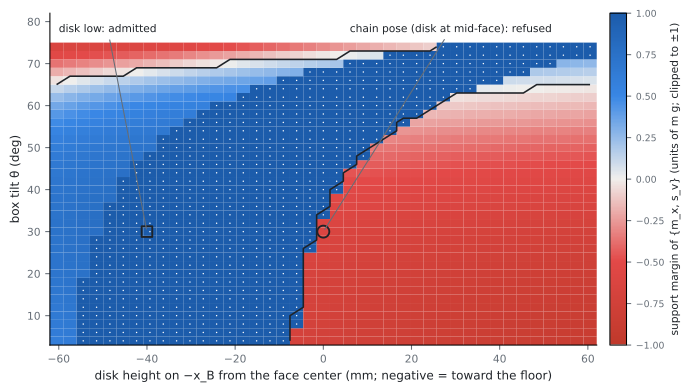
After the pivot, breaking gv leaves the disk and the step corner to hold the box. On a finer grid (0.5° × 1.5 mm) they hold:
| Disk on −xB | Tilts held |
|---|---|
| At the bottom of the face | 34.0°–65.5° |
| 40 mm below the face center | 42°–68° |
| At the face center | 54.0°–71.5° |
Never below 34° or above 75°; never at 30°; at 45° only with the disk at least 30 mm below the face center. Pushing at mid-height, the disk cannot keep the box on the corner without the floor, and at 30° the motors are too weak wherever it pushes. A float64 LP with the same motor limits confirms these answers, so they are facts about the physics and the motors, not about the test. Without motor limits more than twice as many poses would hold (815 against 382 of the 1,599 grid poses).
Accuracy and speed
Checked against a float64 LP (SciPy’s HiGHS) with the same motor limits, coded independently: 1,000 random cases, and 208 near the support boundary (16 sweeps of disk height on the pivot, bisected to the boundary).
| Gate (float32) | Random | Near the boundary | ms per 256 poses, CPU / GPU |
|---|---|---|---|
| LP with motor limits (the gate) | 1,000 of 1,000 | 199 / 202 of 208 (CPU / GPU) | 14.7 / 3.4 |
| LP, no limits | 1,000 | 386 / 383 of 416 | 8.5 / 2.5 |
| Exact cone test, no limits (cross-check) | 1,000 | 390 / 389 of 416 | 5.0 / 1.6 |
The gate makes no false rejection and returns no “uncertain” answer. Every miss is the bisected boundary pose itself: the gate’s margin there is 0 (at most 2·10−7) while HiGHS says “just not”. At 0.33 mm or more from the boundary the two always agree. A positive acceptance threshold would remove these misses; the default (0) does not.
Does the gate prune? (checkpoint 1)
Among candidate edits that are edges and whose new contacts are within reach, the share H rejects:
| Nodes | Candidates | Rejected at χ₀ only | Rejected with the sweep |
|---|---|---|---|
| The chain’s 9 starts | 179 | 18.4% | 14.5% |
| 205 demo nodes | 3,112 | 22.8% | 22.7% |
By type on the demo nodes, H rejects 75% of breaks (211 of 280) and 74% of transfers (444 of 597), but only 47 of 2,022 makes: a make’s less-constrained end is the current formation, which already holds. H prunes the edits that drop or shrink support, which are the ones that need it.
Reproduce
cd ~/repos/research/c-gnn && git switch phase1/planar && git pull && cd cmg
JAX_PLATFORMS=cpu PYTHONPATH=tests .venv314/bin/python -m pytest -q tests/test_planar_step2.py tests/test_step3.py
JAX_PLATFORMS=cpu .venv314/bin/python <website>/research/nonprehensile/planar-build/scripts/02_hold_gate.py <out dir>   # pivot map
JAX_PLATFORMS=cpu .venv314/bin/python <website>/research/nonprehensile/planar-build/scripts/03_figures.py <out dir>     # sweep figure and table
JAX_PLATFORMS=cpu .venv314/bin/python <website>/research/nonprehensile/planar-build/scripts/03_checkpoints.py <out dir>  # checkpoint 1
The fine-grid pivot numbers come from reports/contact-mode-graphs/scripts/pivot/pivot_numbers.py in c-gnn.