Contact states
Which contacts are on at a pose: the planar scene, Xiao and Ji’s principal contacts, and the recognizer that labels simulated poses.
The scene
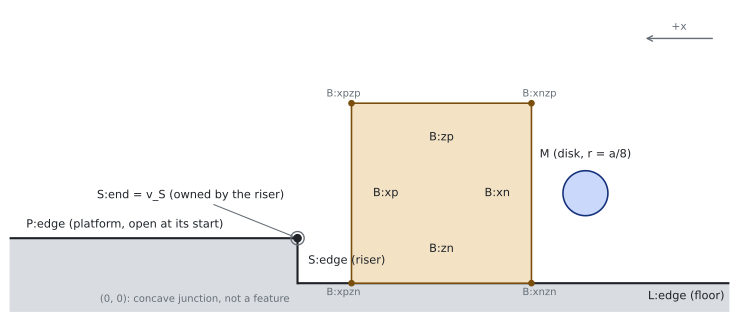
Three bodies move or touch in the x–z plane:
- the manipulator M, a disk of radius r = a/8, driven by two slide motors of ±1 N each;
- the object B, a square box of side a = 125 mm and weight 0.98 N;
- the environment E, one polygon: floor, riser of height h = a/4, and platform.
The features of a body are its edges and its convex vertices; the disk has one feature, its circle. E’s convex vertices are found from the geometry, so only the step corner qualifies. The concave floor–riser junction is not a feature: Xiao and Ji count a convex element pressed into a concave corner as one contact with each of the two edges.
A template is a pair of features on two different bodies that may touch. The catalog has 40: 8 disk–box (the disk against the box’s 4 edges and 4 vertices) and 32 box–environment (the box’s 8 features against E’s 4). Seven have names, used throughout:
| Name | Template | Meaning |
|---|---|---|
| g | (−zB, E:L) | box bottom flat on the floor |
| gv | (v+−, E:L) | box corner on the floor |
| s | (+xB, E:S) | box side flush on the riser |
| sv | (+xB, vS) | box side on the step corner |
| t | (+xB, E:P) | box side on the platform (the landed box) |
| mx, mz | (∂M, −xB), (∂M, −zB) | disk on a box face |
The paper also counts four disk–environment templates (44 in all); the code leaves them out.
Principal contacts
Closed features share their boundaries. When the box sits flat on the floor, its bottom edge touches the floor, and so do its two bottom vertices and the lower ends of its sides. Counting every touching pair would light several templates for one physical contact.
Xiao and Ji’s principal contact fixes this (Xiao 1993; Xiao and Ji, IJRR 2001, Def. 1): a contact between two features counts only if it is not the boundary of a contact between higher-dimensional features. Flat on the floor, the box realizes {g}; tilted onto its corner, {gv}. A formation is a set of templates; a pose realizes a formation when the formation is exactly its set of principal contacts. Formations are what the planner searches over.
Between two convex elements there is at most one principal contact at a time. The box can touch the floor and the riser at once ({g, s} in the corner), but not the floor with two edges.
The recognizer
Simulated poses never touch exactly: contacts sink a little into each other and float a little apart. The recognizer labels a pose with tolerances εon = 1 mm (separation) and εpen (overlap). The contact set Kc of a template lies on the box’s feature and depends on the other feature:
- against an edge of E: the part within εon of the edge, or sunk into E across it (an interval);
- against a vertex of E: the point of the box’s feature closest to it;
- against the disk: the point of the box’s feature closest to the disk’s center.
A template is on when:
- In band. Its gap lies between −εpen and εon, and Kc is not empty.
- It touches interiors. The touching part is not only at an edge’s end that is itself a vertex feature of the same body. For example, a box resting on vS alone is sv, not t or s.
- Edge on edge needs alignment. The two edges are parallel within θe and overlap by at least ℓmin = a/16 = 7.8 mm.
- The larger contact wins. Kc is not contained, within εon, in the contact set of a higher-dimensional template of the same pair that is also on.
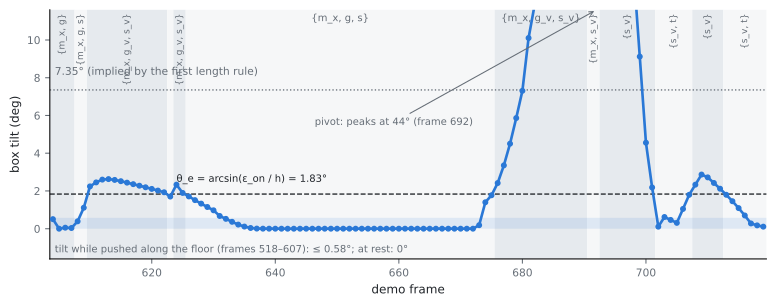
The tilt tolerance is derived, not tuned: θe = arcsin(εon/Le) ≈ 1.83°, where Le = h is the shortest edge in an edge–edge template. On the riser that is the angle at which the far end of the overlap leaves the 1 mm band, so the test agrees with the point-contact test of physics engines there. Using one angle rather than a contact length makes a box flush in the step corner lose its floor and riser contacts at the same tilt. (Why a length rule failed: Issues.)
Ambiguous poses. If the tolerances leave two contacts that cannot coexist (the same pair of convex elements, or one containing the other), the recognizer reports the higher-dimensional one, then the smaller gap, then catalog order, and counts the tie. A tied pose is never a search node or a solver success. Ties happen under deep overlap: εpen = 10 mm is provisional, and 475 of 4,000 jittered demo poses tie at that value (Issues).
Correctness. The paper proves that within ηmax ≈ 0.35 mm of an exact pose that is well away from degenerate configurations, the recognizer returns exactly the exact principal contacts and the pose is not ambiguous. An independent check ran the code on 207,208 such poses and found no counterexample.
Validity
A formation is valid if some admissible pose realizes it. Until that is computed from the geometry (step 4), validity uses a stand-in:
- derived exclusions: at most one contact per pair of convex elements, and no contact alongside one it contains;
- four declared pairs that cannot coexist: {g, t} (the box cannot lie on the floor and the platform), {gv, s} and {g, sv} (a box tilted on its corner is not flush on the riser, and conversely), and {g, mz} (with the box flat the disk cannot reach −zB).
Of the 95 = 59,049 formations with at most one contact per convex element pair, 37,203 pass. The stand-in is pairwise and admits some formations no pose realizes (Issues).
Connected regions
Xiao and Ji define a contact state as a formation together with one connected region of the poses that realize it. The search keys a node by the formation and a rounded pose, so it matters whether a formation’s region splits. Checked by sampling (scripts in c-gnn, reports/contact-mode-graphs/scripts/connectivity/, at commit 9261ece):
- each of the chain’s eight formations is one component at link radii of 20 and 40 mm, and at 5 and 10 mm too, except on a random half of the full-band samples, where {mx, sv} splits at 5 mm and {mz, t} at 10 mm;
- discovery found 285 formations and 89 were analysed; 18 showed several components at 20 or 40 mm, and 14 of those were densified. The two chain formations and 8 others are then one component at 20 and 40 mm; the empty formation splits on a random half at 20 mm; three with the box in the air hold together only at 40 mm; the 4 not densified still split at 20 or 40 mm;
- 196 rarely sampled formations were not analysed, 87 of them containing a chain template.
This is sampling evidence that the chain’s formations are connected at link radii of 20 mm and more, not a proof.
The demo, frame by frame
The viewer replays the 1,721-frame demo shipped with cmg (step_example_trajectory.npz), labels every frame with the recognizer, and draws the contact sets.
Open the viewer on its own page for more room.
What to watch for:
- One contact per pair of convex elements. The “in band” column is the naive count of touching templates, up to 5 for one contact; the on column never holds more than one.
- The chain, in order: {g} → {mx, g} → {mx, g, s} → {mx, gv, sv} → {mx, sv} → {sv} → {t} → {mz, t} → {t}, in 15 runs of frames, with no invalid formation.
- Two rocks. At frame 609 the box hits the riser and rocks onto its corner (up to 2.6°); after landing (frames 708–712) it seesaws on the step corner, so only sv is on. Both are real motion.
- Ties fire on 2 frames, both with the box pressed more than 1 mm into the riser.
Reproduce
cd ~/repos/research/c-gnn && git switch phase1/planar && git pull && cd cmg
source .venv314/bin/activate      # Python 3.14; uv pip install -e ".[dev,cuda]" matplotlib
JAX_PLATFORMS=cpu PYTHONPATH=tests python -m pytest -q tests/test_planar_contact.py
JAX_PLATFORMS=cpu python <website>/research/nonprehensile/planar-build/scripts/01_contact_layer.py <out dir>
The planar gap takes 22 ms per 7,680 poses on the CPU. CPU runs repeat exactly; GPU runs repeat between processes only with XLA_FLAGS=--xla_gpu_deterministic_ops=true.