Background: interval arithmetic
How a computer can prove a statement about every state in a box at once, why the answers come out loose, and why loose is acceptable while wrong never is.
Who this is for. You know control and dynamics, but not validated numerics. This page explains the oldest tool behind our certificates. Its companions are zonotope propagation, intervals and zonotopes together, certified funnels and composition and the techniques that made the chain certify.
1. The idea: compute with ranges, not numbers
Intuition. A simulation answers “what happens from this state?”. A certificate has to answer “what happens from every state in this set?”. Interval arithmetic does that by replacing each number with a range that is guaranteed to contain it, and each operation with a rule that turns ranges into a range.
Check it by hand. If \(x\in[1,2]\) and \(y\in[3,5]\), then
- \(x+y\in[1+3,\ 2+5]=[4,7]\);
- \(x\cdot y\in[\min P,\max P]=[3,10]\), where \(P=\{1\cdot3,\ 1\cdot5,\ 2\cdot3,\ 2\cdot5\}=\{3,5,6,10\}\);
- \(x-y\in[1-5,\ 2-3]=[-4,-1]\) (the smallest minus the largest, and so on).
Every value \(x+y\) can actually take lies in \([4,7]\), and both ends are reached.
The general statement. Write \([x]=[\underline x,\overline x]\) for an interval and call a vector of intervals a box. Replace every operation in a formula by its interval version, and round every endpoint outward (down for lower ends, up for upper ends) so floating-point rounding cannot cut off a true value [1]. The result, the formula’s natural interval extension, contains the formula’s value at every point of the box. The proof is induction over the formula: each interval operation contains every result of the real operation on its arguments. This inclusion property is all a certificate needs [1], [2].
2. How a certificate uses it
Intuition. Take a box of starting states, push the whole box through one step of the dynamics, and check every safety condition (a contact force stays positive, the force stays in its friction cone, the motors stay within their limits) on the result. If the condition’s range lies entirely on the safe side, every state in the box is safe. If the range straddles the limit, the answer is “don’t know”, and the box is split.
Check it by hand. Is \(x\cdot y\ge 0.3\) for every \((x,y)\in[0.5,1]^2\)?
- Whole box: \([x][y]=[0.25,\,1]\). The lower end \(0.25<0.3\), so the range straddles the limit: no verdict.
- Split into 4 boxes of width \(0.25\). On \([0.75,1]\times[0.5,0.75]\) the lower end is \(0.75\cdot0.5=0.375\ge0.3\): certified. Three of the four certify; only \([0.5,0.75]^2\), lower end \(0.25\), does not.
- Split into 16 boxes. Fifteen certify; the corner box \([0.5,0.625]^2\) still has lower end \(0.25\).
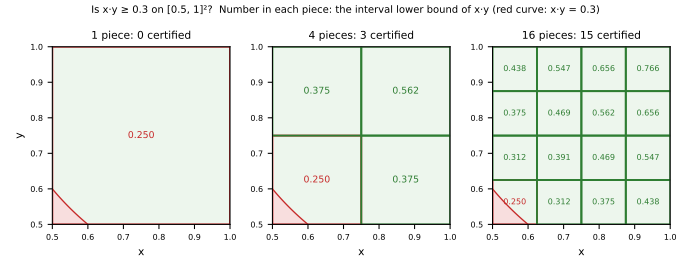
scripts/bg_certification_figures.py.This is bisection [3]: keep splitting the boxes that straddle until each piece is either certified or small enough to give up on. A refused piece is not a proof that the property fails. Here it does fail, at \((0.5,0.5)\), which is why splitting never closes it.
In our chain. Every funnel band is a box of states, and its certificate checks the force floor, the friction cones, the motor box and the recognizer’s reading over the whole box at once (certified funnels). When a check straddles, the entry set is split into sub-boxes (techniques).
3. The two ways interval arithmetic loses
Interval answers are always sound (they contain the truth), but they can be much wider than the truth. There are two reasons.
Dependency
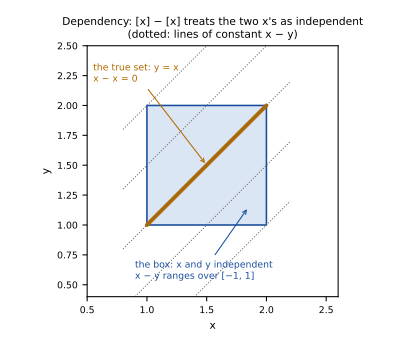
Intuition. Interval arithmetic forgets that two occurrences of the same variable are the same number.
Check it by hand. Let \(x\in[1,2]\). Then \([x]-[x]=[1-2,\ 2-1]=[-1,1]\), although \(x-x=0\) for every \(x\). Interval arithmetic computed \(x-y\) for independent \(x,y\in[1,2]\), the whole box, instead of the diagonal \(y=x\).
scripts/bg_certification_figures.py.The general statement. The natural extension is exact when every variable occurs once in the formula; each repeated occurrence can widen the result. The mean-value form repairs most of it inside one formula: \(f(x)\in f(\hat x)+[\nabla f]([x])\cdot([x]-\hat x)\), the value at the box’s centre \(\hat x\) plus an interval gradient times the offsets. For \(f(x)=x-x\) the gradient is \(1-1=0\) exactly, so the mean-value form returns \([0,0]\) [2].
Wrapping
Intuition. A step of a dynamical system maps a box to a set that is usually not a box: it is rotated or sheared. The next step only accepts a box, so the set is replaced by the smallest box around it, its interval hull. The hull adds corners that the true set does not have, the next step maps those corners too, and the extra width compounds [4], [5].
Check it by hand. Rotate the square \([-1,1]^2\) by \(45^\circ\). Its corners land on the axes at distance \(\sqrt2\), so its hull is \([-\sqrt2,\sqrt2]^2\): the half-width grew by \(\sqrt2\approx1.41\). Rotate that box by \(45^\circ\) and re-box it, and the half-width is \(2\). Every step multiplies it by \(\sqrt2\); after 8 steps, two full turns, the box is \([-16,16]^2\), although the true set is the original square again.
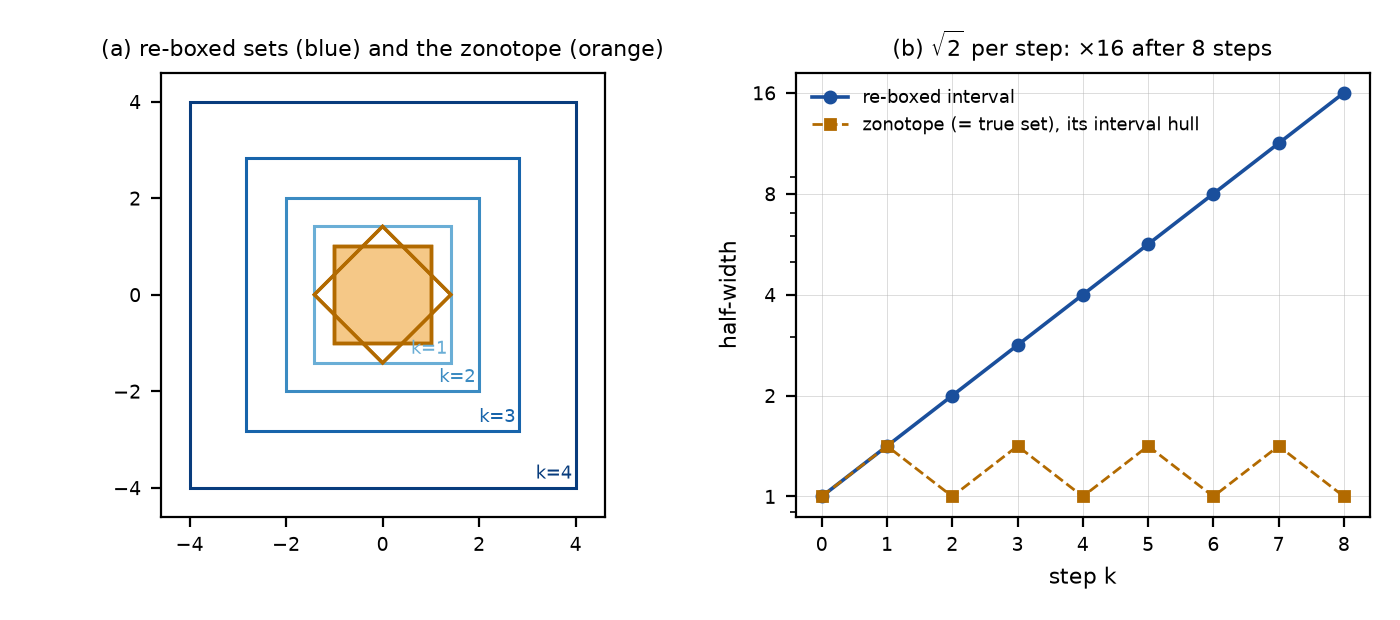
reports/technical-report/scripts/ch18_wrapping.py.The general statement. If a step maps a box of half-width \(h\) by a matrix \(A\), the re-boxed half-width is \(|A|h\) (absolute values entrywise). Unless \(A\) maps boxes to boxes (a scaled permutation), information is lost at every step, and over \(N\) steps the loss multiplies. The fix is to carry a set shape that a step can map without re-boxing: a zonotope.
4. Loose is fine; wrong never is
Intuition. A loose bound costs you a refused certificate or more splitting. A wrong bound, one that misses a true value, makes the certificate a false statement. So every primitive operation has to be sound, including the ones a library implements for you.
A real example. Our interval engine is the immrax library [6]. An audit of its primitives found that integer_pow returned \([0,1]\) for \(x^0\) on an interval containing \(0\), where the correct answer is \([1,1]\). That is not loose, it is wrong. The fix removed \(x^0\) from the affected fit and added a guard test that scans every enclosure for immrax’s known-bad rules.
The general statement. Soundness is checked per primitive (each operation’s interval result must contain the real result on sampled and corner inputs), and rounding is outward. An over-wide result is a cost question; an under-wide one is a bug.
5. The curse of splitting
Intuition. Bisection works, but halving every side of a box in \(d\) dimensions makes \(2^d\) pieces. Halving \(k\) times makes \(2^{dk}\).
Check it by hand. In 2-D, two halvings give \(4\times4=16\) pieces (the figure above). In the 6-D impact window of the landing (tilt, tilt rate, the two contact places, an offset, and the friction coefficient), each halving of every coordinate multiplies the piece count by \(2^6=64\).
In our chain. Interval propagation through the landing’s impact window would need about \(10^{10}\) pieces: wrapping makes each piece’s bound loose, so pieces must be tiny. That is what drove the move to zonotopes, which keep the correlations that wrapping throws away.
What to remember
- An interval computation contains the true value; that, plus outward rounding, is what makes it a proof.
- A range that straddles a limit means “don’t know”: split the box.
- Dependency: the same variable twice is treated as two (\([x]-[x]=[-1,1]\)). The mean-value form fixes most of it within one formula.
- Wrapping: re-boxing a rotated set adds corners, compounding over steps (\(\sqrt2\) per step, 16× after 8).
- Loose is fine, wrong never is: every primitive must be sound.
- Splitting costs \(2^d\) per halving; that is why we carry zonotopes.
Further reading
- Moore, Kearfott and Cloud, Introduction to Interval Analysis [1]: the standard first textbook; interval arithmetic, natural extensions, the inclusion property, and interval Newton methods, with exercises.
- Jaulin, Kieffer, Didrit and Walter, Applied Interval Analysis [3]: bisection and set inversion in practice, with robotics and control examples close to our use.
- Neumaier, Interval Methods for Systems of Equations [2]: the rigorous reference for mean-value forms, centred forms and interval linear systems.
- Hansen and Walster, Global Optimization Using Interval Analysis [7]: branch-and-bound with intervals, the optimization view of “split until decided”.
- Kühn [4] and Nedialkov, Jackson and Corliss [5]: the wrapping effect in validated integration, and the remedies (zonotopes; Lohner’s coordinate frames).
- Harapanahalli, Jafarpour and Coogan [6]: the immrax toolbox our certifier uses, interval analysis inside JAX.