Background: contact forces at an instant
From the block’s and the disk’s equations of motion to the Delassus form a = Wλ + a_f, the per-class solve every certificate relies on, and how a class solution is enclosed over a whole box of states.
Who this is for. You know rigid-body dynamics and Coulomb friction, but not how a certificate turns “which forces act at the contacts?” into a computation it can prove things about. This page derives that computation from first principles, with a worked example you can check by hand. The manipulated object is the block; a box on this page is only a product of intervals, as in interval arithmetic. Companions: deciding support (the static question), certified funnels and composition and the techniques that made the chain certify. The code is endpoint_generic.Edge.contact_data and post_impact_rest.class_maps on branch exp/edge-endpoints; the technical report’s Chapter 19 has the same material with proofs.
1. The question at an instant
Intuition. The deciding-support page asks a static question: can some contact forces hold the block? A moving block asks a sharper one. At this instant, with these positions, velocities and motor force, which contact forces does rigid-body mechanics with Coulomb friction produce, and what accelerations follow? Does a contact open, stick, or slide, and which way? A certificate needs the answer not at one state but at every state of a box, and it needs to know that the answer the plan relies on is the only one.
The plan of the page. Equations of motion (§2), each contact as two rows of a Jacobian (§3), the Delassus form (§4), classes and the class solve (§5), why the landing’s flat family has no velocity terms (§6), the enclosure over a box (§7), excluding and certifying classes (§8), and what an independent check of the code found (§9).
2. Two bodies, five coordinates
The convention. The plane is \(x\)–\(z\), \(z\) up. The \(y\) axis points into the page, and the block’s tilt \(\theta\) is a rotation about it, so a body-fixed vector \(b\) has world components \[ R(\theta)\,b = (b_x\cos\theta + b_z\sin\theta,\; -b_x\sin\theta + b_z\cos\theta). \] Differentiating, a body-fixed vector with world components \(r\) turns at \[ \dot r = \dot\theta\,\rho(r), \qquad \rho(r) = (r_z,\,-r_x). \] \(\rho\) is a quarter turn, so \(\rho(\rho(r)) = -r\) and \(a\cdot\rho(b) = -\rho(a)\cdot b\).
Coordinates and masses. \(q = (x_B, z_B, \theta, x_M, z_M)\): the block’s centre \(c\), its tilt, and the disk’s centre \(P_M\). The disk is the robot’s end effector: it translates and does not spin. With \(u\) the motor force on the disk, \[ M = \operatorname{diag}(m_B, m_B, I_B, m_M, m_M), \qquad f = (0,\,-m_B g,\,0,\,u_x,\,u_z - m_M g). \] The scene: \(m_B = 0.1\) kg, side \(a = 125\) mm, \(I_B = m_B a^2/6\), \(m_M = 0.02\) kg, disk radius \(15.625\) mm, environment friction \(0.2\), disk friction anywhere in \([0.3, 0.5]\).
A material point. The block’s point at world offset \(r\) from the centre moves at \[ \dot p = \dot c + \dot\theta\,\rho(r) = (\dot x_B + \dot\theta r_z,\; \dot z_B - \dot\theta r_x). \]
3. A contact is two rows
Intuition. Each contact has a normal \(n\) and a tangent \(t\). What matters is how fast the gap closes (\(v_n\)) and how fast the surfaces slip (\(v_t\)). Both are linear in the velocities, so each is a row of a Jacobian.
Block on a fixed environment (\(n\) into the block): \[ v_e = e\cdot\dot p, \qquad J_e = (e_x,\; e_z,\; e_x r_z - e_z r_x,\; 0,\; 0), \qquad e\in\{n,t\}. \] The disk on a block face (\(n\) the face’s outward normal, \(K = P_M - Rn\) the block’s point under the disk, \(r = K - c\); the disk relative to the block): \[ J_e = (-e_x,\; -e_z,\; -(e_x r_z - e_z r_x),\; e_x,\; e_z). \] Forces come through the transpose. A contact force \(\lambda_n n + \lambda_t t\) does work \(\lambda_n v_n + \lambda_t v_t\), so its generalized force is \(J^\top\lambda\). The third entry of a row is the torque arm; the disk’s row applies \(+\lambda\) to the disk and \(-\lambda\) to the block. Action and reaction come out of the rows.
Check it by hand. A unit force straight up (\(e = (0,1)\)) at the block’s bottom corner on its \(+x\) side, \(r = (a/2, -a/2)\) at \(\theta = 0\): the row is \((0, 1, -a/2, 0, 0)\), a torque of \(-a/2\) about \(y\). Drawn with \(+x\) to the right and \(y\) into the page, a positive \(\theta\) turns the block clockwise; a push up on the right side turns it counterclockwise, a negative \(\theta\), as the sign says.
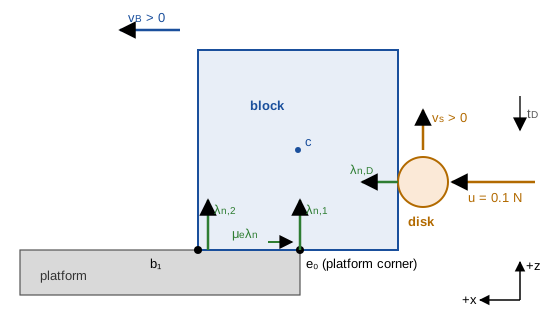
The sign of a slip matters. A class below says “slides with \(v_t > 0\)”, so the tangent’s direction is part of the model. After the landing the disk presses on the block’s left face, whose tangent in the code is \(t_D = (0,-1)\): \(v_t > 0\) means the disk moves down the face relative to the block.
4. The Delassus form
Derivation. Stack the closed contacts’ rows into \(J\) and their forces into \(\lambda\). Newton–Euler is \[ M\ddot q = f + J^\top \lambda . \] The contact accelerations are \(a = J\ddot q + \dot J\dot q\). Substitute \(\ddot q\): \[ \boxed{\; a = W\lambda + a_f, \qquad W = J M^{-1} J^\top, \qquad a_f = J M^{-1} f + \dot J\dot q \;} \] \(W\), the Delassus matrix, says how hard each contact force pushes each contact’s acceleration: symmetric, positive semidefinite, definite when the rows are independent. \(a_f\) is what the contacts would do with no contact force at all: gravity, the motor, and the velocity terms \(\dot J\dot q\). Signorini’s condition (\(0 \le \lambda_n \perp a_n \ge 0\)) and Coulomb’s law close the system. That is the contact problem of Moreau [1] and of the textbooks [2], [3], a linear complementarity problem (LCP) in \(\lambda\) [4]; its velocity-level version is the time step of Stewart and Trinkle [5] and Anitescu and Potra [6]. It can have no solution or several, so a certificate does not assume either away. It enumerates.
Check it by hand. After the landing the block rests on the platform and cannot turn (§6). Lump the platform’s two supports into one contact \(t\) (normal \((0,1)\), tangent \((1,0)\)) and keep the disk \(D\) on the left face (normal \((-1,0)\), tangent \((0,-1)\)). Then \(M^{-1} = \operatorname{diag}(10,10,50,50)\) on \((x_B, z_B, x_M, z_M)\), the rows are \((0,1,0,0)\), \((1,0,0,0)\), \((1,0,-1,0)\), \((0,1,0,-1)\), and with the hold force \(u = (0.1,\, m_M g)\) N: \[ W = \begin{pmatrix} 10 & 0 & 0 & 10\\ 0 & 10 & 10 & 0\\ 0 & 10 & 60 & 0\\ 10 & 0 & 0 & 60\end{pmatrix},\qquad a_f = \begin{pmatrix} -9.804\\ 0\\ -5\\ -9.804 \end{pmatrix}\ \text{m/s}^2 . \] One newton on the platform’s normal lifts the block at \(1/m_B = 10\) m/s²; one newton between disk and block separates them at \(1/m_B + 1/m_M = 60\) m/s². With no contact forces the block falls at \(g\) and the disk runs into it at \(0.1/m_M = 5\) m/s² (negative means closing).
5. Classes: guess, solve, check
Intuition. Coulomb’s law is a switch: a contact is open, sticks, or slides one way or the other. Guess the switch position at every contact. Each guess, a class, makes the problem linear and square. Solve it, then check whether the guess was consistent.
| Class | Meaning | Equations | Conditions (from \(v_t = 0\)) |
|---|---|---|---|
| O | open | \(\lambda_n = 0,\ \lambda_t = 0\) | \(a_n > 0\) |
| S | sticks | \(a_n = 0,\ a_t = 0\) | \(\lambda_n \ge 0,\ \lvert\lambda_t\rvert \le \mu\lambda_n\) |
| P | slides, \(v_t > 0\) | \(a_n = 0,\ \lambda_t + \mu\lambda_n = 0\) | \(\lambda_n \ge 0,\ a_t > 0\) |
| N | slides, \(v_t < 0\) | \(a_n = 0,\ \lambda_t - \mu\lambda_n = 0\) | \(\lambda_n \ge 0,\ a_t < 0\) |
With \(a = W\lambda + a_f\) substituted, a class is a square system \(A\lambda = b\): a closed contact contributes its row of \(W\); a sticking one its tangential row too; a sliding one the friction law. The code solves it by Gauss–Jordan elimination in plain scalar operations, so that interval arithmetic can run through the same code (§7).
Check it by hand: the block slides forward and the disk slides up the face. Up the face is \(v_t < 0\) along \(t_D\), so the class is (P, N). The four equations are \(a_{n,t} = 0\), \(\lambda_{t,t} = -0.2\,\lambda_{n,t}\), \(a_{n,D} = 0\), \(\lambda_{t,D} = \mu\lambda_{n,D}\). At \(\mu = 0.4\): \[ \lambda = (0.9346,\ -0.1869,\ 0.1145,\ 0.0458)\ \text{N},\qquad a = (0,\ -0.7243,\ 0,\ 2.2897)\ \text{m/s}^2 . \] The block’s horizontal balance: \(0.1145 - 0.1869 = 0.1\times(-0.7243)\). The disk’s friction, \(0.0458\) N, pushes the disk down and the block up, so the platform carries only \(0.9804 - 0.0458 = 0.9346\) N. Both slips decelerate: the block at \(0.724\) m/s², the disk’s upward slip at \(2.29\) m/s².
The other directions. With the disk sliding down (P) its friction presses the block onto the platform (1.0274 N), and the block decelerates faster, at \(0.879\) m/s². With the disk sticking (S), \(\lambda_{t,D} = 0\), the block decelerates at \(0.8007\) m/s², and the cone condition \(0 \le 0.4\times 0.1160\) holds. The slip direction changes the answer by 20%: it is part of the model, not a detail.
An excluded class: (O, S). Suppose the block leaves the platform while the disk sticks. Then \(\lambda_{n,D} = 0.0833\) N and \(\lambda_{t,D} = 0.1634\) N. Two conditions fail: the block’s normal acceleration \(-8.17\) m/s² is not positive (it would have to sink into the platform to leave it), and \(0.1634 > 0.4\times0.0833\) puts the disk’s force outside its cone. One failure is enough.
6. Why the flat family has no velocity terms
Intuition. Velocity terms come from turning: a turning body’s points have centripetal accelerations, and its contact frames turn with it. A block that does not turn has none.
The derivation. By hand, with \(\omega = \dot\theta\):
- a block point in a fixed frame: \(\dot J_e\dot q = -\omega^2\, e\cdot r\);
- the disk’s normal row: \(2\omega\,\rho(n)\cdot(\dot P_M - \dot c) - \omega^2\, n\cdot(P_M - c)\);
- the disk’s tangential row: \(2\omega\,\rho(t)\cdot(\dot P_M - \dot c) - \omega^2\, t\cdot(K - c)\).
Every term carries \(\omega\). After the landing, the block’s two supports on the platform both have closed normal rows, \(\dot z_B - \omega r_{x,1} = 0\) and \(\dot z_B - \omega r_{x,2} = 0\) with different moment arms, so \(\omega = 0\): the flat family. There \(a_f = J M^{-1} f\) exactly, whatever the block’s speed and the disk’s slip. The accelerations depend on the velocities only through the class (the friction directions), which is why the rest certificate can evaluate each class once and use it at every speed.
One more fact the check confirms. On the flat family the block only translates, so its translational equations see only the sums of the two supports’ forces. The slips’ accelerations therefore do not depend on the block’s position or the disk’s place on the face at all (only on the small tilt offset and on \(\mu\)); the moment balance only splits the platform’s force between the two supports.
7. From a point to a box: the mean-value form
Intuition. A certificate needs \(\lambda\) and \(a\) at every state of a box \(X\) of positions, offsets and friction coefficients. Treat the class solution as a smooth map \(F\) of the state, and bound it by its value at the box’s centre plus the most its slope can add.
The general statement. With \(m\) the box’s centre, \(r\) its radius and \([J]\) an interval enclosure of \(F\)’s Jacobian over \(X\) (immrax’s natural inclusion [7]), \[ F(X) \subseteq F(m) \pm \operatorname{mag}([J])\, r . \] Why it is sound. For a point \(x\in X\) and an output \(i\), the mean value theorem on the segment from \(m\) to \(x\) gives \(F_i(x) - F_i(m) = \nabla F_i(\xi)\cdot(x - m)\) for some \(\xi\) on the segment. The box is convex, so \(\xi \in X\) and \(\nabla F_i(\xi)\in [J]_i\); with \(|x - m| \le r\) the bound follows [8], [9].
Why \(F\) is smooth there. \(F\) is rational; it can only break where an elimination pivot vanishes. Every pivot is a divisor in \(F\) and its derivatives, interval division by an interval containing 0 is unbounded, and the pivot’s interval contains its range over \(X\). So a finite \([J]\) certifies that no pivot vanishes on \(X\). A non-finite one leaves the class undecided, never passed.
Check it by hand. In the class (P, N) of §5 the block’s acceleration is a function of \(\mu\) alone, \[ a_t(\mu) = -1.9608 + 69.608\,\frac{1 + 0.2\mu}{60 + 2\mu}, \] with slope \(696.08/(60 + 2\mu)^2\). Over \(\mu\in[0.3,0.5]\): \(m = 0.4\), \(r = 0.1\), \(a_t(0.4) = -0.72434\), and the slope’s interval is \(696.08/[60.6, 61]^2 = [0.18707, 0.18955]\). The enclosure is \[ -0.72434 \pm 0.018955 = [-0.74330, -0.70539]\ \text{m/s}^2, \] against the true range \([-0.74323, -0.70557]\).
Where it loses. Over a large box the Jacobian’s natural inclusion suffers the dependency effect: the same entries of \(W\) appear many times in the elimination. On the flat family the slips’ accelerations do not depend on position at all (§6), so any width their enclosures gain along the position coordinates is pure overestimate. That is what refuses some boxes after they are grown by the stopping distance, and splitting the box recovers them.
8. Excluding and certifying classes
Excluding. A class is excluded on a box when one of its conditions fails for every member, and the enclosure decides that soundly: if the upper end of \(\lambda_n\)’s enclosure is negative, no member has \(\lambda_n \ge 0\). The conditions are positive normal forces, the friction cone at sticking contacts, and the strict sign conditions (\(a_n > 0\) to open, \(a_t\) in the direction of a slip that starts from rest).
Certifying. The class the plan follows must hold with margin: normal forces at least the derived floor \(N_{\min}\), and every sliding contact decelerating, \(a_t + w \le -a_{\min} < 0\) over the box, with \(w\) the measured residual. Then the slip reaches zero within \(T \le v_t(0)/a_{\min}\) after at most \(v_t(0)^2/(2a_{\min})\) of travel, and the conditions are checked on the box grown by that distance. At zero slip the class that would restart the slide needs \(a_t \ge 0\), which the same deceleration bound excludes.
Starting versus moving. The table’s last column is for a contact that starts to slide from \(v_t = 0\): its acceleration must point along the slip. A contact that is already sliding has its friction fixed by the sign of \(v_t\), and a negative \(a_t\) is the deceleration we want, not a contradiction. For moving contacts a class is impossible only through its forces. Applying the starting conditions to a moving contact excludes it for decelerating, which is the wrong conclusion.
9. What an independent check found
A script written from this derivation alone (cmg/scripts/checks/class_solve_check.py, branch docs/class-solve) recomputes \(W\), \(a_f\) and the class solutions (P, P, P), (P, P, S) and (P, P, N) at 20 random states of the rest certificate’s set, and the pivot’s \(W\) and \(a_f\) with the velocity terms at tilt rates up to 1 rad/s. The code agrees to rounding: the largest relative difference is \(9\times10^{-15}\).
Two modelling points came out of it.
- The platform corner’s frame. The code gives both supports the platform’s frame. The exact frame at the corner is the block face’s, turned by the tilt offset (\(\le 1.08\times10^{-3}\) rad); the supports’ accelerations differ by at most \(7\times10^{-3}\) m/s², about 1%.
- The disk’s slip direction. The landing hands off a disk that slides up the face, which is class N in the code’s frame, while the rest certificate follows class P (sliding down). In P the block decelerates at about 0.88 m/s², in N at about 0.72 m/s² (the worked example’s numbers). This is open and recorded in the technical report, Chapter 19.
What to remember
- Each contact is two rows of a Jacobian; forces enter through the transpose.
- Eliminating the accelerations gives \(a = W\lambda + a_f\): \(W = JM^{-1}J^\top\) couples the contacts, \(a_f\) holds gravity, the motor and the velocity terms.
- A class fixes each contact’s state; it makes the problem a square linear system, whose solution is checked against the class’s conditions.
- On the flat family the block does not turn, so there are no velocity terms: one solve per class serves every speed.
- The mean-value form encloses a class solution over a box; a finite Jacobian enclosure also proves the system is nonsingular there.
- Starting and moving differ: a moving contact may decelerate; only its forces can rule its class out.
Further reading
- Moreau [1]: the contact problem at the acceleration and velocity levels, the measure-differential formulation behind time stepping.
- Pfeiffer and Glocker [2]: multibody systems with unilateral contacts, the classes of contact states and their complementarity formulation, worked engineering examples.
- Brogliato, Nonsmooth Mechanics [3]: the standard reference for the Delassus operator, impacts and complementarity systems.
- Pang and Trinkle [4]: the acceleration-level problem with Coulomb friction as an LCP, and when solutions exist.
- Stewart and Trinkle [5] and Anitescu and Potra [6]: the velocity-level time step, the kind of step map the impact window certifies.
- Neumaier [9] and Moore, Kearfott and Cloud [8]: mean-value forms and interval linear systems.