Background: dissipation (passivity) certificates
A storage function, a supply and a dissipation inequality: what they prove, how a sliding block’s rest follows from its kinetic energy, why that beat per-class deceleration bounds, and the general avenue.
Before this page: interval arithmetic, zonotopes and certified funnels and composition. The terminology: the block is the manipulated object; a box is only an interval box (a product of intervals).
1. The idea in one inequality
Intuition. A system that cannot create energy, and loses some whenever it moves, must eventually stop. Friction is the classic loss: while anything slides, Coulomb friction turns kinetic energy into heat. If the forces that can add energy are weaker than the friction that removes it, the energy can only go down, and with it the motion.
The general statement [1], [2]. Take a state \(x\) in a set \(\mathcal X\), an input \(u\) and a disturbance \(w\). Choose
- a storage function \(S(x)\ge 0\) (an “energy”);
- an output \(y\) and a supply rate \(s(u,y,w)\) (the power the outside world can feed in);
- a dissipation \(d(x)\ge 0\) (the power that is surely lost).
They form a dissipation certificate on \(\mathcal X\) if, along every motion,
\[ \dot S \;\le\; s(u,y,w) - d(x). \]
For contact, “every motion” means every admissible stick/slip contact class at every state of \(\mathcal X\), and the inequality is checked as a lower bound on \(s-d-\dot S\) with the same sound enclosures as every other certificate on this site: interval or zonotope arithmetic with outward rounding, where a refusal is always possible and a false pass is not.
What it gives. Each follows in one line from the inequality:
| Use | Condition | Conclusion |
|---|---|---|
| Termination | \(s\le0\), \(d\ge c\sqrt S\) off the target | target reached by \(T\le 2\sqrt{S_0}/c\) |
| Reach set | \(d\ge c\,\lvert\dot r\rvert\) for a distance \(r\) | \(\Delta r\le S_0/c\) |
| Disturbance | the measured residual’s power inside \(s\) | a margin \(c\) that shrinks, no extra argument |
| Composition | the exit’s level set \(\{S\le S_0\}\) inside the next entry | one containment check at the junction |
2. A worked toy: a block pushed against friction
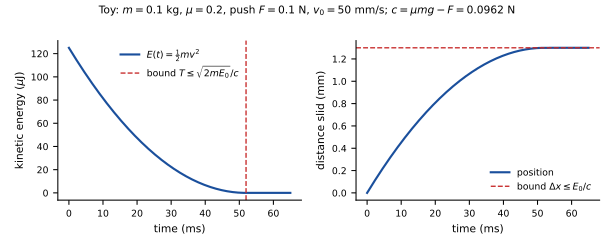
A block of mass \(m=0.1\) kg slides on a floor with friction \(\mu=0.2\) at \(v_0=50\) mm/s, while something pushes it forward with \(F=0.1\) N.
- Storage: \(E=\tfrac12 mv^2\), with \(E_0=\tfrac12(0.1)(0.05)^2=1.25\times10^{-4}\) J.
- Supply: the push’s power, \(Fv\).
- Dissipation: friction’s power, \(\mu m g\,v = 0.196\,v\) W.
- So \(\dot E = Fv-\mu mgv = -c\,v\) with \(c=\mu mg-F=0.0962\) N \(>0\).
The push is not passive (it feeds energy in), but friction removes more. Integrating, \(c\,\Delta x\le E_0\):
\[ \Delta x \;\le\; \frac{E_0}{c} = \frac{1.25\times10^{-4}}{0.0962} = 1.30\ \text{mm}. \]
And since \(v=\sqrt{2E/m}\), \(\tfrac{d}{dt}\sqrt E=\dot E/(2\sqrt E)\le -c/\sqrt{2m}\), so the block stops within \(T\le\sqrt{2mE_0}/c=52\) ms.
Check it by hand. The deceleration is \(c/m=0.962\) m/s², so the exact stopping distance is \(v_0^2/(2\cdot0.962)=1.30\) mm and the exact time \(0.05/0.962=52\) ms. In one dimension the bounds are exact.
3. The real case: the rest after the impact
After the impact on the platform, the block slides forward at \(v_B\) (up to 48.4 mm/s on the hand-off) and the disk slips up the block’s face at \(v_s\) (up to 73 mm/s), while the hold force presses the block forward. Does it come to rest, and where?
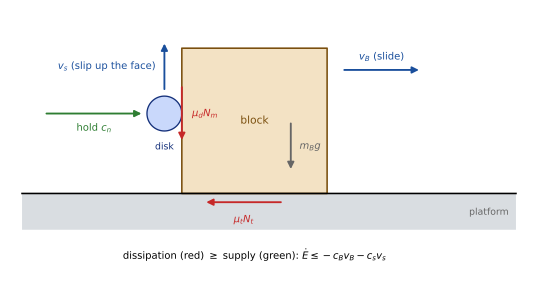
- Storage: \(E=\tfrac12(m_B+m_M)v_B^2+\tfrac12 m_M v_s^2\).
- Supply: the hold force’s power and the measured simulator residual’s.
- Dissipation: friction at the block’s two platform supports, \(\mu_t N_t v_B\), and at the disk, \(\mu_d N_m v_s\), with \(\mu_d\) anywhere in \([0.3,0.5]\).
The balance is \(\dot E\le -c_Bv_B-c_sv_s\), where \(c_B\) and \(c_s\) are the friction forces’ lower bounds less the hold force and the residual. Then \(\Delta x_B\le E_0/c_B\) and \(\Delta k\le E_0/c_s\), with \(k\) the disk’s place on the face.
With numbers. The hand-off’s largest speeds give the largest initial energy, \[ E_0=\tfrac12(0.12)(0.0484)^2+\tfrac12(0.02)(0.073)^2=1.94\times10^{-4}\ \text{J}. \] Over all 16,384 post-impact units the certified braking margins are at least \(c_B=0.082\) N and \(c_s=0.030\) N. Per unit, with each unit’s own \(E_0\) and margins, the energy bound alone gives at most \(\Delta x_B\le 2.36\) mm and \(\Delta k\le 6.20\) mm.
The hold force does work. The hold force pushes the block forward while it slides, with a power of 2.6–4.8 mW, so the block and disk are not strictly passive: energy flows in through the hold. The certificate does not need strict passivity. The hold’s work is part of the supply, and the margins \(c_B\) and \(c_s\) are what is left of the friction after it.
The tightened rest set. Per coordinate, the certified slide is the smaller of the energy bound and the deceleration bound \(v^2/(2(a-w))\), with \(v\) the unit’s initial speed in that coordinate, \(a\) its certified deceleration and \(w\) the bound on the residual. The deceleration bound is the smaller one on every unit: per unit the block slides at most \(\Delta x_B\le 1.70\) mm and the disk’s place shifts at most \(\Delta k\le 1.53\) mm. The certified rest set is \(x_B\in[0.475,\ 3.666]\) mm and \(k_{m_z}\in[-9.608,\ +0.104]\) mm.
What makes it closed-form: position invariance. The bounds need the friction forces over the whole region the block can reach, and that region is what the bounds produce, a fixed point in general. On the flat platform it is not: the two supports keep the block from rotating, and the translational balance has no lever arm in it, so the total normal force at the supports and the disk’s forces depend only on the tilt, the friction coefficients and the hold force, never on where the block is. They are enclosed once, at a point, and hold everywhere.
The result. All 16,384 of the 16,384 post-impact units certify. In the composed chain the rest still counts as measured, because the departure from it into the transport is checked in MJX: all 1536 end-to-end departures lie inside the certified rest set enlarged by the measured 95/95 hold creep. A certified departure from the whole rest set is being completed (Certified funnels).
4. Why it beat per-class deceleration bounds
The per-class route asks, in every contact class, that each slip decelerate at every state of a region: the hand-off’s positions grown by the stopping distance. It encloses the class’s accelerations over that grown position box with an interval Jacobian, and the box is wide enough that the enclosure loses the margin: the deceleration bound crosses zero although every actual motion decelerates. Splitting the box recovers some units, at a cost.
The energy route asks a different question. It never bounds a deceleration pointwise over the grown box; it adds up the power over the whole motion. And because the forces it needs are position-invariant, the grown box does not enter at all. The same physics, a different inequality, and no loss to the box.
Why a deceleration bound tightens the rest set all the same. The per-class bounds that failed enclosed the deceleration over boxes grown by the stopping distance, so the interval Jacobian added up variations that cannot occur together. The tightened rest set (§3) uses the same kind of deceleration bound, but on the flat platform the slip accelerations do not depend on position (position invariance, §3), so they enter in closed form over each unit’s own box and nothing is grown. The energy argument certifies that the block stops and bounds where; the closed-form deceleration then tightens that bound coordinate by coordinate.
5. Where this stands
The facts are classical: dry friction stops an oscillator in finite time [3], and mechanical systems with unilateral contact and friction have a full stability theory [4]. The closest certificate is Posa, Tobenkin and Tedrake’s [5], [6]: sums-of-squares Lyapunov functions for rigid bodies with impacts and friction, with energy as the first example. What differs here is the certificate’s form: an input and a measured disturbance as supply, a friction band, outward-rounded enclosures, and composition at the junctions of a plan.
6. The general avenue
Kinetic energy is monotone here because nothing but the hold’s small push feeds it. Where it is not (a pivot driven by the disk, an accelerating transport), the storage function and the output must be found together:
- Search, then verify soundly. Propose \(S\) and \(y\) per edge, from a parametric family or a learned proposer, and verify the inequality with the same enclosures; a bad proposal can fail, never pass. Joint storage–supply search with a sound verifier exists for smooth systems [7], [8] and in sums-of-squares form [9]; mode-dependent storage for hybrid systems goes back to [10].
- The step-integrated inequality. The simulator steps, and an impact is a jump, so the inequality to verify is \(S(x_{k+1})-S(x_k)\le\int (s-d)\,dt\) over one step, on the reachable set. Hybrid zonotopes represent an edge’s contact classes exactly [11], and a ReLU storage function has an exact hybrid-zonotope graph [12].
- An ablation. The joint search must be shown to matter: certify the same edges with a fixed supply and with the searched one.
- Composition by level sets along the contact-formation graph, in the tradition of compositional dissipativity [13].
Figures
The two figures are drawn by scripts/bg_dissipation_figures.py (python bg_dissipation_figures.py media): small, checkable examples, not records.