Background: the hold test as a linear program
The same support question posed as linear programs that work unchanged in 2D and 3D, with a witness, a certificate, a margin and force limits.
What this explains. Deciding support exactly answers “can these contacts hold the box?” by enumeration, which only works in the plane. This page poses the same question as linear programs (LPs). The LPs don’t care whether wrenches have 3 components (planar) or 6 (spatial). The 3D version therefore only adds a builder for its generators, and the LPs and the solver stay the same. The LPs also do two things the enumeration cannot: they handle limits on the manipulator’s force and margins against a set of disturbances. Read the exact-test page first; this one reuses its notation and its running example (a square box on the floor, μ = 0.2, forces in mg, moments in mg·ℓ). Every number here comes from scripts/bg_hold_lp.py, which solves the LPs with HiGHS (dual simplex, float64).
1. One backbone, two dimensions
The LPs take four pieces of data:
| Data | Meaning |
|---|---|
| \(W \in \R^{d\times k}\) | generators: one column per friction-cone edge at each support point, as a wrench |
| \(\text{need} \in \R^d\) | the wrench the contacts must supply (minus gravity, minus any known external wrench) |
| \(B\,\lambda \le f_{\max}\) (optional) | force limits, one row per limited contact |
| \(u_1, \dots, u_J\) (optional) | disturbance directions for the margin |
The unknowns are the edge weights \(\lambda \in \R^k\), \(\lambda \ge 0\). Only the builder of \(W\) and need knows the dimension:
| Planar (now) | Spatial (3D, later) | |
|---|---|---|
| Wrench, \(d\) | \((f_x, f_z, \tau_y/\ell)\), \(d = 3\) | \((f, \tau/\ell)\), \(d = 6\) |
| Friction cone at a point | exactly 2 edges, \(n \pm \mu t\) | circular cone; inner pyramid with \(m\) edges \(n + \mu(\cos\theta_j t_1 + \sin\theta_j t_2)\) |
| Support points of a contact | the 2 endpoints of the contact segment | the vertices of the contact polygon |
| Each edge’s normal component | 1 (so a contact’s normal force is the sum of its weights) | 1 (same) |
| LPs, solver, checks | shared | shared |
The pyramid’s edges lie on the circular cone, so the pyramid sits inside it. A box the pyramid holds is really held. The approximation can only reject, never accept wrongly, and 8 edges keep at least \(\cos(\pi/8) = 92\%\) of the friction in every direction. The reduction to a polygon’s vertices is the same linearity argument as for a segment’s endpoints: a force’s moment is linear in its point of application.
2. LP-1: feasibility, with a witness and a certificate
The direct LP, “find \(\lambda \ge 0\) with \(W\lambda = \text{need}\)”, has no solution exactly when the answer is no. A solver then reports “infeasible”, and some solvers report nothing more. The fix is to make the LP always solvable by adding slack \(s^\pm \ge 0\) that pays for any mismatch: \[ \text{LP-1:}\qquad \delta \;=\; \min_{\lambda,\, s^+,\, s^- \,\ge\, 0}\; \mathbf 1^\top s^+ + \mathbf 1^\top s^- \quad\text{s.t.}\quad W\lambda + s^+ - s^- = \text{need}. \]
- It always has a solution: \(\lambda = 0\), \(s^+ = \max(\text{need}, 0)\), \(s^- = \max(-\text{need}, 0)\) satisfies it, and \(\delta \ge 0\).
- Its optimum is a distance: \(\delta = \min_{\lambda \ge 0}\|W\lambda - \text{need}\|_1\), the ℓ₁ distance from need to the cone \(C\). So \(\delta = 0\) means supported.
- Yes comes with a witness. The simplex method returns a basic optimal solution, with at most \(d\) nonzero variables. When \(\delta = 0\), those are at most \(d\) generators that hold the box. This is Carathéodory’s theorem again, now produced by the solver.
No comes with a certificate. The LP dual is
Dual of LP-1. \(\displaystyle \delta = \max_{y}\ \text{need}^\top y \quad\text{s.t.}\quad W^\top y \le 0,\ \ -\mathbf 1 \le y \le \mathbf 1.\)
If \(\delta > 0\), the optimal \(y\) has \(W^\top y \le 0\) and \(\text{need}^\top y = \delta > 0\). So \(z = -y\) has \(z\cdot w_i \ge 0\) for every generator and \(z\cdot\text{need} < 0\): the Farkas certificate of the exact-test page. A simplex solver has \(y\) in hand at the end, at no extra cost.
Example. Flat box on both corners: \(\delta = 0\), and the witness is \(\lambda_{A_+} = \lambda_{B_-} = \tfrac12\), the same as the exact test’s. Corner A alone: \(\delta = 1.0\), with dual \(y = (-1, 1, -1)\). Then \(z = (1, -1, 1)\) gives \(z\cdot w_{A_\pm} = 0\) and \(z\cdot\text{need} = -1 < 0\). That is the exact test’s certificate \((1,-1,1)/\sqrt3\), unscaled. A grid search over \(\lambda\) confirms the ℓ₁ distance 1.0.
3. LP-2: the margin, as exit distances
The exact test’s margin is a Euclidean distance, and a Euclidean ball is not a polytope, so it needs a second-order cone program, not an LP. A polytope of disturbances is an LP. The natural one is the ℓ₁ ball, whose \(2d\) corners are the pure disturbances \(\pm e_i\): a pure sideways push, a pure lift, a pure twist.
For a direction \(u\), the exit distance is how far need can move along \(u\) before leaving the cone: \[ \text{LP-2:}\qquad t(u) \;=\; \max_{\lambda \ge 0,\ 0 \le t \le T}\; t \quad\text{s.t.}\quad W\lambda = \text{need} + t\,u . \] The cap \(T\) keeps the LP bounded when the cone never ends in that direction (the code uses \(T = 10\); §6 says why). Here \(u\) is the extra wrench the contacts must supply; a disturbance of \(-t\,u\) acts on the box.
Claim. If need \(\in C\), the largest ℓ₁ ball around need that fits in \(C\) has radius \(\min_i\, t(\pm e_i)\).
Why. The ℓ₁ ball of radius \(r\) is the convex hull of its \(2d\) corners \(\text{need} \pm r\,e_i\). A convex set contains it exactly when it contains the corners. Along each direction, the points of \(C\) form an interval \([0, t(u)]\), because \(C\) is convex and contains need. So the corners fit iff \(r \le t(\pm e_i)\) for every \(i\). Any polytope \(D\) of disturbances works the same way, with one LP per corner of \(D\).
Together with LP-1, this gives a signed ℓ₁ margin: \(\min_i t(\pm e_i)\) inside the cone and \(-\delta\) outside. It is the same construction as the exact test’s signed Euclidean distance, with a different norm.
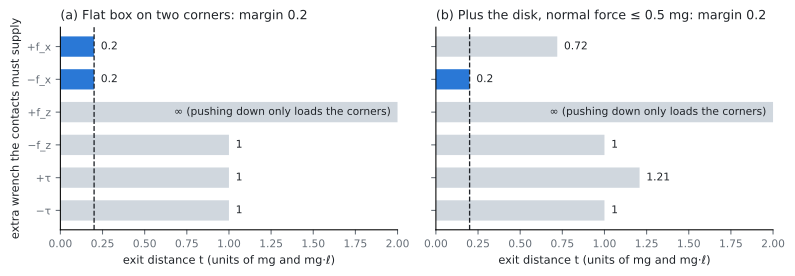
Reading the flat box. The ℓ₁ margin is 0.2, exactly μ: the smallest pure push that breaks support. The Euclidean margin was 0.196, because the worst Euclidean direction mixes a push with a slight lift. The ℓ₁ number is easier to state, and its directions are the ones an engineer would test. Both depend on \(\ell\), since it sets how a moment trades against a force.
4. LP-3: force limits
The disk’s force is unbounded in the cone model, so with the disk in the formation the cone can fill all of \(\R^3\) and the margin becomes infinite (the exact test reports a cap). Every edge has unit normal component, so a contact’s normal force is the sum of its edge weights. A limit is one more row: \[ \sum_{j \in \text{edges of contact } c} \lambda_j \;\le\; f_{\max,c}. \] Add it to LP-1 and LP-2. The feasible wrenches then form a cone (the environment’s contacts) plus a polytope (the manipulator’s). Directions the disk helps now have finite exits: in panel (b), \(t(+f_x) = 0.72\). That is 0.5 from the disk plus 0.22 of floor friction, because the disk’s friction also presses the box onto the floor (\(0.2 \times 1.1\)). The dual gains one multiplier per limit, and the certificate becomes \((z, v)\) with \(v \ge 0\): still a few inequalities anyone can check.
This settles the open item “finite margins with the disk” (Decision 6), once the manipulator’s force limits are known.
5. Robustness, again for free
The robust versions are the same as on the exact-test page, now as more LPs of the same shape:
- Friction: use the lower end of the friction interval.
- Mass and center of mass: one need per corner of the uncertainty box. The verdict and margin are the worst over those needs.
The LPs all have the same size, so they batch with vmap: over poses, over needs and over directions.
6. Solving it
The LPs are tiny and dense: \(d = 3\) or \(6\) rows, tens to a hundred-odd columns. Many of them are solved at once, and the interesting ones sit on the support boundary, where they are degenerate. That rules some methods in and some out:
| Method | Returns | Fit |
|---|---|---|
| Simplex | a vertex (witness with ≤ d generators) and the dual (certificate) | Best fit: a handful of pivots; exact up to rounding; Bland’s rule avoids cycling at degenerate points |
| Interior point | an interior point; duals | Workable: always converges in a few dozen iterations; the witness is dense, and the certificate needs care near the boundary |
| First-order (PDHG, e.g. MPAX) | an approximate point | Poor fit: built for huge sparse LPs. On ours it converges slowly near the boundary and cannot certify “no” when it stops early. In step 2, MPAX falsely rejected about 193 of 416 supported cases near the boundary |
Solvers that run inside JAX (so the test can be jitted and vmapped with the rest of the planner): linrax (Georgia Tech, ACC 2026), a two-phase tableau simplex method with Bland’s rule, is the only one we found. Patrick Kidger’s Lineax and Optimistix do linear solves and nonlinear optimisation, not LPs. JAXopt is no longer maintained. qpax, an interior point method, was surveyed but not needed. HiGHS (via SciPy) stays outside JAX as the float64 reference that checks every answer in the tests.
Decision (Nov 6, 2026). The backbone is adopted and solved by linrax (cmg/src/cmg/physics/hold_lp.py, PlanarHold(method="lp"), commit e29d96f). Two caveats and one option are on record:
- linrax has no license file (neither its repository nor its PyPI package). cmg depends on it as published, pinned to 0.3.0, without copying its code. This is accepted; linrax stays.
- linrax returns no dual. The dual is recovered at the end from its final basis \(B\), by solving \(B^\top y = c_B\); LP-1’s certificate is then \(-y\).
- Set inclusion stays an option for the margin, beside the ℓ₁ margin and the exact test’s Euclidean one: the corners of a disturbance polytope \(D\) as LP-2 directions (§3).
linrax’s pivot loop, replaced. linrax takes no iteration cap. Its whole pivot loop, though, is one small function that linprog looks up when it is traced, so hold_lp swaps in its own version at import (checked against the pinned 0.3.0). The tableau and the entering rule stay the same, with three changes:
- An iteration cap, 300 pivots per phase. Under
vmapthe loop runs until the slowest LP of the batch finishes, so a single LP that never finishes hangs them all. That happened on 3D cones (below). - Bland’s leaving rule. Ties in the ratio test go to the basic variable with the lowest index. linrax took the lowest row instead, which does not rule out cycling, and one 3D LP cycled.
- Artificial rows marked with ≥. After phase 1 the artificial columns are deleted, and the first artificial index equals the index of the right-hand-side column. linrax’s test used >, so it missed that row, and on the flat box it returned a slack of −1 and called it optimal.
Making it work in float32. All computations stay in float32. Each of these measures fixed, or measurably helped with, a failure the tests found:
- Spread the right-hand side. A planar need from gravity alone is \((0, 1, 0)\), with two zero rows. The equality rows are rotated by the Householder reflection \(H\) that maps need to \(\lvert\text{need}\rvert(1,\dots,1)/\sqrt{d}\). \(H\) is orthogonal, so the LP is the same (\(Ax = b \iff HAx = Hb\)), perfectly conditioned, and every right-hand side is positive. The dual maps back by \(y = Hy'\). It first worked around the artificial-row bug above. It stays because it still tests slightly better: 5 uncertain answers in 768 3D cases against 10 without it.
- Recompute the primal from the final basis, by one solve with \(B\), rather than reading it off the tableau, which carries the rounding of every pivot.
- Pivot tolerance \(10^{-4}\). linrax’s default, \(10^{-6}\), is both its smallest allowed pivot and its optimality tolerance. In float32 it pivots on noise: on 600 random LPs it gave 19 wrong answers, and none at \(10^{-4}\).
- Cap exits at 10 (\(mg\), \(mg\ell\)), not \(10^3\). The cap row reads \(t/T \le 1\). With \(T = 10^3\) its coefficient fell to the pivot threshold during pivoting, the ratio test skipped the row, and linrax returned negative weights. Ten times the weight in a pure direction counts as unlimited for margins of order μ.
Every answer is then checked independently of the solver, with elementwise products (no reduced-precision TF32 on GPUs). A witness is checked by its residual, a certificate by its signs, and an exit by its weights. A failed exit check sets that exit to 0, so a solver error can shrink the margin but not enlarge it.
Benchmark (step 2: 1,000 random cases and 416 within 2 mm of disk height of the support boundary; reference HiGHS in float64; all float32):
| Device | Exact test, near boundary | LP, near boundary | ms per 256: exact / LP-1 / LP with margins |
|---|---|---|---|
| CPU | 390 of 416 | 386 of 416 | 4.1 / 2.7 / 6.3 |
| GPU | 389 of 416 | 383 of 416 | 1.5 / 2.0 / 2.5 |
Both get all 1,000 random cases right. Near the boundary the two make the same 12 confident mistakes. These are poses where both certify “not supported” with margins of −0.7 to −1 while HiGHS says supported, so the inputs differ upstream of the test, not in the solvers. Every other disagreement is a pose reported as uncertain and rejected, the safe direction. These poses sit where the cone is nearly flat and a witness needs weights of 60–190 times the weight, beyond what float32 can check to \(10^{-5}\). An earlier run that trusted linrax’s own feasibility flag scored 404, but nothing checked that flag, and it accepted a pose that HiGHS rejects.
In 3D. The same code was run on a cube touched by up to four contacts (face patches, edges and points; 8-edge pyramids; \(d = 6\), up to 128 generators; 1,024 cases batched with vmap; float32 on CPU). The results:
- Nothing hangs. linrax’s own loop had cycled and stalled the whole batch.
- Nothing is certified wrongly.
- 763 of 768 random cases and 255 of 256 near-boundary cases come out right.
- The other 5 random cases are supported but end “uncertain”, which is safe.
- The one near-boundary miss is a false acceptance 0.1% outside the boundary.
- LP-1 takes 40 ms per 256 cases, and the full test with 12 exits about 300 ms.
The uncertain cases come from float32 rounding that builds up in linrax’s dense tableau over the longer pivot sequences of 3D cones. They are not caused by the cap: the same cases stay uncertain at 5,000 pivots. The standard cure is reinversion: rebuild the tableau from the final basis (\(B^{-1}A\) and \(B^{-1}b\), computed fresh) and continue. It is planned for when the 3D build arrives.
The exact test remains the default gate until the margin is chosen. The planar and spatial builders never see the solver: it sits behind solve(c, A_eq, b_eq, A_ub, b_ub), which returns the primal, the dual and the status.
7. The exact test and the LPs, side by side
| Exact test (plane only) | LPs (any dimension) | |
|---|---|---|
| Yes | witness, ≤ 3 generators | witness, ≤ d generators (basic solution) |
| No | Farkas plane from a candidate list | Farkas plane from the dual |
| Margin | signed Euclidean distance | signed ℓ₁ distance, or any polytope of disturbances |
| Force limits | no | yes (one row each) |
| 3D | no (about 5×10⁹ subsets) | yes (6 rows) |
| Cost per 256 cases, float32 (CPU / GPU) | 4.8 / 1.6 ms | 2.4 / 1.8 ms (linrax, feasibility only) |
In the plane, the two agree on yes and no wherever floating point allows, and the exact test remains a cross-check.
Check yourself
\(\lambda = 0\) with \(s^\pm\) equal to the positive and negative parts of need satisfies every constraint, and the objective is at least 0. So the LP is feasible and bounded, and the solver always ends with an optimal basis and its dual.
No. The pyramid lies inside the true friction cone, so every force it allows is a real force. The error is one-sided: it may reject a pose that needs more than 92% of the available friction in an unlucky direction.
The margin is the smallest exit. The disk can only push in +x, so it cannot help resist a disturbance that needs −x force from the contacts; floor friction alone sets \(t(-f_x) = 0.2\). A second disk on the other face, or a gripper, would.
← Deciding support exactly · 2. Valid, transfers and a certified hold gate · Back to the planar build