3. Formations
The search’s discrete state is the formation, one bit per template. Today the formation at a pose is simply Catalog.band(pose). This step prints it at the seven named poses the tests use (tests/configs/step.txt) and along a 1,721-frame trajectory recorded by moving the disk by hand, and counts how many bits each body pair has on at once.
python walkthrough/03_formations.py
The script, 03_formations.py (download)
"""Step 3: formations (the band test) at named poses and along a trajectory.

The formation the search starts from is Catalog.band(pose): every template
whose gap lies in [-epsilon_pen, epsilon_on). Print it at each fixture in
tests/configs/step.txt, then count, along the hand-moved demo trajectory,
how many bits each body pair has on at once.
"""
import jax
import jax.numpy as jnp
import numpy as np

from cmg.catalog.templates import Catalog
from cmg.physics.world import ExecutionWorld, State

from _common import TRAJECTORY, fixtures, load_spec, on, template_names

spec = load_spec()
catalog = Catalog.from_spec(spec)
world = ExecutionWorld(spec.execution)
names = template_names(spec, catalog)


def band_of(qpos):
    qpos = jnp.asarray(qpos)
    return catalog.band(world.pose(State(qpos, jnp.zeros_like(qpos))))


for name, qpos in fixtures().items():
    print(f"{name:16s} {on(band_of(qpos), names)}")

# Which body pair does each template belong to?
pair_of = [tuple(sorted((t.feature1.body(), t.feature2.body()))) for t in catalog]
pairs = sorted(set(pair_of), key=pair_of.index)
member = np.array([[p == q for q in pair_of] for p in pairs])  # (pairs, templates)

qpos = jnp.asarray(np.load(TRAJECTORY)["qpos"])
bands = np.asarray(jax.jit(jax.vmap(band_of))(qpos))  # (frames, templates)
per_pair = bands.astype(int) @ member.T.astype(int)   # (frames, pairs)

print(f"\nDemo trajectory: {len(qpos)} frames")
for k, (a, b) in enumerate(pairs):
    label = f"{spec.bodies[a].name}-{spec.bodies[b].name}"
    counts = np.bincount(per_pair[:, k], minlength=6)
    print(f"  {label}: frames with 0..5 bits on = {counts[:6].tolist()}")
print("Distinct formations visited:", len({tuple(r) for r in bands}))
Output
flat_stable_far  {B:xp-L:boundary, B:xn-L:boundary, B:yp-L:boundary, B:yn-L:boundary, B:zn-L:boundary, B:xp-S:boundary, B:yp-S:boundary, B:yn-S:boundary, B:zn-S:boundary, B:xp-P:boundary, B:yp-P:boundary, B:yn-P:boundary}
flat_stable_close {M:boundary-B:xn, B:xp-L:boundary, B:xn-L:boundary, B:yp-L:boundary, B:yn-L:boundary, B:zn-L:boundary, B:xp-S:boundary, B:yp-S:boundary, B:yn-S:boundary, B:zn-S:boundary, B:xp-P:boundary, B:yp-P:boundary, B:yn-P:boundary}
flat             {B:xp-L:boundary, B:xn-L:boundary, B:yp-L:boundary, B:yn-L:boundary, B:zn-L:boundary}
hanging          {B:xp-S:boundary, B:yp-S:boundary, B:yn-S:boundary, B:xp-P:boundary, B:yp-P:boundary, B:yn-P:boundary, B:zp-P:boundary}
toppled30_far    {B:xp-L:boundary, B:yp-L:boundary, B:yn-L:boundary, B:zn-L:boundary, B:xp-S:boundary, B:yp-S:boundary, B:yn-S:boundary, B:xp-P:boundary, B:yp-P:boundary, B:yn-P:boundary}
toppled30_close  {M:boundary-B:xn, B:xp-L:boundary, B:yp-L:boundary, B:yn-L:boundary, B:zn-L:boundary, B:xp-S:boundary, B:yp-S:boundary, B:yn-S:boundary, B:xp-P:boundary, B:yp-P:boundary, B:yn-P:boundary}
toppled60_far    {B:xp-L:boundary, B:yp-L:boundary, B:yn-L:boundary, B:zn-L:boundary, B:xp-S:boundary, B:yp-S:boundary, B:yn-S:boundary, B:xp-P:boundary, B:yp-P:boundary, B:yn-P:boundary}

Demo trajectory: 1721 frames
  M-B: frames with 0..5 bits on = [1148, 573, 0, 0, 0, 0]
  B-L: frames with 0..5 bits on = [1030, 0, 0, 0, 41, 650]
  B-S: frames with 0..5 bits on = [1408, 0, 0, 262, 51, 0]
  B-P: frames with 0..5 bits on = [608, 0, 0, 103, 209, 801]
Distinct formations visited: 14
The demo trajectory and its gaps
The test suite renders the demo into tests/result/step_mujoco_trajectory.mp4:
and plots all 24 gaps along it in tests/result/step_gap_trajectory.png:
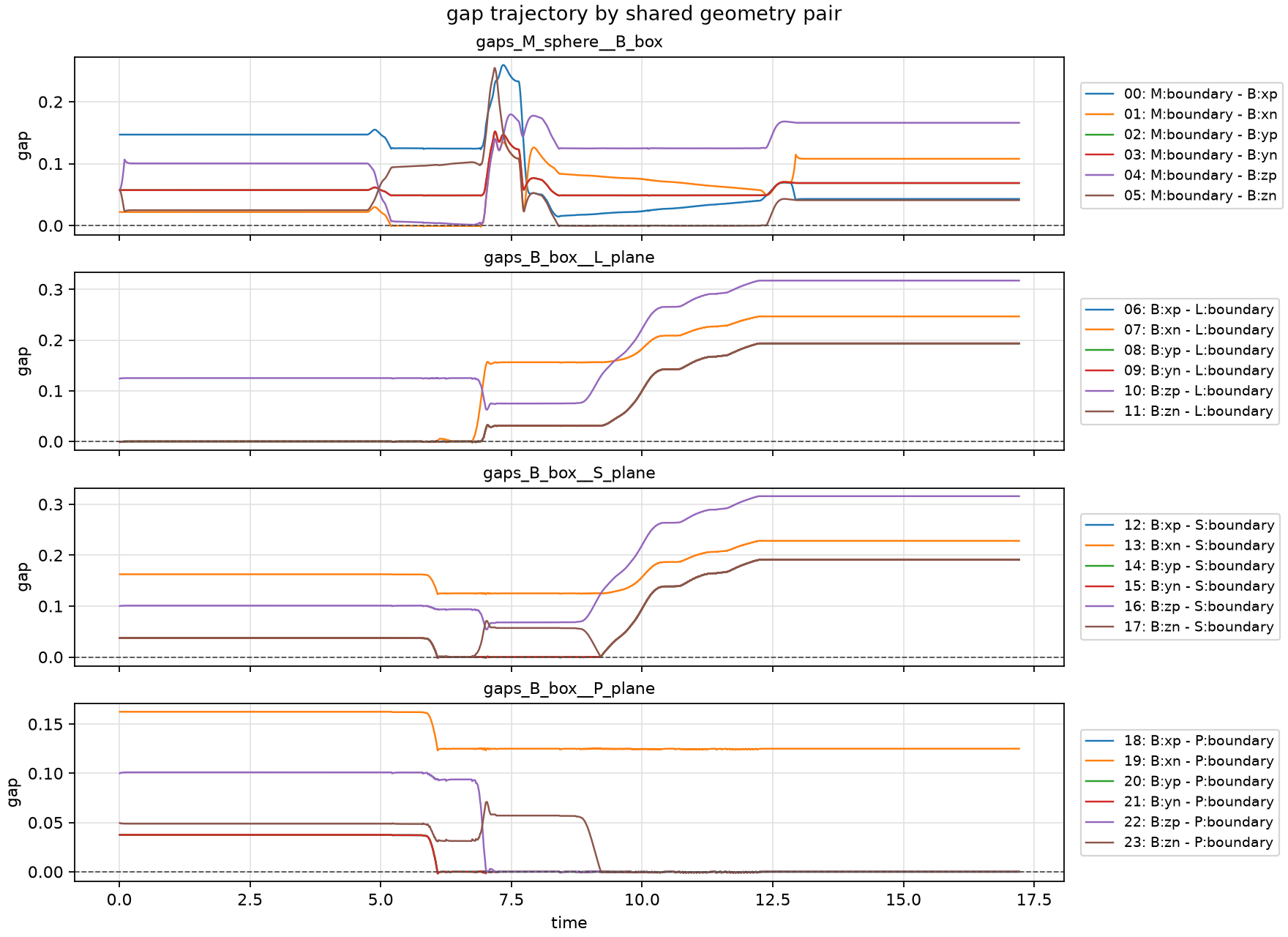
What to notice
- The disk–box pair behaves: it has at most one bit on, because a sphere touches only one face of a box at a time (except exactly at an edge).
- Every environment pair has 3 to 5 bits on whenever it has any. The box–floor pair is never in contact through one bit only. Xiao and Ji’s principal contacts allow exactly one per pair; step 1 enforces that.
- The step corner belongs to two bodies. At
flat_stable_farthe box’s front face sits at x = 0, so it touches both the riserS(along its whole height) and the platformP(at its left edge, the point (0, h)). Decision 4 gives that corner to the riser and makes the platform open at x = 0. - Feature names are in the box’s own frame.
hangingis the box after the topple: turned 90°, lying on its local +x face (xp) on the platform, and overhanging the step by 5.25 cm. Its local +z face (zp) now faces forward, and that face’s bottom edge lies on the platform, soB:zp-Pis on: the same closed-face effect as on the floor. - 14 distinct formations over the demo. A search over formations sees many more nodes than the seven steps of the paper’s chain.
Code to read
tests/configs/step.txt: the named poses, with a one-line comment each.tests/test_gap_test.py,test_gap_trajectory: how the plot and the video are made (offscreenmujoco.Renderer,imageio).
Exercises
3.1 At flat_stable_far, why is B:zn-S:boundary (bottom face against the riser) on?
The bottom face spans x ∈ [−0.125, 0] at z = 0, and the riser is the segment x = 0, z ∈ [0, h]. They share the point (0, 0), the concave junction where the floor meets the riser. Both closed sets contain it, so the gap is zero. Decision 4 rules that concave junctions are not features; this bit should not exist.
3.2 On how many of the 1,721 demo frames does at least one body pair have more than one bit on?
Add one line at the end of 03_formations.py:
print("Frames with some pair above one bit:", int((per_pair > 1).any(axis=1).sum()))It prints 1721: every frame. The box always touches some part of the environment, and the per-pair counts show that whenever it touches the floor, riser or platform, that pair has at least three bits on.
3.3 At toppled30_far, B:zn-L and B:xp-L are on but B:xn-L is off. Which edge of the box is on the floor, and where?
The box is turned by θ = 30° about y with its center at (−0.0409, 0.0854). MuJoCo’s rotation about y maps a body-frame point (x, z) to (x cos θ + z sin θ, −x sin θ + z cos θ). The corner (+a/2, −a/2) lands at (−0.0409 + 0.0229, 0.0854 − 0.0854) = (−0.018, 0): on the floor. That corner is the edge shared by the +x and bottom faces, so xp and zn touch the floor (and yp, yn, whose closed rectangles contain that edge’s endpoints), while the −x face is in the air. The front face rises from (−0.018, 0) in the direction (sin θ, cos θ) and passes through (0, h): the box leans on the step corner, which is why the riser and platform bits are on too.