$$ % Define your custom commands here \newcommand{\bmat}[1]{\begin{bmatrix}#1\end{bmatrix}} \newcommand{\E}{\mathbb{E}} \newcommand{\P}{\mathbb{P}} \newcommand{\S}{\mathbb{S}} \newcommand{\R}{\mathbb{R}} \newcommand{\S}{\mathbb{S}} \newcommand{\norm}[2]{\|{#1}\|_{{}_{#2}}} \newcommand{\pd}[2]{\frac{\partial #1}{\partial #2}} \newcommand{\pdd}[2]{\frac{\partial^2 #1}{\partial #2^2}} \newcommand{\vectornorm}[1]{\left|\left|#1\right|\right|} \newcommand{\abs}[1]{\left|{#1}\right|} \newcommand{\mbf}[1]{\mathbf{#1}} \newcommand{\mc}[1]{\mathcal{#1}} \newcommand{\bm}[1]{\boldsymbol{#1}} \newcommand{\nicefrac}[2]{{}^{#1}\!/_{\!#2}} \newcommand{\argmin}{\operatorname*{arg\,min}} \newcommand{\argmax}{\operatorname*{arg\,max}} \newcommand{\dd}{\operatorname{d}\!} $$

Neural Operators and U-Net

Notes adapted from UNet Tutorial in JAX Machine Learning & Simulation

Notes adapted from MIT OpenCourseWare Adjoint Differentiation of ODE Solutions

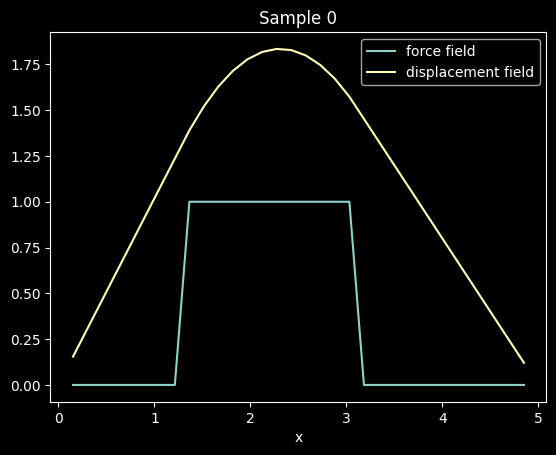
A simple implementation of a hierarchical convolutional neural network in JAX; used to learn a solver to a \(1\)D Poisson equation. \[ \frac{\dd^2 u}{\dd x^2} = -f(x), \quad x \in (0, L), \quad u(0) = u(L) = 0. \] The Poisson equation (together with homogeneous Dirichlet boundary conditions) maps a force field \(f(x)\) to the displacement \(u(x)\) of a thin string.

  • The U-Net \(f_\theta\) is trained to map \(f(x) \mapsto u(x)\).
  • In this concrete scenario, the forcing functions will have a discontinuity: \[ f(x) = \begin{cases} 1 & x \in [\ell_0, \ell_1] \\ 0 & \text{otherwise} \end{cases} \] with \(\ell_0 \propto \mathcal{U}\left(\nicefrac{L}{5}, \nicefrac{2L}{5}\right)\) and \(\ell_1 \propto \mathcal{U}\left(\nicefrac{3L}{5}, \nicefrac{4L}{5}\right)\).
  • We will draw \(P = 1,000\) forcing functions and then discretize them on a grid of \(N = 32\) interior nodes.
  • A reference solution is computed by a direct linear solver applied to the three-point discretization.
  • With a \(4:1\) train/test split, the U-Net is trained on MSE error on batch size of \(\abs{\mc{B}} = 32\) for \(100\) epochs.

Dataset Generation

  • Discretize the interval \((0, L)\) at \(N+2\) equally-spaced points (\(2\) gridpoints at the endpoints, remaining \(N\) in the interior of the domain)
  • Define the grid spacing as \(h = \nicefrac{L}{N}\).
  • The forcing function is discretized as \[ f_j = f(x_j), \quad j = 1, \dots, N. \]
  • The solution is discretized as \[ u_j = u(x_j), \quad j = 1, \dots, N. \]
  • The second-order central difference approximation to the second derivative is \[ \frac{\dd^2 u}{\dd x^2} \approx \frac{u_{j-1} - 2u_j + u_{j+1}}{h^2}. \]
    • This follows from defining the first-order central difference as \[ \frac{\dd u}{\dd x} \approx \frac{u_{j+\nicefrac{1}{2}} - u_{j-\nicefrac{1}{2}}}{h}. \]
    • Iterating this a second time \[ \frac{\dd^2 u}{\dd x^2} \approx \frac{\frac{u_{j+1} - u_j}{h} - \frac{u_j - u_{j-1}}{h}}{h} = \frac{u_{j-1} - 2u_j + u_{j+1}}{h^2}. \]
  • The boundary conditions are \[ u_0 = u_{N+1} = 0. \]
  • Substituting these into the Poisson equation yields a linear system of equations for the interior nodes: \[ -u_{j-1} + 2u_j - u_{j+1} = h^2 f_j, \quad j = 1, \dots, N. \]
  • This yields a linear system of the form \[ \bm{A} \bm{u} = -h^2 \bm{f}, \] where \(\bm{A}\) is the following tridiagonal matrix: \[ \bm{A} = \begin{pmatrix} 2 & -1 & 0 & \dots & 0 \\ -1 & 2 & -1 & \dots & 0 \\ 0 & -1 & 2 & \dots & 0 \\ \vdots & \vdots & \vdots & \ddots & \vdots \\ 0 & 0 & 0 & -1 & 2 \end{pmatrix}. \]
  • Solving this system yields the (discretized) solution \(\bm{u}\) to a given (discretized) forcing function \(\bm{f}\).
Dataset Generation
import jax
import jax.numpy as jnp

NUM_POINTS = 32         # N
NUM_SAMPLES = 1000      # P
DOMAIN_EXTENT = 5.0     # L

# Interior grid (excludes the two Dirichlet boundary points)
grid = jnp.linspace(0, DOMAIN_EXTENT, NUM_POINTS + 2)[1:-1]
dx = grid[1] - grid[0]

# Second-order finite-difference matrix  A ≈ d²/dx²
_A = (
    jnp.diag(jnp.ones(NUM_POINTS - 1), -1)
    - 2 * jnp.diag(jnp.ones(NUM_POINTS), 0)
    + jnp.diag(jnp.ones(NUM_POINTS - 1), 1)
) / dx**2


def solve_poisson(f: jax.Array) -> jax.Array:
    """Solve  A u = -f  for u given a force field f on the interior grid."""
    return jnp.linalg.solve(_A, -f)


def create_discontinuity(key: jax.Array) -> jax.Array:
    """
    Generate a random box-function force field on the interior grid.
    The active interval is drawn uniformly from [0.2L, 0.4L] x [0.6L, 0.8L].
    """
    limit_1_key, limit_2_key = jax.random.split(key)
    lower_limit = jax.random.uniform(
        limit_1_key, (), minval=0.2 * DOMAIN_EXTENT, maxval=0.4 * DOMAIN_EXTENT
    )
    upper_limit = jax.random.uniform(
        limit_2_key, (), minval=0.6 * DOMAIN_EXTENT, maxval=0.8 * DOMAIN_EXTENT
    )
    return jnp.where((grid >= lower_limit) & (grid <= upper_limit), 1.0, 0.0)


def generate_dataset(
    num_samples: int = NUM_SAMPLES,
    seed: int = 0,
) -> tuple[jax.Array, jax.Array]:
    """
    Generate (force_fields, displacement_fields) each of shape
    (num_samples, 1, NUM_POINTS) — channel-first, ready for Conv1d.

    Returns
    -------
    force_fields : jax.Array, shape (N, 1, NUM_POINTS)
    displacement_fields : jax.Array, shape (N, 1, NUM_POINTS)
    """
    primary_key = jax.random.PRNGKey(seed)
    keys = jax.random.split(primary_key, num_samples)

    force_fields = jax.vmap(create_discontinuity)(keys)          # (N, P)
    displacement_fields = jax.vmap(solve_poisson)(force_fields)  # (N, P)

    # Add singleton channel axis → (N, 1, P)
    force_fields = force_fields[:, None, :]
    displacement_fields = displacement_fields[:, None, :]

    return force_fields, displacement_fields


def train_test_split(
    force_fields: jax.Array,
    displacement_fields: jax.Array,
    train_fraction: float = 0.8,
) -> tuple[jax.Array, jax.Array, jax.Array, jax.Array]:
    """
    Split arrays into train / test sets.

    Returns
    -------
    train_x, test_x, train_y, test_y
    """
    split = int(force_fields.shape[0] * train_fraction)
    return (
        force_fields[:split],
        force_fields[split:],
        displacement_fields[:split],
        displacement_fields[split:],
    )

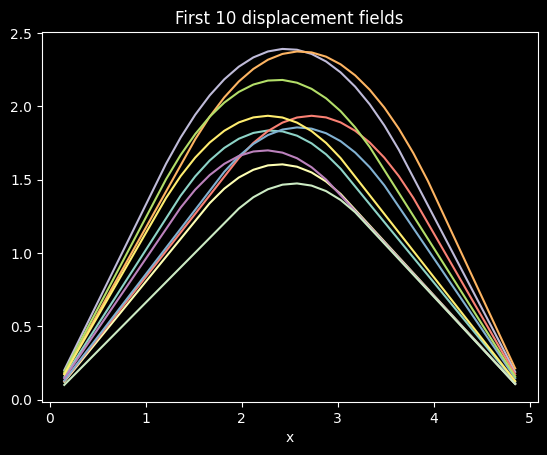
Displacement fields for a few samples.

Displacement fields for a few samples.

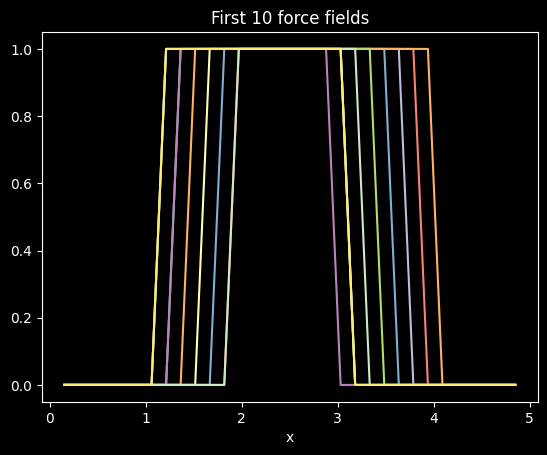
Force fields for a few samples.

Force fields for a few samples.

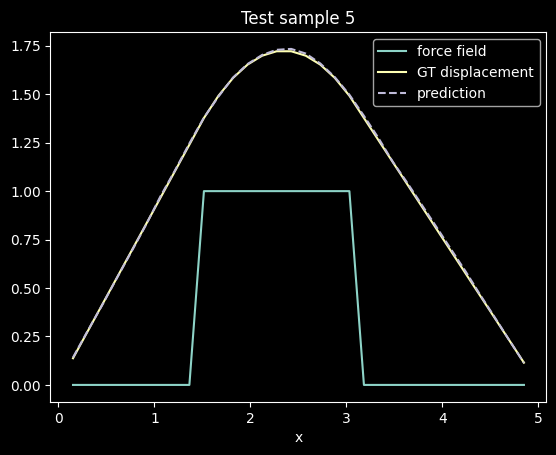
Sample pair

Sample pair

U-Net Implementation

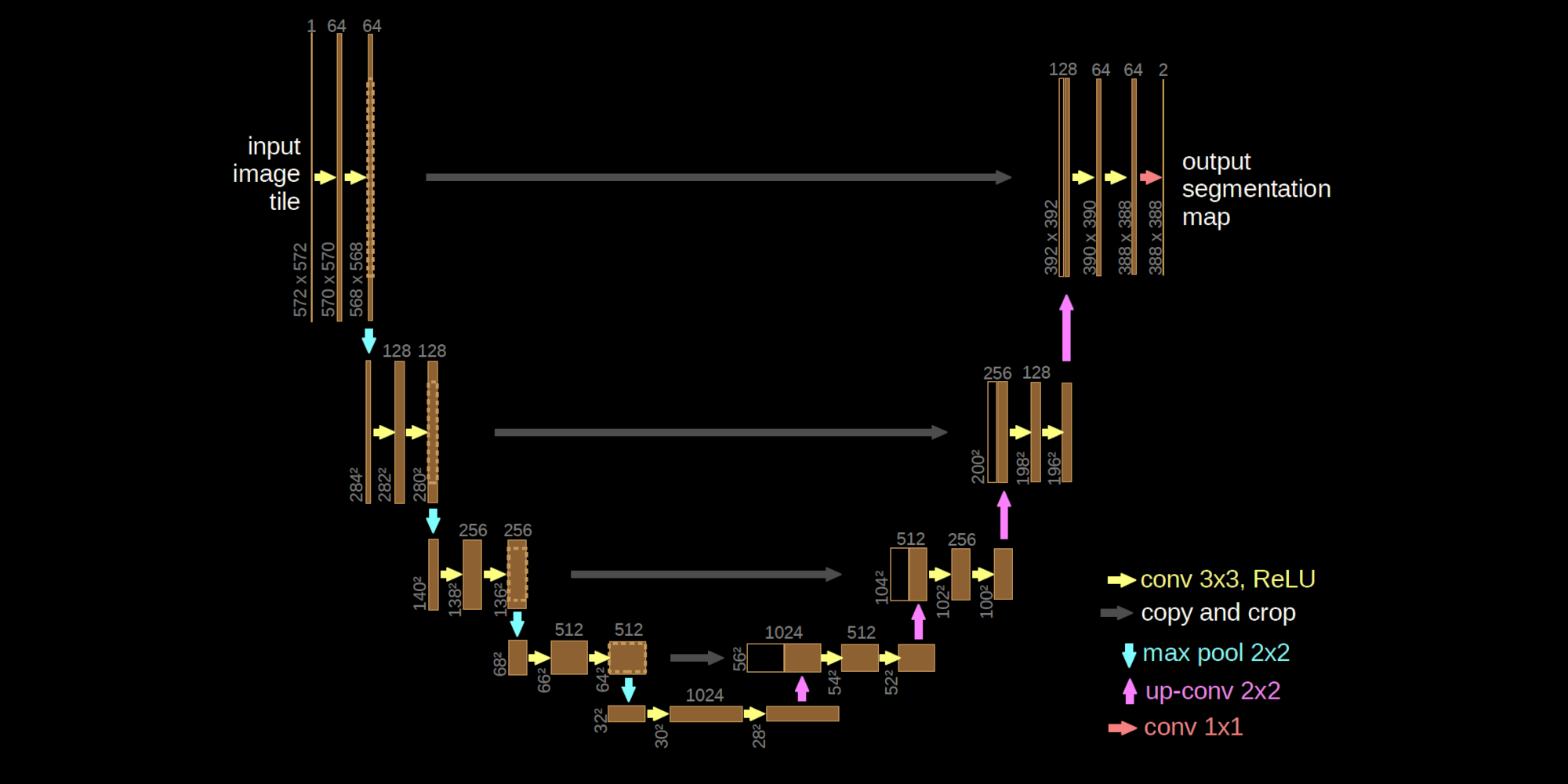
Original UNet schematic by Ronneberger et al. (2015) (our concrete implementation deviates from this)

Original UNet schematic by Ronneberger et al. (2015) (our concrete implementation deviates from this)
WarningModifications from the classical U-Net
  • Use linear convolution for downscaling instead of max-pooling
  • Downscaling and upscaling are \(3 \times 3\) convolutions with stride \(2\) (instead of \(2 \times 2\))
  • “Same” padding to never have issues with spatial sizes
  • No normalization layers for simplicity
  • Variable number levels (here we will use two)
U-Net neural operator implemented with Equinox
"""
U-Net neural operator implemented with Equinox.

Architecture:
  - Lifting DoubleConv
  - Encoder: stride-2 Conv downsampling + DoubleConv at each level
  - Decoder: ConvTranspose upsampling + skip-connection concat + DoubleConv
  - 1x1 Conv projection to output channels
"""

import jax
import jax.numpy as jnp
import jax.tree_util as jtu
import equinox as eqx
from typing import Callable


class DoubleConv(eqx.Module):
    conv_1: eqx.nn.Conv
    conv_2: eqx.nn.Conv
    activation: Callable

    def __init__(
        self,
        num_spatial_dims: int,
        in_channels: int,
        out_channels: int,
        activation: Callable,
        *,
        key,
    ):
        c_1_key, c_2_key = jax.random.split(key)
        self.conv_1 = eqx.nn.Conv(
            num_spatial_dims,
            in_channels,
            out_channels,
            kernel_size=3,
            padding=1,
            key=c_1_key,
        )
        self.conv_2 = eqx.nn.Conv(
            num_spatial_dims,
            out_channels,
            out_channels,
            kernel_size=3,
            padding=1,
            key=c_2_key,
        )
        self.activation = activation

    def __call__(self, x: jax.Array) -> jax.Array:
        x = self.activation(self.conv_1(x))
        x = self.activation(self.conv_2(x))
        return x


class UNet(eqx.Module):
    lifting: DoubleConv
    down_sampling_blocks: list[eqx.nn.Conv]
    left_arc_blocks: list[DoubleConv]
    right_arc_blocks: list[DoubleConv]
    up_sampling_blocks: list[eqx.nn.ConvTranspose]
    projection: eqx.nn.Conv

    def __init__(
        self,
        num_spatial_dims: int,
        in_channels: int,
        out_channels: int,
        hidden_channels: int,
        num_levels: int,
        activation: Callable,
        *,
        key,
    ):
        key, lifting_key, projection_key = jax.random.split(key, 3)

        self.lifting = DoubleConv(
            num_spatial_dims,
            in_channels,
            hidden_channels,
            activation,
            key=lifting_key,
        )
        self.projection = eqx.nn.Conv(
            num_spatial_dims,
            hidden_channels,
            out_channels,
            kernel_size=1,
            key=projection_key,
        )

        # Channel counts at each level: [C, 2C, 4C, ...]
        channel_list = [hidden_channels * 2**i for i in range(num_levels + 1)]

        self.down_sampling_blocks = []
        self.left_arc_blocks = []
        self.right_arc_blocks = []
        self.up_sampling_blocks = []

        for upper_ch, lower_ch in zip(channel_list[:-1], channel_list[1:]):
            key, down_key, left_key, right_key, up_key = jax.random.split(key, 5)

            self.down_sampling_blocks.append(
                eqx.nn.Conv(
                    num_spatial_dims,
                    upper_ch,
                    upper_ch,
                    kernel_size=3,
                    stride=2,
                    padding=1,
                    key=down_key,
                )
            )
            self.left_arc_blocks.append(
                DoubleConv(num_spatial_dims, upper_ch, lower_ch, activation, key=left_key)
            )
            self.right_arc_blocks.append(
                DoubleConv(num_spatial_dims, lower_ch, upper_ch, activation, key=right_key)
            )
            self.up_sampling_blocks.append(
                eqx.nn.ConvTranspose(
                    num_spatial_dims,
                    lower_ch,
                    upper_ch,
                    kernel_size=3,
                    stride=2,
                    padding=1,
                    output_padding=1,
                    key=up_key,
                )
            )

    def __call__(self, x: jax.Array) -> jax.Array:
        x = self.lifting(x)
        x_skips = []

        # Encoder (left arc)
        for down, left in zip(self.down_sampling_blocks, self.left_arc_blocks):
            x_skips.append(x)
            x = down(x)
            x = left(x)

        # Decoder (right arc)
        for right, up in zip(
            reversed(self.right_arc_blocks), reversed(self.up_sampling_blocks)
        ):
            x = up(x)
            # Equinox operates without a batch axis; channels are at axis 0
            x = jnp.concatenate([x, x_skips.pop()], axis=0)
            x = right(x)

        return self.projection(x)


def count_parameters(model: eqx.Module) -> int:
    """Return the total number of trainable scalar parameters."""
    return sum(p.size for p in jtu.tree_leaves(eqx.filter(model, eqx.is_array)))
Training and Results

Training and results
# ---------------------------------------------------------------------------
# Hyper-parameters
# ---------------------------------------------------------------------------
HIDDEN_CHANNELS = 32
NUM_LEVELS = 2
LEARNING_RATE = 3e-4
NUM_EPOCHS = 100
BATCH_SIZE = 32
SEED_DATA = 0
SEED_MODEL = 0
SEED_SHUFFLE = 151


# ---------------------------------------------------------------------------
# Helpers
# ---------------------------------------------------------------------------
def dataloader(data, *, batch_size: int, key):
    """Mini-batch generator over a PyTree / tuple of arrays."""
    n_samples_list = [a.shape[0] for a in jtu.tree_leaves(data)]
    if not all(n == n_samples_list[0] for n in n_samples_list):
        raise ValueError("All arrays must have the same leading (sample) dimension.")
    n_samples = n_samples_list[0]
    n_batches = int(jnp.ceil(n_samples / batch_size))
    permutation = jax.random.permutation(key, n_samples)

    for batch_id in range(n_batches):
        start = batch_id * batch_size
        end = min((batch_id + 1) * batch_size, n_samples)
        indices = permutation[start:end]
        yield jtu.tree_map(lambda a: a[indices], data)


def normalized_l2_norm(pred: jax.Array, ref: jax.Array) -> jax.Array:
    """Per-sample normalised L2 error: ||pred - ref|| / ||ref||."""
    return jnp.linalg.norm(pred - ref) / jnp.linalg.norm(ref)


# ---------------------------------------------------------------------------
# Loss and update step
# ---------------------------------------------------------------------------
def loss_fn(model, x, y):
    y_pred = jax.vmap(model)(x)
    return jnp.mean(jnp.square(y_pred - y))


def make_update_fn(optimizer):
    """Closes over optimizer so filter_jit doesn't see it as a traced value."""
    @eqx.filter_jit
    def update_fn(model, opt_state, x, y):
        loss, grad = eqx.filter_value_and_grad(loss_fn)(model, x, y)
        updates, new_state = optimizer.update(grad, opt_state, model)
        new_model = eqx.apply_updates(model, updates)
        return new_model, new_state, loss
    return update_fn


# ---------------------------------------------------------------------------
# Main
# ---------------------------------------------------------------------------
def main():
    # -- Dataset -----------------------------------------------------------
    print("Generating dataset …")
    force_fields, displacement_fields = generate_dataset(seed=SEED_DATA)
    train_x, test_x, train_y, test_y = train_test_split(force_fields, displacement_fields)
    print(f"  train: {train_x.shape}  test: {test_x.shape}")

    # -- Model -------------------------------------------------------------
    model = UNet(
        num_spatial_dims=1,
        in_channels=1,
        out_channels=1,
        hidden_channels=HIDDEN_CHANNELS,
        num_levels=NUM_LEVELS,
        activation=jax.nn.relu,
        key=jax.random.PRNGKey(SEED_MODEL),
    )
    print(f"  parameters: {count_parameters(model):,}")

    optimizer = optax.adam(LEARNING_RATE)
    opt_state = optimizer.init(eqx.filter(model, eqx.is_array))
    update_fn = make_update_fn(optimizer)

    # -- Training loop -----------------------------------------------------
    loss_history = []
    shuffle_key = jax.random.PRNGKey(SEED_SHUFFLE)

    for epoch in tqdm(range(NUM_EPOCHS), desc="epochs"):
        shuffle_key, subkey = jax.random.split(shuffle_key)
        for batch in dataloader((train_x, train_y), batch_size=BATCH_SIZE, key=subkey):
            model, opt_state, loss = update_fn(model, opt_state, *batch)
            loss_history.append(float(loss))

    # -- Evaluation --------------------------------------------------------
    test_predictions = jax.vmap(model)(test_x)
    test_errors = jax.vmap(normalized_l2_norm)(test_predictions, test_y) 

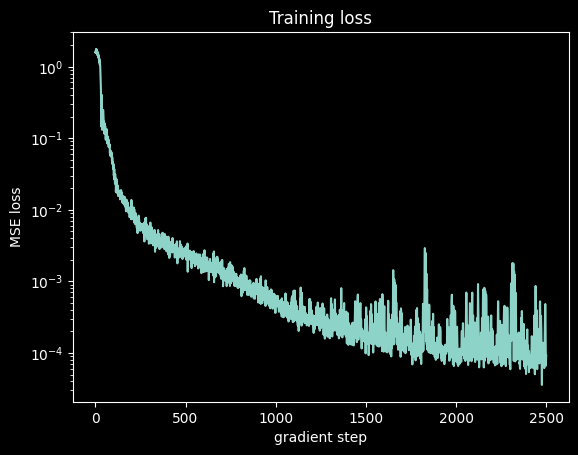
Training loss history.

Training loss history.

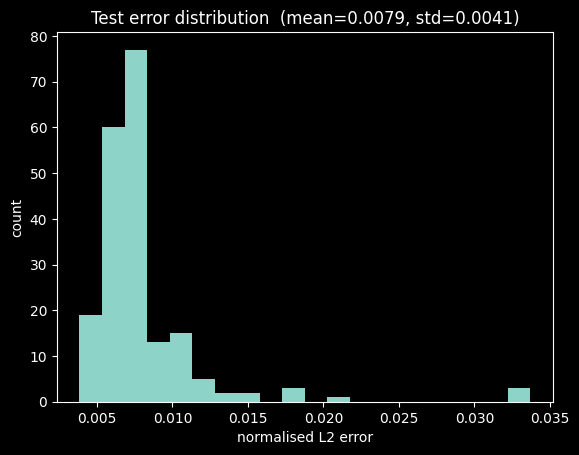
Error distribution.

Error distribution.

Sample predictions.

Sample predictions.

Ordinary Differential Equations (ODEs)

  • Initial Value Problem \[ \begin{aligned} \frac{\dd u}{\dd t}(t) &= f(t, u(t), \theta) \\ u(t_0) &= u_0 \end{aligned} \]
  • How do we solve an ODE?
TipToy Example: Free falling ball
  • ODE with state \(u(t) = \bmat{z(t) & v(t)}^\top\) \[ \begin{aligned} \dd z(t) &= v(t) \dd t && z(t=t_0) = z_0 = 5 \text{ m}\\ \dd v(t) &= -g \dd t && v(t=t_0) = v_0 = -\nicefrac{1}{10} \text{ m/s} \end{aligned} \]
  • Analytical solution (available in this case) \[ \begin{aligned} z(t) &= z_0 + v_0 (t-t_0) - \frac{1}{2} g (t-t_0)^2 \\ v(t) &= v_0 - g (t-t_0) \end{aligned} \]
  • More generally, we would have a numerical solver, the simplest of which is the Euler method \[ \begin{aligned} u_{n+1} &= u_n + \Delta t f(t_n, u_n, p), \\ t_n &= t_0 + n \Delta t \end{aligned} \]
  • There are tons of more sophisticated methods.

Sensitivities

Different methods for performing sensitivity analysis of ODEs

  • Two main ways of differentiating through an ODE
    • Discrete sensitivity analysis (autodiff on solver operations)
      • “Exact gradient approximation” or “discretize-then-differentiate”
    • Continuous sensitivity analysis (custom rules)
      • “Approximation of the exact gradient” or “differentiate-then-discretize”
  • Two modes each (forward/tangent and reverse/adjoint)
    • Best choice depends on the number of states/parameters and system properties.

What are sensitivities or derivatives good for?

  • Sensitivity analysis
    • How sensitive is the solution to changes in the initial conditions (ICs) and/or parameters?
  • Parameter estimation
    • What parameters match the observed data?
  • Control
    • How can I drive the solution to a certain final state?
TipToy Example: Parameter Estimation
  • For the free-falling ball example, let us consider loss function \[ \mc{J}(z; g) = \frac{1}{2} \left(z(T; g) - z_{\text{obs}}\right)^2, \] where \(z(T; g)\) is the analytical solution and \(z_{\text{obs}}\) is the observed position at time \(T\).

  • We want to take the derivative of \(\mc{J}\) with respect to \(g\)

    • By the chain rule, this requires, in turn, that we compute the derivative of \(z(T; g)\) with respect to \(g\).
  • Since we know the analytical solution, this computation is easy. \[ \pd{z(T; g)}{g} = \pd{}{g} \left( z_0 + v_0 (T-t_0) - \frac{1}{2} g (T-t_0)^2 \right) = -\frac{1}{2} (T-t_0)^2 \]

  • In general, we have a loss functional \(\mc{J}(u; p)\), for example, \[ \begin{aligned} \mc{J}(u; p) &= \int_{t_0}^T r(u; p) \dd t, \\ r(u; p) &= u^\top Q u. \end{aligned} \]
  • We want to compute its sensitivity \(\frac{\dd \mc{J}}{\dd p}\).

Total Derivative

Let’s compute the total derivative of the loss functional with respect to the parameters.

\[ \frac{\dd \mc{J}}{\dd p} = \int_{t_0}^T \frac{\dd r}{\dd p} \dd t = \int_{t_0}^T \left( \frac{\partial r}{\partial p} + \frac{\partial r}{\partial u} \frac{\dd u}{\dd p}\right) \dd t, \tag{1}\] where \(\pd{r}{p} \in \R^{1 \times n_p}\), \(\pd{r}{u} \in \R^{1 \times n_u}\) and \(\pd{u}{p} \in \R^{n_u \times n_p}\).

  • The term \(\pd{u}{p}\) is difficult to compute, since it requires solving an ODE for each parameter.
  • Two choices:
    1. Forward sensitivity
    2. Adjoint or backward sensitivity

Forward Sensitivity Analysis

The goal is to compute the sensitivity matrix (Jacobian) of the state with respect to the parameters: \[ \frac{\dd u}{\dd p} = \begin{pmatrix} | & & | \\ \pd{u}{p_1} & \dots & \pd{u}{p_m} \\ | & & | \end{pmatrix} \in \R^{n_u \times n_p} \]

Consider the Initial Value Problem (IVP): \[ \begin{cases} \frac{\dd u}{\dd t} = f(t, u, p) \\ u(0) = u_0 \end{cases} \]

To find how the solution \(u\) changes with respect to a parameter \(p_i\), we implicitly differentiate the ODE: \[ \frac{\dd}{\dd p_i} \left( \frac{\dd u}{\dd t} \right) = \pd{}{p_i} f(t, u, p) \]

By swapping the order of differentiation \(\left(\frac{\dd}{\dd p_i} \frac{\dd}{\dd t} \to \frac{\dd}{\dd t} \frac{\dd}{\dd p_i}\right)\) and applying the chain rule to the right-hand side: \[ \frac{\dd}{\dd t} \left( \pd{u}{p_i} \right) = \pd{f}{u} \pd{u}{p_i} + \pd{f}{p_i} \]

Let \(s_i = \pd{u}{p_i}\) be the sensitivity of the state with respect to parameter \(p_i\). This yields a new IVP for each sensitivity vector: \[ \begin{cases} \frac{\dd s_i}{\dd t} = \pd{f}{u} s_i + \pd{f}{p_i} \\ s_i(t_0) = \pd{u_0}{p_i} \end{cases} \]

Summary:

  • Build the Jacobian \(\pd{u}{p}\) by solving the \(n_u \times n_p\) sensitivity equations alongside the original ODE.
  • Plug the sensitivities into the total derivative integral in Equation 1 and solve by quadrature.
  • Scalability: This method scales linearly with the number of parameters \(n_p\)!

Adjoint Sensitivity Analysis

We aim to solve the following constrained optimization problem: \[ \begin{aligned} \min_p \quad & \mc{J}(u; p) \\ \text{subj. to} \quad & \frac{\dd u}{\dd t} = f(u, t, p) \end{aligned} \] This is a dynamic equality constrained optimization problem. We can define the Lagrangian: \[ L(u, \lambda; p) = \mc{J}(u; p) + \int_{t_0}^T \lambda^\top \left( f - \frac{\dd u}{\dd t} \right) \dd t, \] where \(\lambda\) is a continuous Lagrange multiplier with \(\lambda(t) \in \R^{n_u}\). Using the integral form of \(\mc{J}\) from Equation 1: \[ L = \int_{t_0}^T \left[ r(u; p) + \lambda^\top(t) \left( f - \frac{\dd u}{\dd t} \right) \right] \dd t \] Differentiating with respect to \(p\): \[ \frac{\dd L}{\dd p} = \int_{t_0}^T \left[ \pd{r}{p} + \pd{r}{u} \frac{\dd u}{\dd p} + \lambda^\top(t) \left( \pd{f}{p} + \pd{f}{u} \frac{\dd u}{\dd p} - \frac{\dd}{\dd t} \frac{\dd u}{\dd p} \right) \right] \dd t. \] Here, the terms \(\frac{\dd u}{\dd p}\) are difficult to compute. Rearranging the terms: \[ \frac{\dd L}{\dd p} = \int_{t_0}^T \left[ \pd{r}{p} + \lambda^\top \pd{f}{p} + \underbrace{\left( \pd{r}{u} + \lambda^\top \pd{f}{u} - \lambda^\top \frac{\dd}{\dd t} \right)}_{\text{make zero}} \frac{\dd u}{\dd p} \right] \dd t \tag{2}\]

ImportantIntegration-by-parts

We can integrate the term \(\int_{t_0}^T \lambda^\top \frac{\dd}{\dd t} \frac{\dd u}{\dd p} \dd t\) by parts:

\[ \begin{aligned} \int_{t_0}^T -\lambda^\top \frac{\dd}{\dd t} \frac{\dd u}{\dd p} \dd t &= \left[ -\lambda^\top \frac{\dd u}{\dd p} \right]_{t_0}^T + \int_{t_0}^T \frac{\dd \lambda}{\dd t}^\top \frac{\dd u}{\dd p} \dd t \\ &= \lambda^\top(t_0) \frac{\dd u}{\dd p}(t_0) - \lambda^\top(T) \frac{\dd u}{\dd p}(T) + \int_{t_0}^T \frac{\dd \lambda}{\dd t}^\top \frac{\dd u}{\dd p} \dd t \end{aligned} \]

Substituting the result from the integration-by-parts into Equation 2 gives

\[ \frac{\dd L}{\dd p} = \int_{t_0}^T \left[ \pd{r}{p} + \lambda^\top \pd{f}{p} + \underbrace{\left( \pd{r}{u} + \lambda^\top \pd{f}{u} + \frac{\dd \lambda}{\dd t}^\top \right)}_{\text{make zero}} \frac{\dd u}{\dd p} \right] \dd t + \lambda^\top(t_0) \frac{\dd u}{\dd p}(t_0) - \underbrace{\lambda(T)^\top}_{\text{make zero}} \frac{\dd u}{\dd p}(T). \]

Hence, we choose the Lagrange multiplier \(\lambda\) such that \[ \pd{r}{u}^\top + \lambda^\top \pd{f}{u} + \frac{\dd \lambda}{\dd t}^\top = 0, \quad \lambda(T) = 0 \] Taking the transpose yields \[ \begin{cases} \dot{\lambda} = -f_u^\top \lambda - r_u^\top \\ \lambda(T) = 0 \end{cases} \]

This is a terminal value problem that must be solved backwards in time. With this choice of \(\lambda\), the total derivative simplifies to: \[ \frac{\dd \mc{J}}{\dd p} = \frac{\dd \mc{L}}{\dd p} = \int_{t_0}^T \left[ \pd{r}{p} + \lambda^\top \pd{f}{p} \right] \dd t + \lambda^\top(t_0) \pd{u}{p}(t_0) \]

Numerical Strategy:

  1. Solve forward: \(\dot{u} = f(u, t, p)\) with \(u(t_0) = u_0\) to obtain \(u(t)\) for \(t \in [t_0, T]\).
  2. Solve backward: \(\dot{\lambda} = -\pd{f}{u}^\top \lambda - \pd{r}{u}^\top\) with \(\lambda(T) = 0\) to obtain \(\lambda(t)\).
  3. Evaluate: Compute the gradient using the quadrature: \[ \frac{\dd \mc{J}}{\dd p} = \int_{t_0}^T \left[ \pd{r}{p} + \lambda^\top \pd{f}{p} \right] \dd t + \lambda^\top(t_0) \pd{u}{p}(t_0) \]

Scalability: This method scales constantly with the number of parameters \(n_p\)!

Tips and Tricks

  1. To avoid storing the continuous solution \(u(t)\), solve it once forward to obtain \(u(T)\), then solve the \(\dot{u}\) ODE in lock-step with the \(\dot{\lambda}\) ODE starting from this final solution (Doesn’t always work, especially for chaotic systems).

  2. Quadrature as an ODE \[ F(T) = \int_{t_0}^T f(t) \dd t \quad ; \quad \dot{w}(t) = f(t), \quad w(t_0) = 0 \] \[ w(t+n \Delta t) \approx w(t) + \Delta t \sum_{k=0}^n f(t+k \Delta t) \]

  3. Adjoint Augmented Dynamics For the case where we want to compute the derivative of the loss with respect to parameters: \[ \begin{aligned} \dot{w} &= g_p + \lambda^\top f_p, && w(T) = 0 \\ \dot{\lambda} &= -f_u^\top \lambda - g_u^\top, && \lambda(T) = 0 \\ \dot{u} &= f(t, u, p), && u(T) = u_{\text{end}} \end{aligned} \] \(w\) is the derivative you want!

Learning the gravitational acceleration with Euler method
import jax
import jax.numpy as jnp

z0 = jnp.array(5.0)
v0 = jnp.array(0.1)
p_true = jnp.array(3.70)
p = jnp.array(10.56)

u0 = jnp.array([z0, v0])
tspan = jnp.array([0.0, 1.0])
dt = 0.001
n_steps = int((tspan[1] - tspan[0]) // dt)

eta = 0.25

z_cf = jax.jit(lambda t, p: z0 + v0 * t - 0.5 * p * t ** 2)
v_cf = jax.jit(lambda t, p: v0 - p * t)

def freefall(u, t, p):
    z, v = u
    dzdt = v
    dvdt = -p
    return jnp.array([dzdt, dvdt])

def euler_step(f, u, t, dt, p):
    return u + dt * f(u, t, p)

def rollout(
    stepper_fn, 
    n,
    *,
    include_init=False,
):
    def scan_fn(u, t):  # State x Time(and/or Control)->New_State x Observation
        u_next = stepper_fn(u, t)
        obs = dt * 1/2 * (u_next[0] - z_cf(t, p_true)) ** 2
        # obs = jnp.abs(u_next[0] - z_cf(t, p_true)) * dt
        # u_next_true = jnp.array([z_cf(t, p_true), v_cf(t, p_true)])
        # state_error = u_next - u_next_true
        # obs = dt * 1/2 * jnp.dot(state_error, state_error)
        return u_next, (u_next, obs)

    def rollout_fn(init):
        xs = jnp.linspace(tspan[0], tspan[1], n)
        _, history = jax.lax.scan(
            scan_fn,    # Euler step
            init,       # Initial state
            xs,         # tspan, (could also include Forcing trajectory)
            length=n,   # Number of steps
        )

        if include_init:
            init_obs = (u0, 0.0)
            return (jnp.concatenate(
                [jnp.expand_dims(init_obs[0], axis=0), history[0]], 
                axis=0), 
                jnp.concatenate(
                [jnp.expand_dims(init_obs[1], axis=0), history[1]],
                axis=0),
            )

        return history
    return rollout_fn

trj = lambda p: rollout(
        lambda u, t: euler_step(freefall, u, t, dt, p), 
        n_steps, include_init=True
    )

@jax.jit
@jax.value_and_grad
def loss(p):
    return jnp.sum(trj(p)(u0)[1])

N = int(2 ** 10)
for i in range(N):
    l, grad = loss(p)
    p -= eta * grad
    if i % (2**(jnp.log2(N)//2)) == 0 or i == N-1:
        print('i={:3d}, loss={:.3e}, grad={:.4f}, p={:.4f}'.format(i, l, grad, p))
Learning the gravitational acceleration with the adjoint method
import jax 
from jax import numpy as jnp

z0 = 5.0
v0 = 0.1
g_true = 9.802
g = 20.0
p_true = jnp.array(g_true)
p = jnp.array(g)

u0 = jnp.array([z0, v0])
tspan = jnp.array([0.0, 1.0])
dt = 0.005
n_steps = int((tspan[1] - tspan[0]) // dt)

eta = 1.0

# %% 
z_cf = jax.jit(lambda t, p: z0 + v0 * t - 0.5 * p * t ** 2)
v_cf = jax.jit(lambda t, p: v0 - p * t)

def freefall(u, t, p):
    z, v = u
    dzdt = v
    dvdt = -p
    return jnp.array([dzdt, dvdt])

# ICs: z(1) = z_cf(1, p), v(1) = v_cf(1, p), lz(1) = 0, lv(1) = 0, w(1) = 0
@jax.jit
def adjoint(u, t, p):
    z, v, lz, lv, w = u
    dzdt = v
    dvdt = -p
    dlzdt = z_cf(t, p_true) - z
    dlvdt = -lz
    dwdt = -lv
    return jnp.array([dzdt, dvdt, dlzdt, dlvdt, dwdt])

def euler_step(f, u, t, dt, p):
    return u - dt * f(u, t, p)

def euler(f, u0, tspan, dt, p):
    t = tspan[1]
    u = u0
    while t > tspan[0]:
        yield t, u
        u = euler_step(f, u, t, dt, p)
        t -= dt

# @jax.jit
@jax.value_and_grad
def loss(p):
    # gen_true = euler(freefall, u0, tspan, dt, p_true)
    gen = euler(freefall, u0, tspan, dt, p)
    value, value_true = u0, u0
    G = 0.0
    while True:
        try: 
            t, value = next(gen)
            e = value[0] - z_cf(tspan[1]-t, p_true)
        except StopIteration:
            break
        G += 1/2 * e ** 2 * dt
    return G

adj_gen = euler(adjoint, jnp.array([
    z_cf(tspan[1], p), v_cf(tspan[1], p), 0, 0, 0]), tspan, dt, p)

# %%
while True:
    try:
        t, value = next(adj_gen)    # t, u
    except StopIteration:
        break
print(t, -value[-1])

print(loss(p))


# %%
N = 2 ** 8
for i in range(N):
    adj_gen = euler(adjoint, jnp.array([
        z_cf(tspan[1], p), v_cf(tspan[1], p), 0, 0, 0]), tspan, dt, p)
    while True:
        try:
            _, value = next(adj_gen)    # t, u
        except StopIteration:
            break
    p += eta * value[-1]
    if i % 2**5 == 0 or i == N-1:
        print('i={:3d}, grad={:.4f}, p={:.4f}'.format(i, -value[-1], p))
Learning the gravitational acceleration with autodifferentiation
import jax
from jax import numpy as jnp
import diffrax

z0 = 5.0
v0 = 0.1
g_true = 9.802
g = 20.0
p_true = jnp.array(g_true)
p = jnp.array(g)

u0 = jnp.array([z0, v0])
tspan = jnp.array([0.0, 1.0])
dt = 0.01
n_steps = int((tspan[1] - tspan[0]) // dt)

eta = 1.0

# %% 
z_cf = jax.jit(lambda t, p: z0 + v0 * t - 0.5 * p * t ** 2)
v_cf = jax.jit(lambda t, p: v0 - p * t)

def freefall_w_adj(t, x, args):
    z, v, lz, lv, w = x
    p = args
    dzdt = v
    dvdt = -p
    dlzdt = z_cf(t, p_true) - z
    dlvdt = -lz
    dwdt = -lv
    return jnp.array([dzdt, dvdt, dlzdt, dlvdt, dwdt])

# %% Test the adjoint equations
def loss(p):
    soln = diffrax.diffeqsolve(
        diffrax.ODETerm(freefall_w_adj),
        diffrax.Tsit5(),
        t0=tspan[1],
        t1=tspan[0],
        dt0=-dt,
        y0=jnp.array(
            [z_cf(tspan[1], p), v_cf(tspan[1], p), 0.0, 0.0, 0.0]
        ),
        stepsize_controller=diffrax.PIDController(rtol=1e-5, atol=1e-5),
        saveat=diffrax.SaveAt(ts=jnp.linspace(tspan[1], tspan[0], n_steps)),
        args=p,
    )
    z = soln.ys[:, 0]
    t = soln.ts
    e = z - z_cf(t, p_true)
    G = jnp.sum(1/2 * e ** 2 * (t[0] - t[1]))
    return G, soln.ys[-1, -1]

loss_fn = jax.jit(lambda p: loss(p)[0])

l, grad = jax.value_and_grad(loss_fn)(p)
print(-loss(p)[1])
print(grad)

# %%
N = 2 ** 7
for i in range(N):
    l, grad = jax.value_and_grad(loss_fn)(p)
    p -= eta * grad
    if i % 2**5 == 0 or i == N-1:
        print('i={:3d}, grad={:.4f}, p={:.4f}'.format(i, grad, p))