This chapter analyzes function: what a system does
Function describes activity and change, so representing it requires more than a static description of form
Architecture maps function to form
Once we can analyze both form and function, Chapter 6 shows how they combine into system architecture.
5.2 Function in Architecture
Box 5.1 · Definition: Function
Function is the activity, operation, or transformation that causes or contributes to performance. In designed systems, function is the actions for which a system exists, which ultimately lead to the delivery of value. Function is executed by form, which is instrumental in function. Function emerges from functional interaction between entities.
Function is a product/system attribute.
Source: Crawley, Cameron & Selva (2016), Box 5.1.
Table 5.1 · Questions for Defining Function
Question
Produces
5a. What is the primary externally delivered function? What is value?
The value-related operand, its state, the process that changes it, and the enabling form
5b. What are the internal functions?
The internal processes and operands
5c. What is the functional architecture?
The functional interactions among internal processes
5d. What are secondary value-related functions?
Additional operands and processes delivering value
Function as Process and Operand
Function joins an action to the object acted upon:
Process
Operand
Function
Housing
Resident
Housing a resident
Instructing
Passenger
Instructing a passenger
Tip
Function = process + operand. Form supplies the instrument that enables the process.
Examples and relation from Crawley, Cameron & Selva (2016), §5.2, pp. 98–99.
Box 5.2 · Definition: Operand
An operand is an object and therefore has the potential for stable, unconditional existence for some period of time. Operands are objects that need not exist prior to the execution of function and are in some way acted upon by the function. Operands may be created, modified, or consumed by the process part of function.
Source: Crawley, Cameron & Selva (2016), Box 5.2.
Box 5.3 · Definition: Process
Process is a pattern of transformation undergone by an object. Processes generally involve creation of, destruction of, or a change in an operand.
Source: Crawley, Cameron & Selva (2016), Box 5.3.
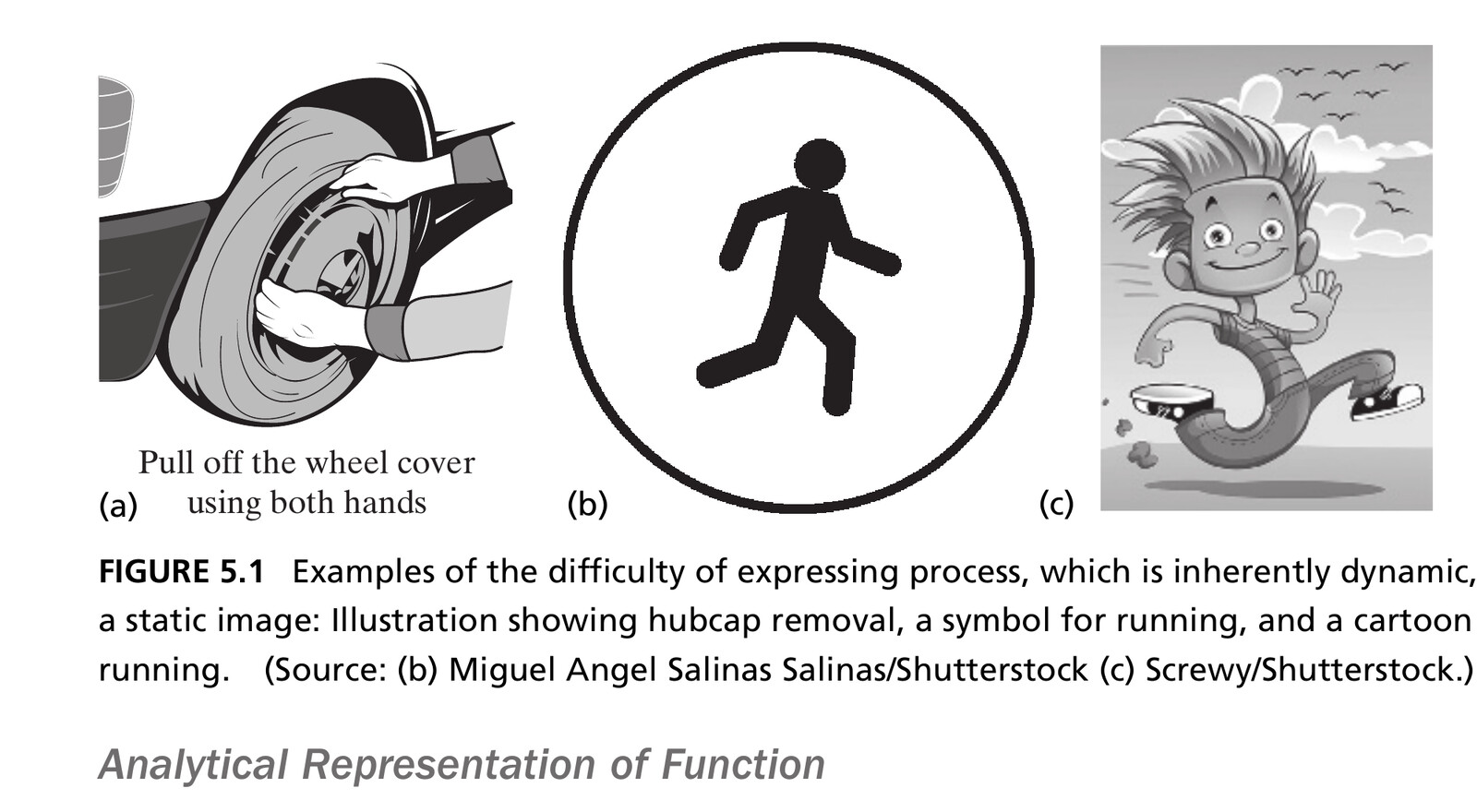
Figure 5.1 · Function Is Hard to Draw
Process is inherently dynamic: a static image always struggles to capture it. Source: Crawley, Cameron & Selva (2016), Fig. 5.1. Photo (b) Miguel Angel Salinas Salinas/Shutterstock, (c) Screwy/Shutterstock.
OPM Notation for Process and Operand
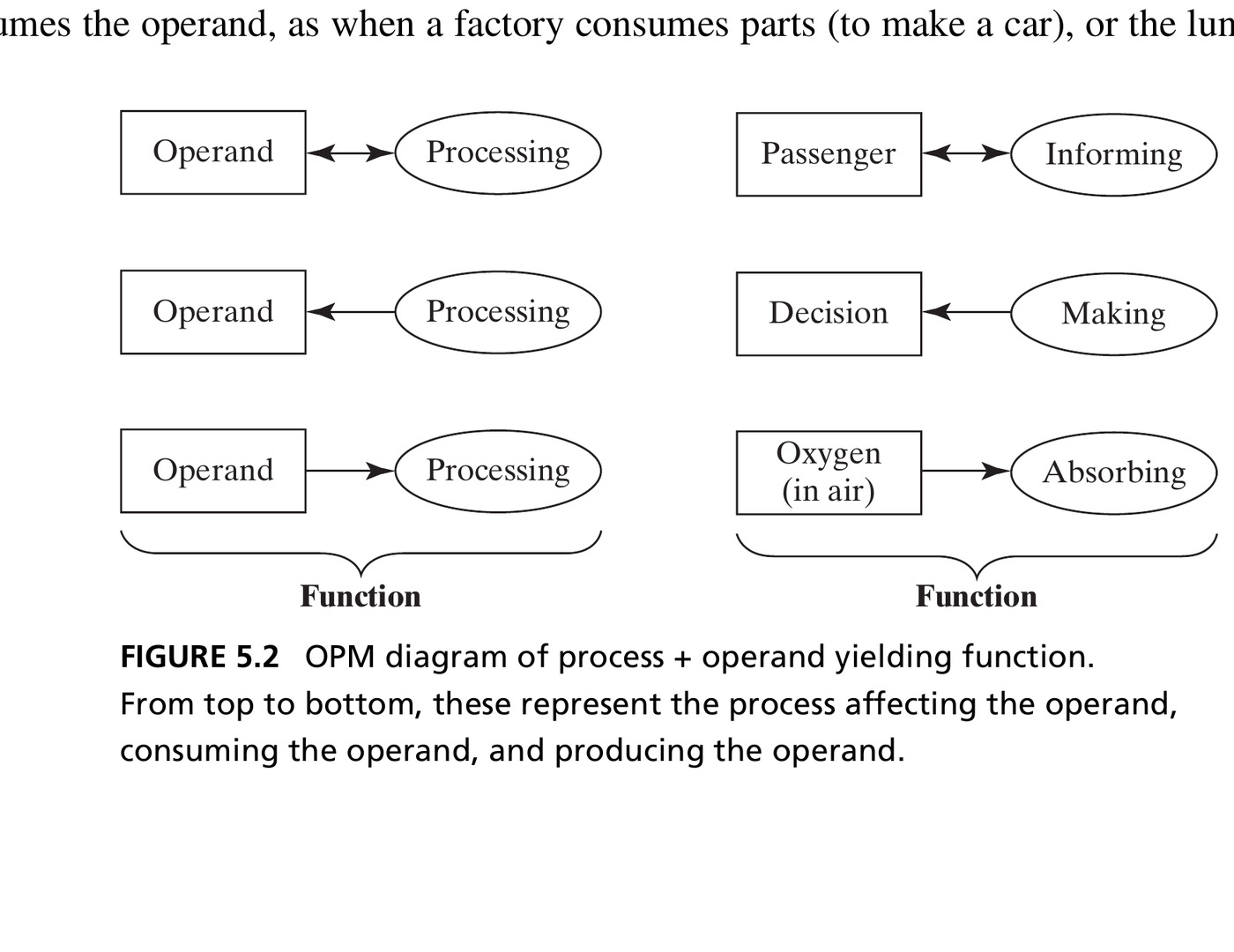
Three ways a process and operand can relate in OPM:
Affect
(double arrow)
The process changes an attribute of the operand, but doesn’t create or destroy it.
Consume
(arrow into process)
The operand no longer exists in its original form after the process.
Produce
(arrow out of process)
The operand didn’t exist before the process, and does after.
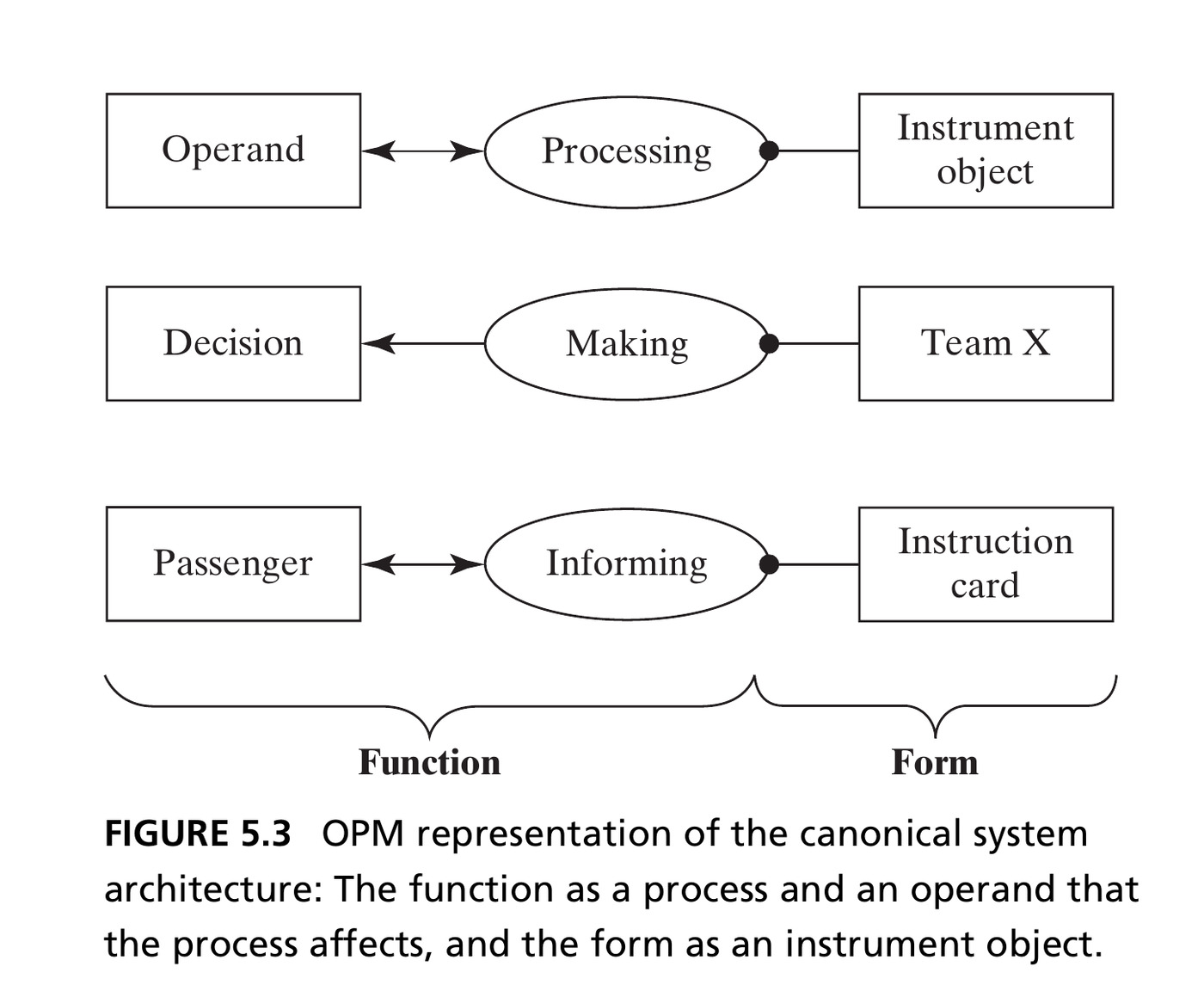
Figure 5.3 · The Canonical Model
Function is a process affecting an operand. The instrument object enables the process. This pattern recurs in the architecture models throughout the course. Source: Crawley, Cameron & Selva (2016), Fig. 5.3.
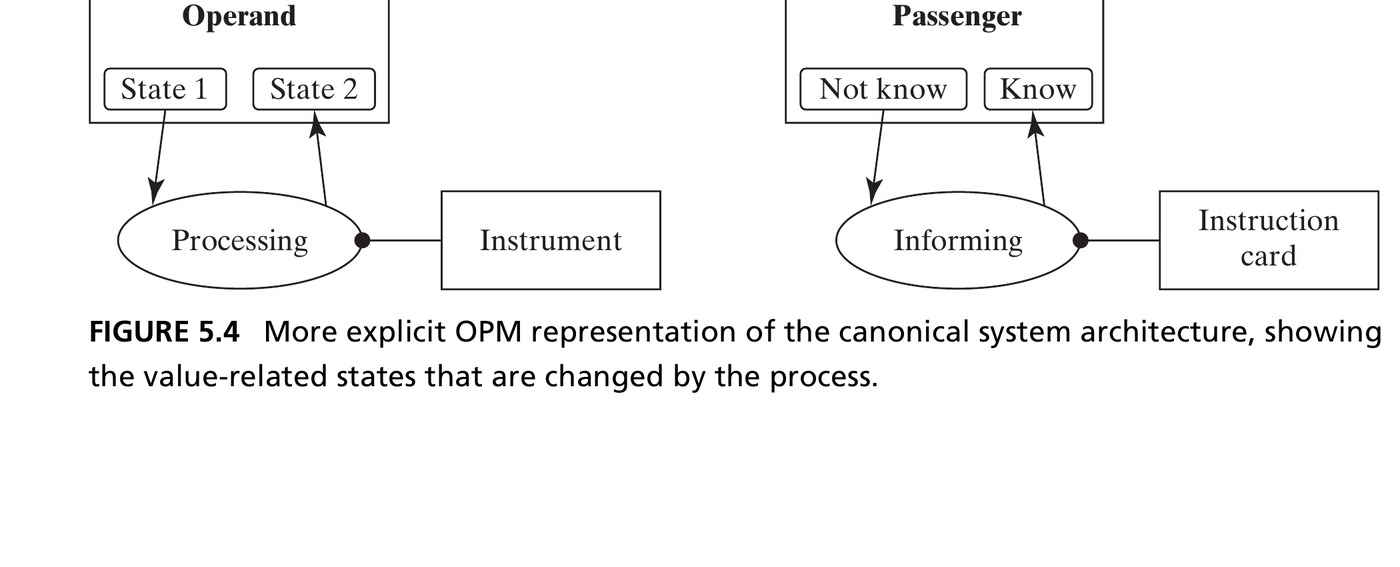
Making States Explicit
A more detailed OPM view shows the operand’s states directly, and which state the process moves it from and to
This is often the most useful representation: it shows exactly what “changes” means for a given operand
5.3 External Function and Value
The Primary Externally Delivered Function
The primary externally delivered function emerges when a process acts across the system boundary, at an interface
The value-related operand is the one whose change in state is the reason the system exists
To find it, ask: What is the most specific operand the system acts on to deliver value? What attribute and state change is associated with that value? What process changes it?
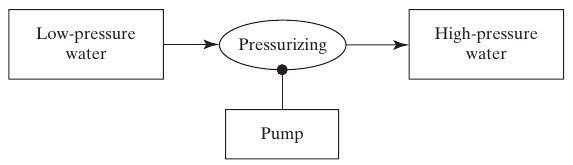
Pump primary function
Pump: operand is water, attribute is pressure, value-state is high, process is pressurizing.
Table 5.2 · External Function and Form
Value-related operand
Attribute → valued state
Process
System form
Output signal
Magnitude → higher
Amplifying
Operational amplifier
Design
Completeness → complete
Developing
Team X
Oxygen
Location → at organs
Supplying
Circulatory system
Water
Pressure → high
Pressurizing
Centrifugal pump
Array
Sortedness → sorted
Sorting
Bubblesort code
Bread
Slicedness → sliced
Making
Kitchen
Read across: what changes, what outcome matters, what activity causes it, and what form enables it.
Adapted from Table 5.2. The operand and process describe function; the last column identifies form.
Box 5.4–5.5 · Value and Benefit
Value is the benefit received relative to the cost incurred.
Box 5.5 · Benefit delivery
Good architectures deliver benefit through the emergence of the primary function and its delivery across a system boundary at an interface.
Value relates benefit to cost. Architecture determines how form enables the required functions and therefore influences both.
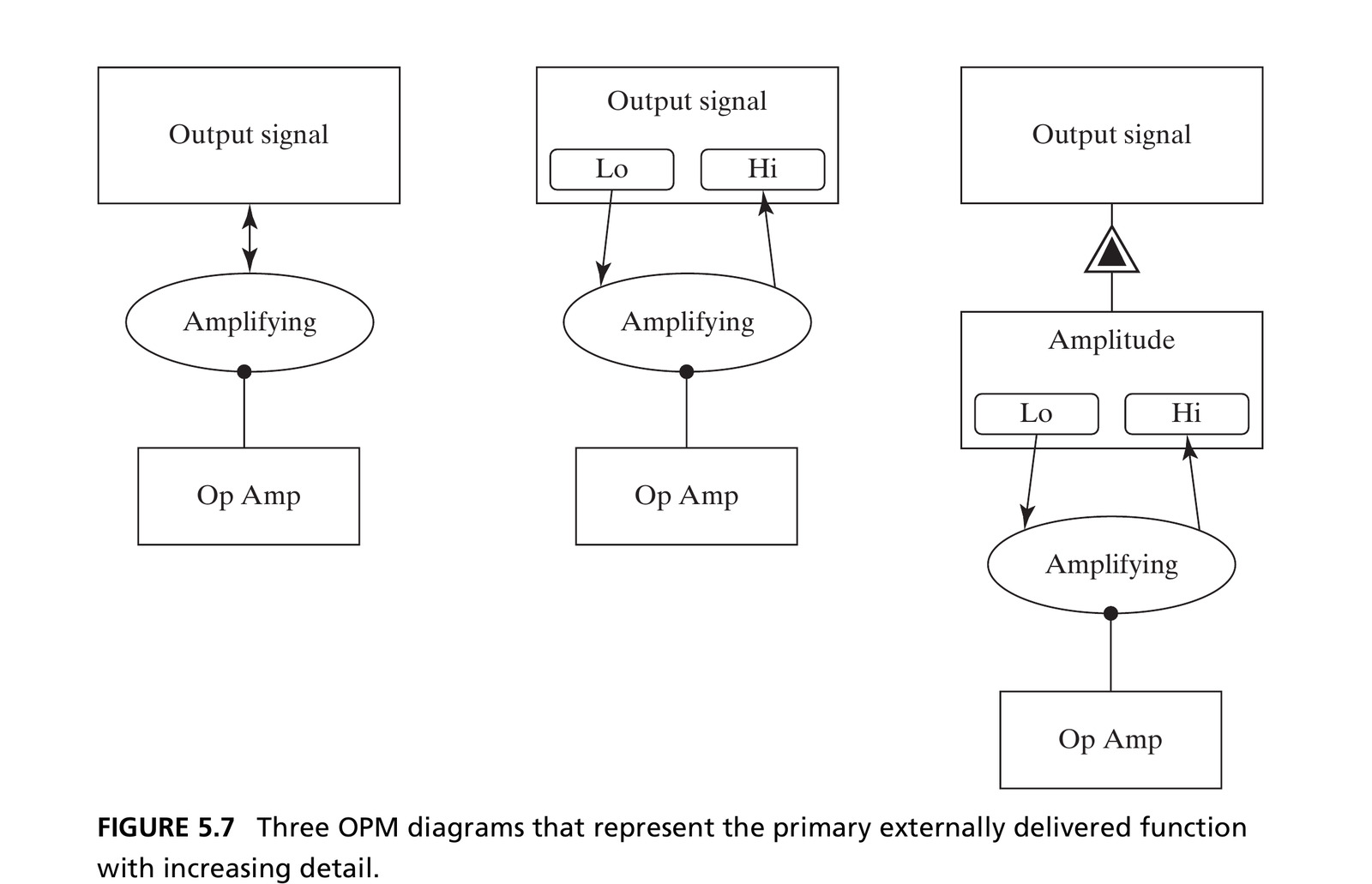
Figure 5.7 · Increasing Levels of Detail
Three equally valid OPM diagrams of the same external function: increasingly explicit about the operand’s states. Source: Crawley, Cameron & Selva (2016), Fig. 5.7.
Separate input/output objects emphasize what crosses the interface.
“Consume/create” describes the modeled objects; it does not imply that water matter disappears or is manufactured.
Source: Figure 5.8. Compare the persistent-water representation in Figure 5.9 next.
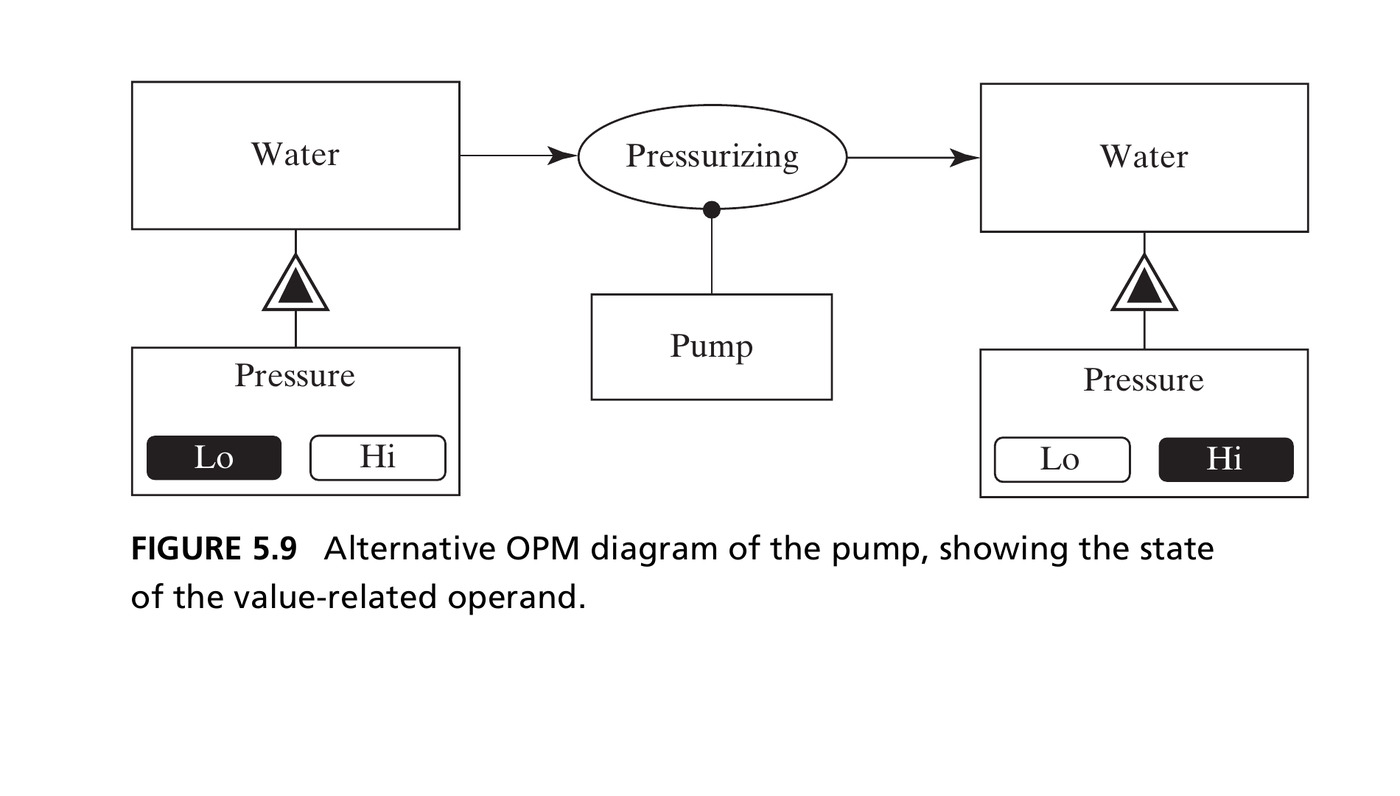
Figure 5.9 · The Pump’s Value-Related Operand
Water is the operand; pressure is the value-related attribute; pressurizing is the process that moves it from Lo to Hi. Source: Crawley, Cameron & Selva (2016), Fig. 5.9.
Figures 5.8 and 5.9 · Same Function, Two Views
Figure 5.8: input/output objects
Emphasizes the transformation between named flow objects.
Figure 5.9: explicit states
Emphasizes the pressure change of water that persists.
Both express Pressurizing + water. Choose a view that answers the engineering question; do not mix object identities midway through a model.
Section 5.2–5.3 Summary
Function is a process acting on an operand, enabled by an instrument of form
The primary externally delivered function emerges when a process acts on the value-related operand across the system boundary
Benefit materializes as a consequence of a process acting on the value-related operand: analyze the operand, its value-related attribute and state change, and the process
5.4 Internal Function
Identifying Internal Functions
Internal functions are the processes and operands inside the boundary that lead to the value-related external function
Identifying internal functions requires domain knowledge. Use the elements of form, established designs, or suitable analogies as starting points
The three techniques from Chapter 2 for predicting emergence apply here too: precedent, experiments, and analysis
Pump internal functions
Pump: increments kinetic energy (accelerating), then trades it for pressure (diffusing): in addition to inflowing and outflowing.
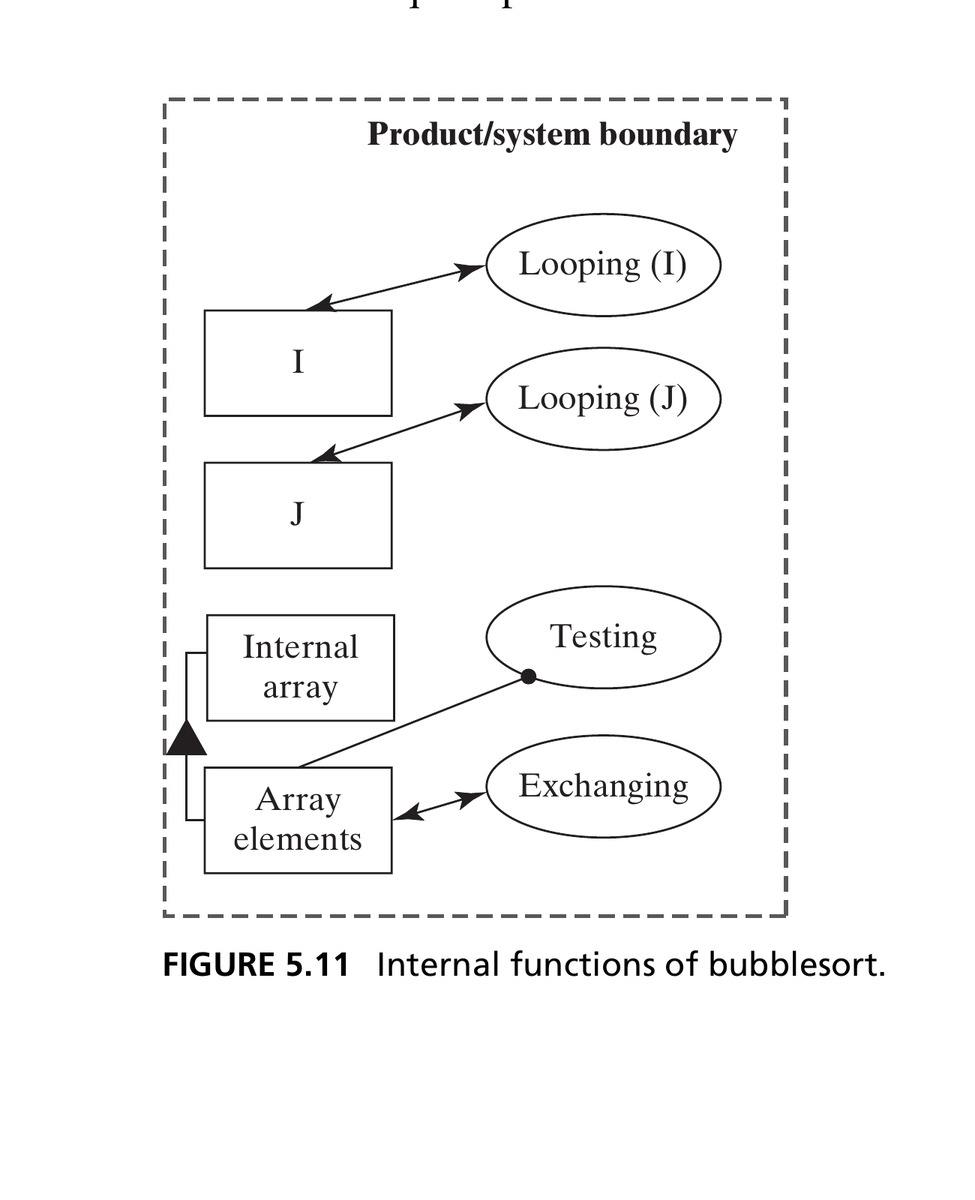
I index — Looping; J index — Looping; Array entries — Testing / Exchanging
Kitchen
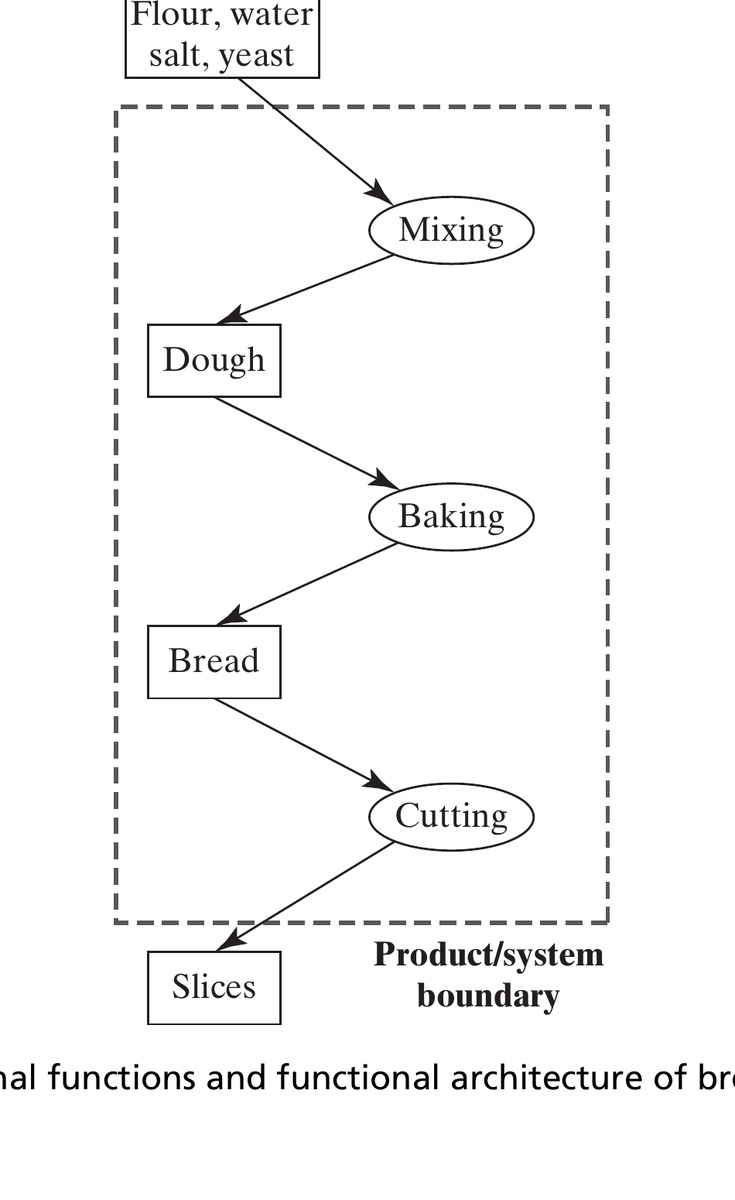
Dough — Mixing; Bread — Baking; Slices — Cutting
Compare Table 5.2: several internal functions contribute to one externally delivered function. Their interactions still need to be identified.
Adapted from Table 5.3; all listed pairs retained. The dash pairs an operand with a process; it does not specify an OPM link direction.
Box 5.6 · Standard Process Patterns
Purpose
A starting blueprint
Transport mass
Overcome gravity; overcome drag; guide the mass
Transfer information
Encode; transmit while directing; decode
Engage an employee
Recruit; agree; train; assign tasks; evaluate
Make a decision
Gather evidence; develop options and criteria; evaluate; decide
Assemble parts
Bring together; inspect; assemble; test
Use these patterns to propose internal functions. Check them against the actual system, observations, and domain knowledge.
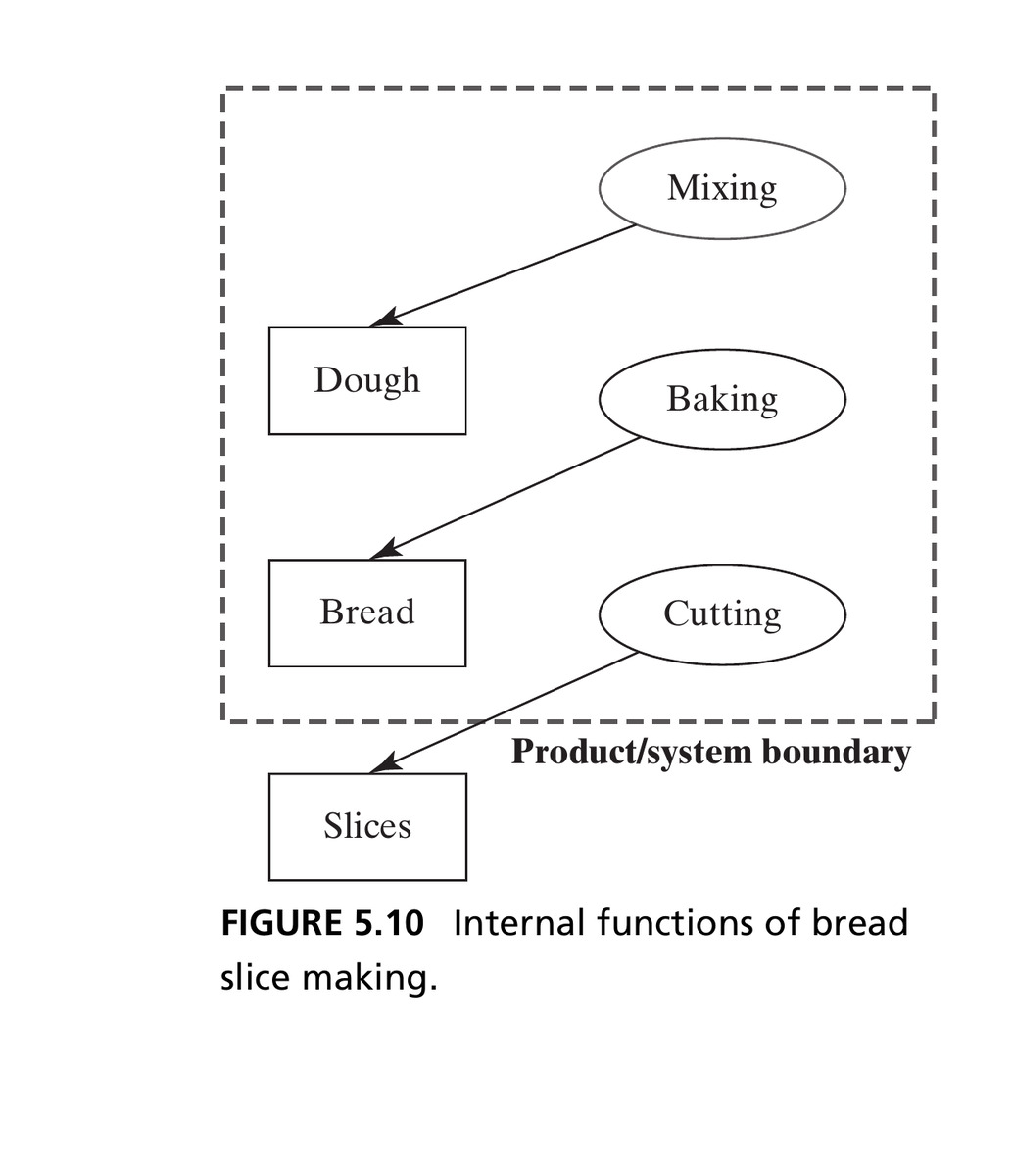
Figure 5.10 · Internal Functions of Bread Slicing
Mixing produces dough, baking produces bread, cutting produces slices: inferred from a standard cooking blueprint. Source: Crawley, Cameron & Selva (2016), Fig. 5.10.
Table 5.4 · Pump Flow-Through PO Array
Process
Internal low-p flow
Internal high-v flow
Internal high-p flow
External low-p flow
External high-p flow
Inflowing
c′
d
Accelerating
d
c′
Diffusing
d
c′
Outflowing
d
c′
c′ = create; d = consume. Blank = no direct relationship.
Trace a handoff: In the high-v column, Accelerating creates the operand that Diffusing consumes. Figure 5.13 later draws this handoff as an OPM diagram.
Table 5.4, with abbreviated headers: p = pressure; v = velocity. External columns represent interface operands.
Figure 5.11 · Internal Functions of Bubblesort
Looping affects the index (doesn’t create/destroy it); exchanging affects array entries; testing uses array elements as an instrument, without changing them. Source: Crawley, Cameron & Selva (2016), Fig. 5.11.
5.5 Functional Interactions
Functional Architecture
Functional architecture
The exchanged or shared operands are the functional interactions. The functions plus the functional interactions are the functional architecture.
Interactions among internal functions produce the externally delivered function
Comparing the internal-function view to the functional-architecture view usually reveals additional input/output operands that were implicit before
Completing a Functional Architecture
Start with the known internal processes and the value-related operand.
Add missing boundary processes, such as importing or exporting.
Add missing operands, including inputs and intermediate results.
For each process, check every required operand and its relationship.
For each operand, check all the processes that use or change it.
Trace backward from the valued output: can this connected model explain the desired emergence?
Bread example: Mixing → Baking → Cutting needs ingredients, dough, bread, and delivered slices to become a complete pathway.
Figure 5.12 · Functional Architecture of Bread Slicing
Adding the raw-ingredient input reveals the full functional architecture: compare to Figure 5.10. Source: Crawley, Cameron & Selva (2016), Fig. 5.12.
Box 5.7 · From OPM to a PO Array
Put processes in rows and operands in columns.
Read one process and its direct OPM connections at a time.
Entry
Meaning in that process row
c′
Creates the operand
d
Consumes/destroys the modeled operand
a
Affects an existing operand’s state
I
Uses an unchanged object as an instrument
Blank
No direct relationship in this model
The prime marks a created, post-process operand. A PO array can be rectangular; a DSM uses the same entity set on both axes.
Worked PO Array · Making Bread Slices
Process ↓ / Operand →
Ingredients*
Dough
Bread
Slices
Mixing
d
c′
Baking
d
c′
Cutting
d
c′
*Flour, water, salt, and yeast grouped for readability; separate columns would each contain d in the Mixing row.
Read a row: Baking consumes dough and creates bread.
Read a column: Dough connects its producer, Mixing, to its consumer, Baking.
External ingredients enter; valued slices leave the boundary.
Worked translation of Figure 5.12 using Box 5.7. Blank cells mean no direct relationship.
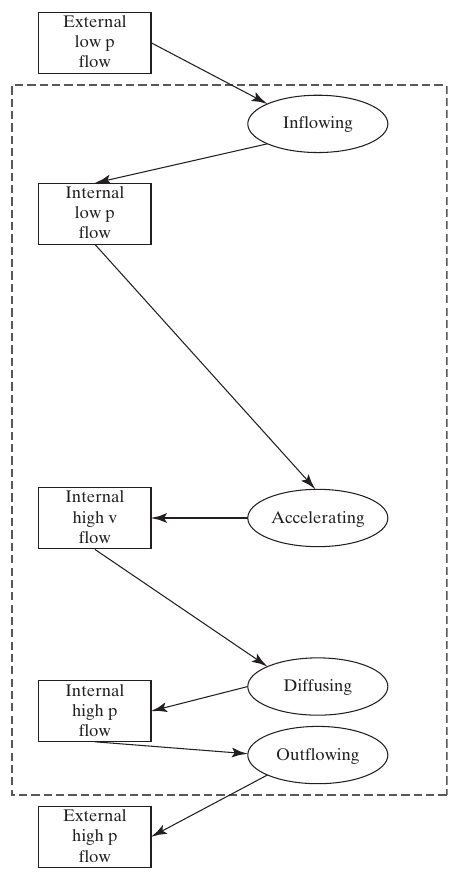
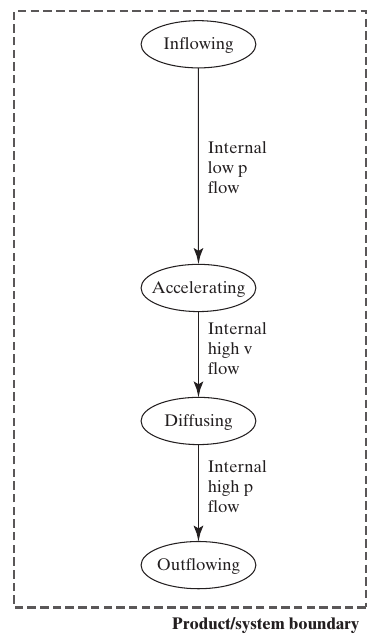
Figure 5.13 · Pump Flow-Through Model
Four processes connect the external inlet and outlet flows.
Each internal flow-stage object is created by one process and consumed by another.
Follow the arrows from low-pressure input to high-pressure output.
p = pressure; v = velocity.
Source: Figure 5.13. The dashed line marks the system boundary.
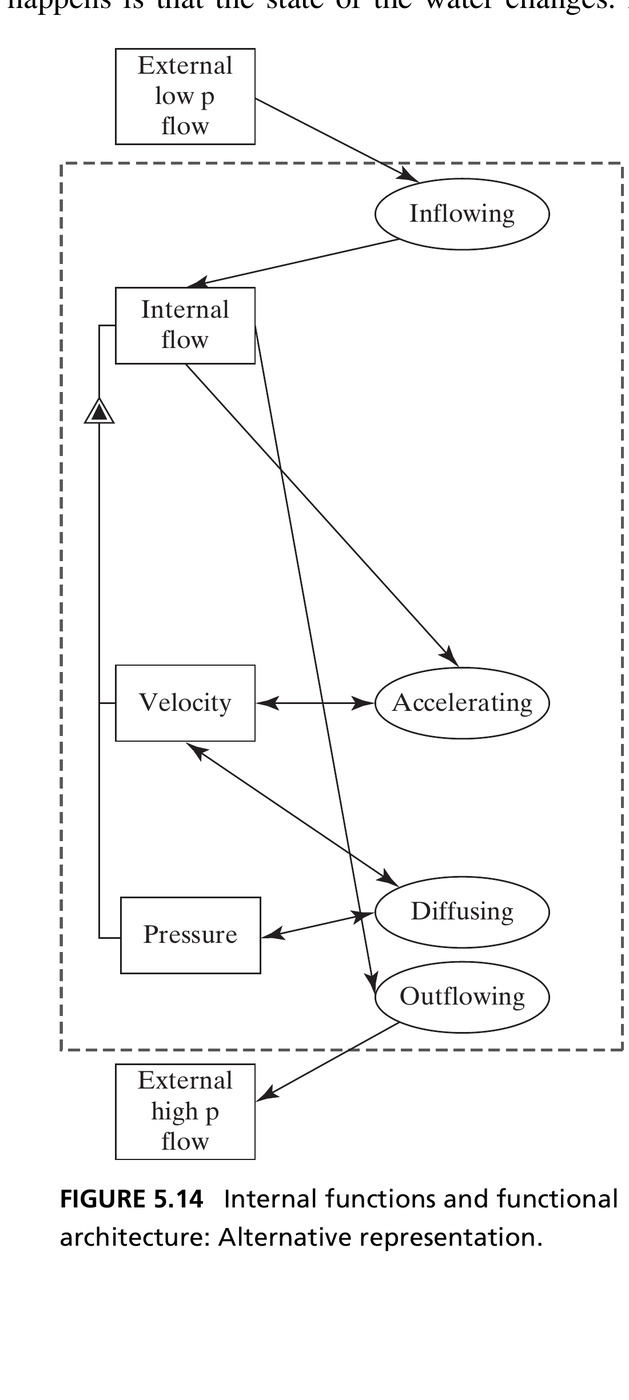
Figure 5.14 · The Pump, Redrawn with States
Figure 5.13 uses separate flow-stage objects to represent the water at successive stages
Figure 5.14 instead represents the water as a continuing operand whose state changes
Choose the view that explains emergence
Choose an interpretation of internal functions that helps explain and predict the system’s emergent behavior.
Table 5.5 · Pump PO Array with States
Process
Internal flow: existence
Internal flow: velocity
Internal flow: pressure
External low-p flow
External high-p flow
Inflowing A
c′
d
Accelerating B
a
Diffusing C
a
a
Outflowing D
d
c′
a = affect a state; c′ / d = create / consume the modeled object.
Accelerating changes velocity; Diffusing changes velocity and pressure.
One internal-flow object persists between inlet and outlet; its attribute columns expose what changes.
Table 5.5 corresponds to Figure 5.14. Velocity and pressure are attributes of the internal flow, not extra material objects.
Figures 5.13 and 5.14 · Compare the Models
5.13 / Table 5.4: flow stages
Separate flow objects; c′ and d show handoffs.
5.14 / Table 5.5: persistent flow
One internal flow; a exposes velocity and pressure changes.
Same intended external benefit. Different choices of operand identity make different questions easier to answer.
The Value Pathway
The value pathway is the chain of internal processes and operands that leads to the primary externally delivered function
Not every operand and process is on it: some are:
Not contributing to any desired function (unwanted side-effects, poor design, legacy: a source of gratuitous complexity, Ch. 13)
Supporting processes and form (even further from the value pathway: Ch. 6)
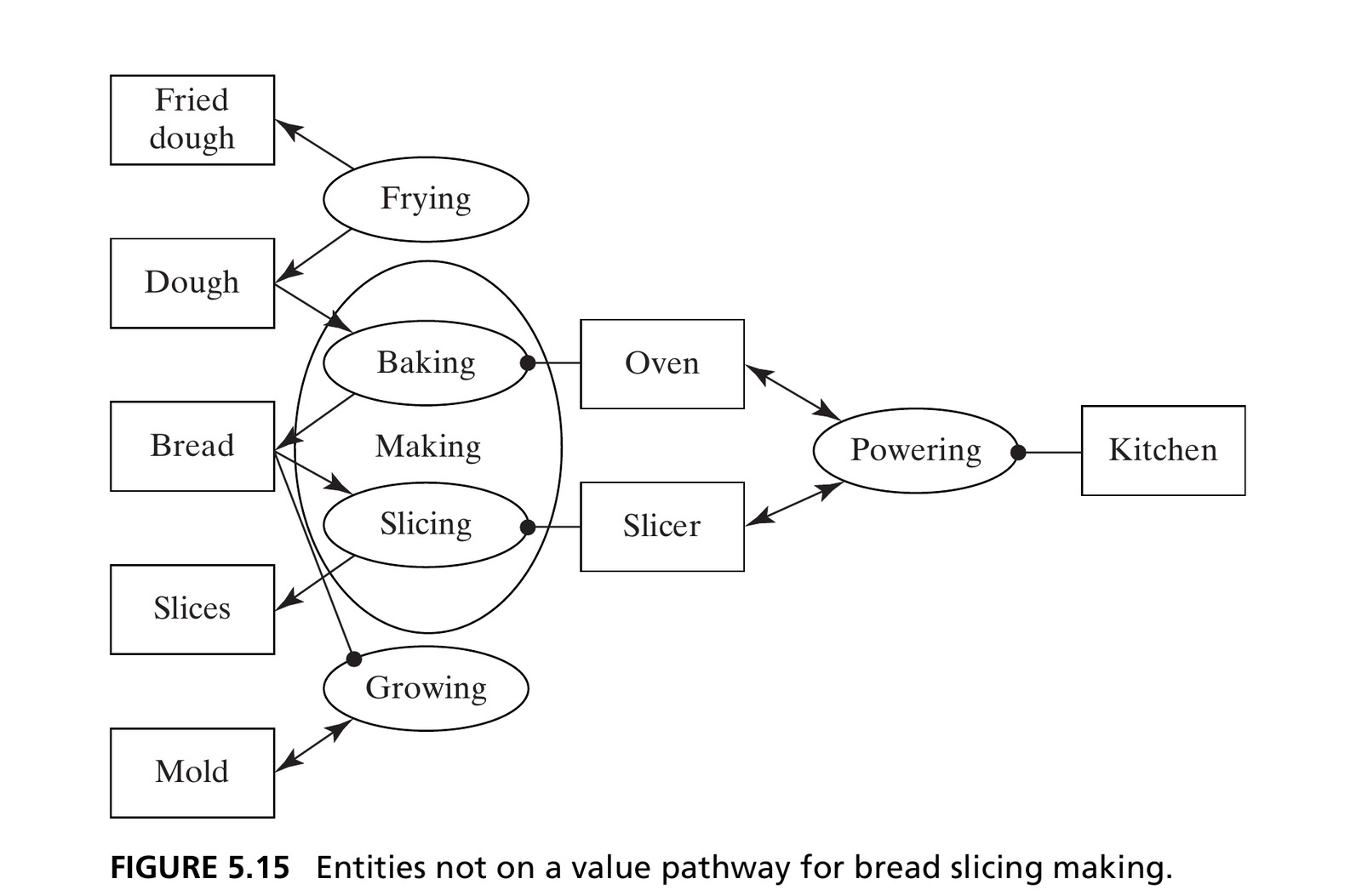
Figure 5.15 · Entities Not on the Value Pathway
Frying belongs to a secondary value pathway; growing mold is unwanted. Powering (the kitchen) is a supporting function, one step further removed. Source: Crawley, Cameron & Selva (2016), Fig. 5.15.
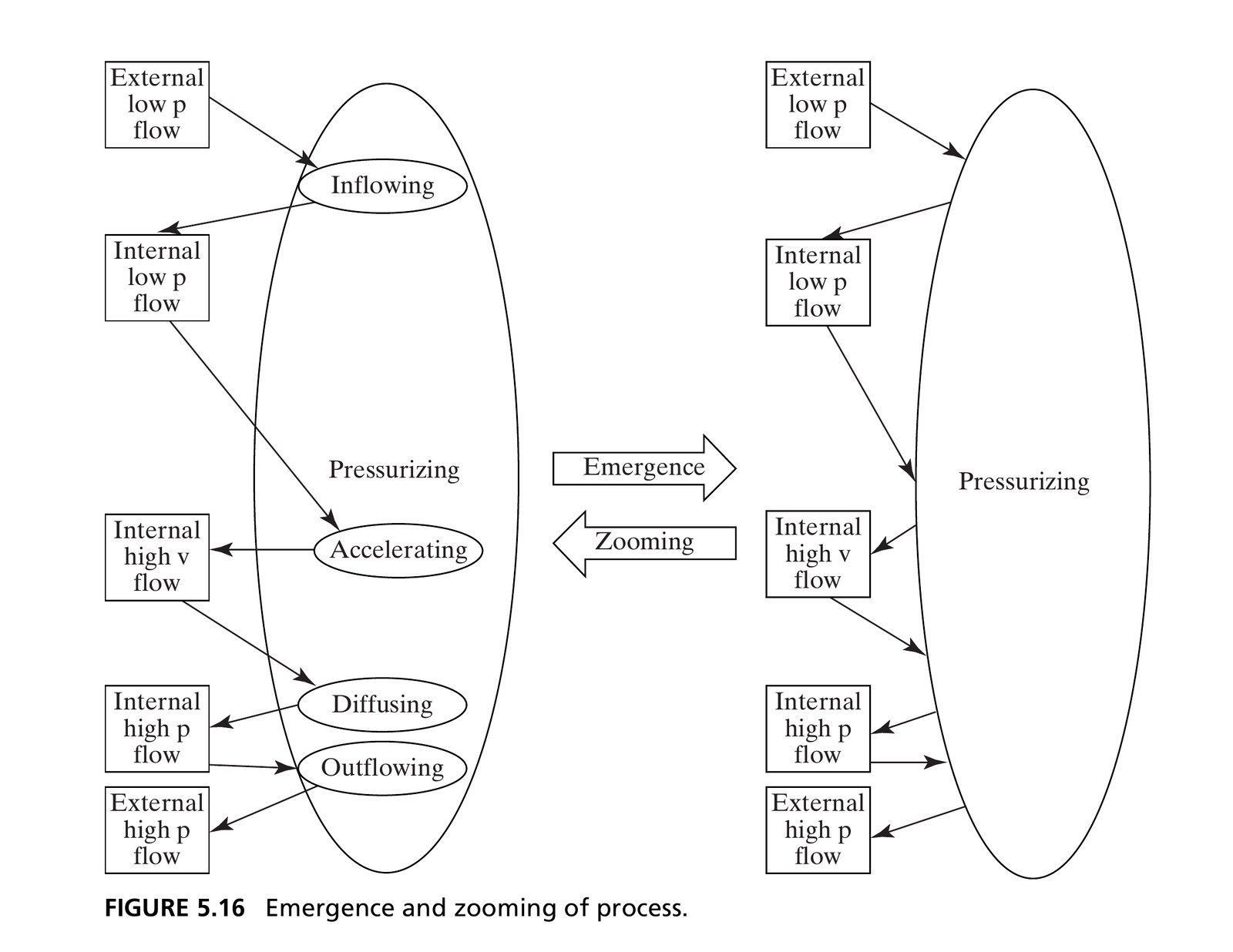
Emergence and Zooming
Emergence: the “smaller to larger” whole-part relationship for process: internal processes combine into the emergent external function
Zooming: the reverse, “larger to smaller”: reasoning from the emergent function back down into the internal processes that produce it
Figure 5.17 · Projecting onto Processes
Replace an explicit operand node between processes with a process-to-process dependency.
Here, flow labels preserve the reason for each link.
The projection highlights the pathway but hides detailed operand relationships and states.
Return to the full OPM/PO model to analyze an interface.
Source: Figure 5.17, a projection of the flow-through pump model. The next slides develop Box 5.8’s matrix construction.
Each term follows source process j → operand k → receiving process i. Here multiplication joins labels into a path; addition collects paths. It is symbolic, not ordinary arithmetic. Afterward, discard terms containing a prime to retain the book’s causal links; read each surviving entry column → row. We apply this to Table 5.4’s pump to obtain Figure 5.17.
Box 5.8 prints PP × OO × OP; the first factor must be PO for the dimensions and the process–operand links to match.
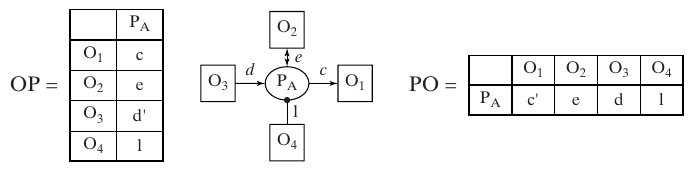
Figure 5.18 · From PO to OP
Start with PO: process rows and operand columns.
Transpose it to form OP; change c′ → c and d → d′. Affect and instrument entries stay the same.
For the pump, apply this to all four processes and all three internal flows: low-pressure (\(L\)), high-velocity (\(V\)), and high-pressure (\(H\)).
Source: Figure 5.18 and Box 5.8. Figure 5.18 uses e for effect; the text uses a.
\(P_1\rightarrow P_2\) via internal low-pressure flow (\(L\)).
\(P_2\rightarrow P_3\) via internal high-velocity flow (\(V\)).
\(P_3\rightarrow P_4\) via internal high-pressure flow (\(H\)).
These are the three labeled arrows in Figure 5.17.
Pump Projection · Numeric Check
For the same four process rows and three internal-flow columns, let \(C_{jk}=1\) when process \(j\)creates operand \(k\), and \(D_{ik}=1\) when process \(i\)consumes it:
\(A_{ij}=\sum_k D_{ik}C_{jk}\) counts direct producer-to-consumer handoffs. Its three 1s occur in the same cells as \(dLc\), \(dVc\), and \(dHc\).
Functional Architecture in Software
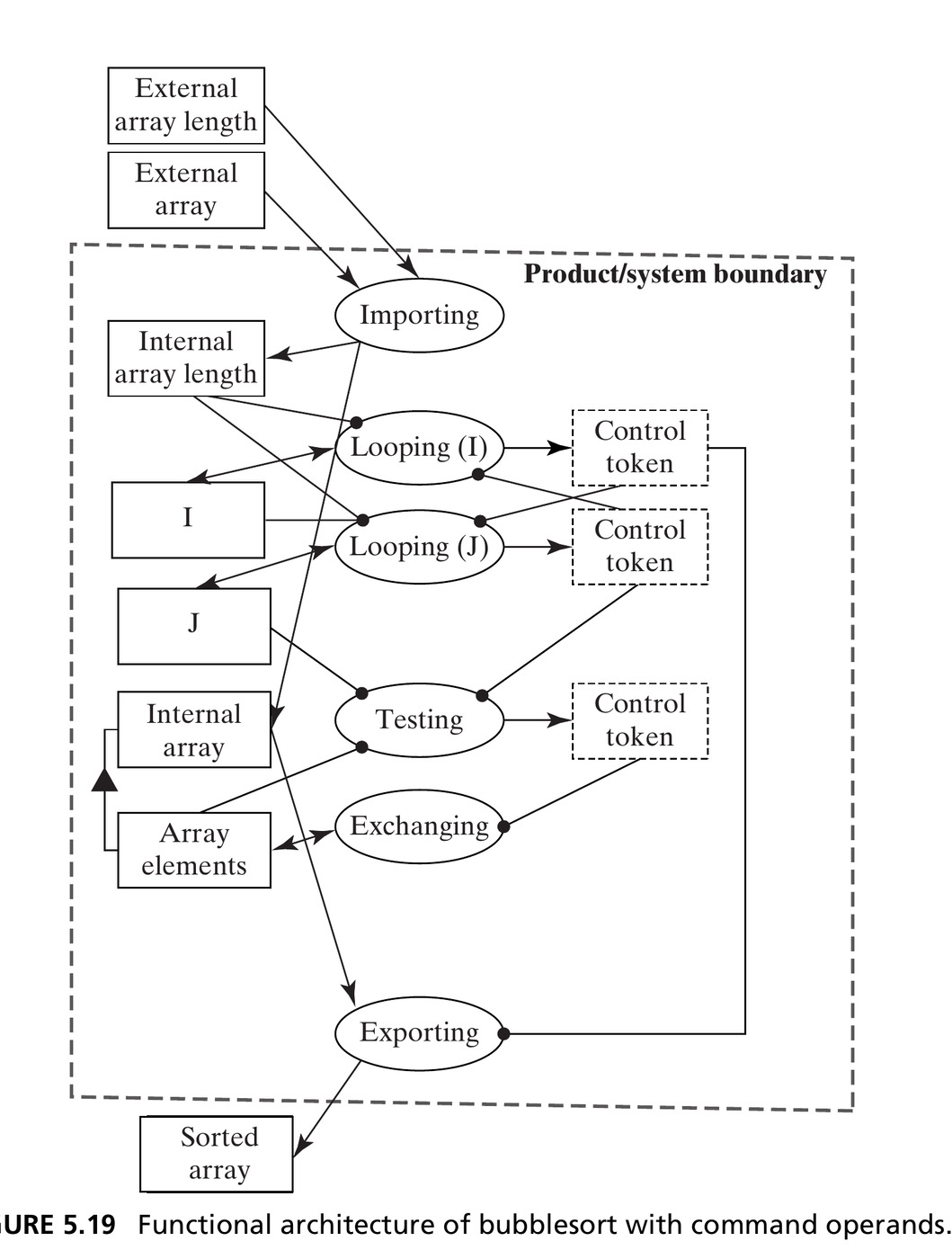
Software functions are of two types: computational statements (A = B + C) and functions that dynamically allocate control (if... then...)
Control functions need operands too: control tokens, more implicit than explicit data variables
This produces two parallel kinds of functional interaction: data interactions and command (control) interactions
Figure 5.19 · Bubblesort with Command Operands
Control tokens pass between Looping, Testing, and Exporting: the command interactions running in parallel with the data interactions. Source: Crawley, Cameron & Selva (2016), Fig. 5.19.
Section 5.5 Summary
The entities of internal function, the internal processes, and the interactions of operands among processes establish the functional architecture
Representation of internal function is not unique: it depends on interpretation and style
The functional architecture generally contains a value pathway; we zoom the external function to identify it
Diagrams can be simplified using projections, where interactions between processes are indicated by shared operands alone
5.6 Secondary Functions
Secondary Value-Related Functions
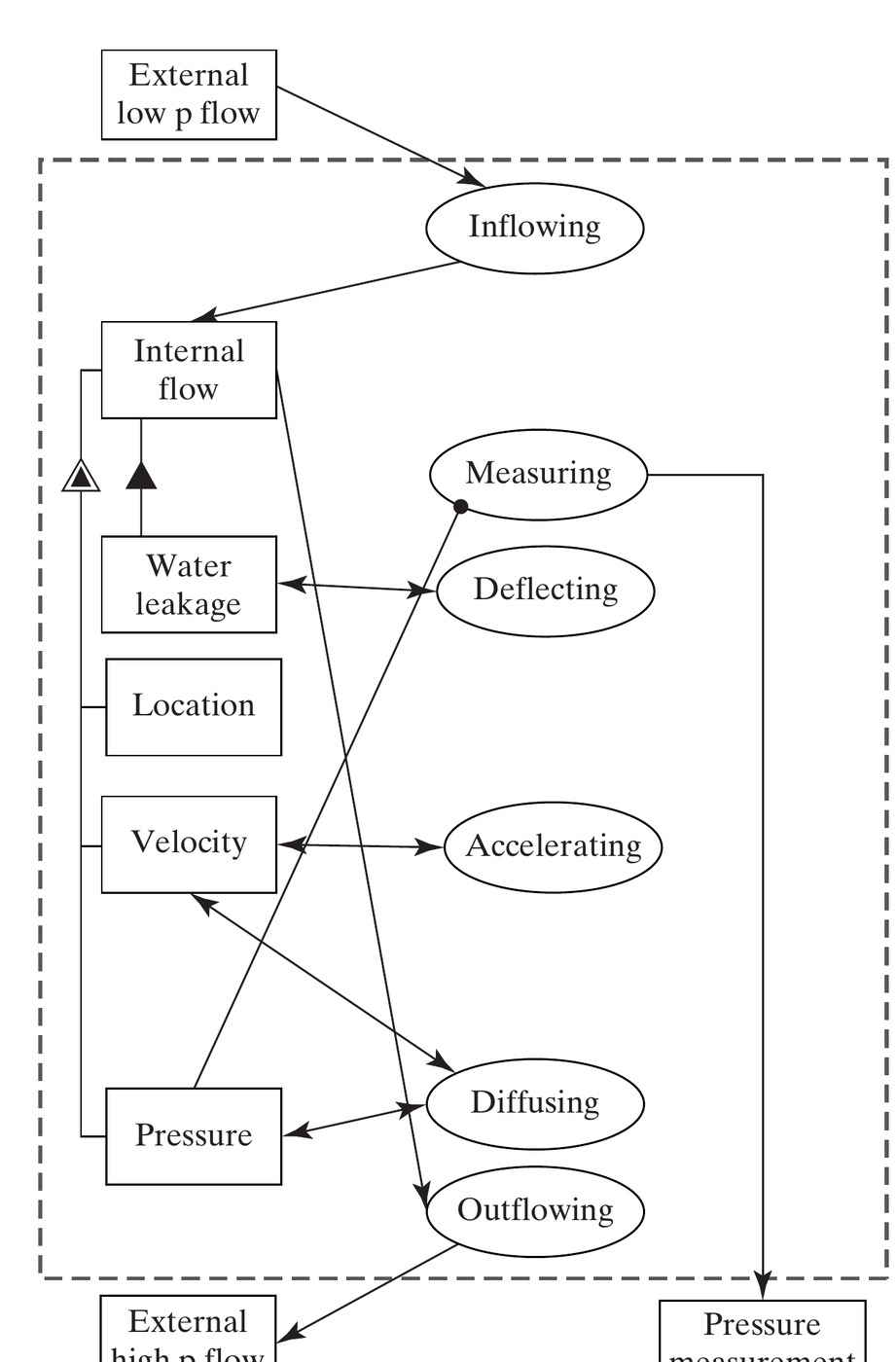
Systems may deliver secondary value-related functions in addition to their primary function
Team X could also produce reports; the circulatory system also returns CO₂; an op-amp could also filter noise
Secondary functions can meet customer expectations and distinguish competing products
Procedure: repeat the same reasoning used for the primary value-related function
Figure 5.20 · Secondary Functions of the Pump
A “slinger” deflects leaked water away from the motor; a sensor measures outlet pressure. Neither is on the primary value pathway, but both add real value. Source: Crawley, Cameron & Selva (2016), Fig. 5.20.
Chapter 5 Summary
Function is a process (enabled by an instrument of form) acting on an operand
The primary externally delivered function emerges where a process crosses the system boundary and changes the value-related operand
Internal functions require domain knowledge to identify; their interactions (shared/exchanged operands) form the functional architecture
The value pathway explains how the primary function emerges. Other entities may serve secondary functions, provide support, or add gratuitous complexity
Systems can deliver secondary value-related functions too, beyond the primary one
Table 5.6 · Form and Function
Form
Function
What a system is (noun)
What a system does (verb)
Objects + formal structure
Operands + processes
Aggregates and decomposes
Emerges and zooms
Enables function
Requires an instrument of form
Specified at an interface
Specified at an interface
Source of cost
Source of external benefit
Transaction: a good
Transaction: a service
Architecture connects the columns: which elements of form enable which processes, acting on which operands?
Adapted from Table 5.6. These are analytical emphases; real offerings can combine goods and services.
Next: System Architecture
Chapter 6 combines form and function: the mapping of instrument objects to internal processes is the architecture of a system.
Reference
Crawley, E., Cameron, B., & Selva, D. (2016). System Architecture: Strategy and Product Development for Complex Systems. Pearson. Chapter 5.