Classification of Four-Bar Linkages
Kinematics and Machine Dynamics · Chapter 3
Chapter overview
- Check whether four lengths form a movable closed linkage.
- Apply Grashof’s criterion.
- Identify the effect of choosing a different fixed link.
- Evaluate the transmission angle.
Name the links before sorting lengths
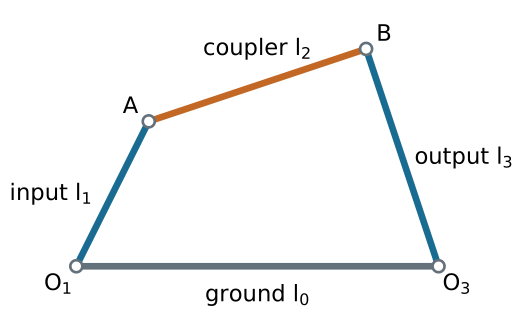
Use l_0 for ground, l_1 for input, l_2 for coupler, and l_3 for output. Sorted lengths are s\leq p\leq q\leq l.
Can the linkage close?
A nondegenerate quadrilateral requires
\boxed{l<s+p+q.}
If l>s+p+q, the links cannot close.
If l=s+p+q, they can only lie collinearly in a degenerate assembly; this is not an ordinary moving four-bar.
Grashof’s criterion
For an assemblable four-bar:
| Length test | Motion class |
|---|---|
| s+l<p+q | Strict Grashof |
| s+l=p+q | Change-point case |
| s+l>p+q | Non-Grashof |
In the strict Grashof case, at least one link can rotate completely relative to an adjacent link. Rotation relative to ground depends on which link is fixed.
Inversion: choosing the fixed link
Keep the same four lengths and the same cyclic connectivity, but fix a different link.
For a strict Grashof chain with a unique shortest link:
| Position of shortest link | Ground-referenced motion |
|---|---|
| Fixed | Double crank (drag link) |
| Adjacent to ground | Crank-rocker |
| Opposite ground, as the coupler | Double rocker |
Crank-rocker
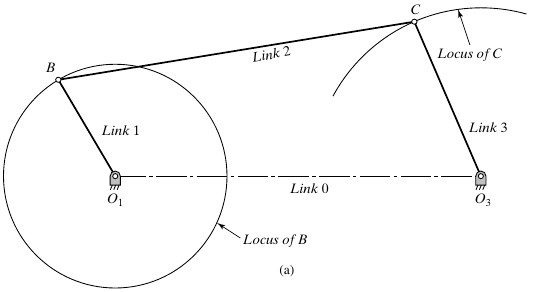
The shortest link is adjacent to ground and can rotate continuously. The other ground-connected link oscillates.
The driver must be chosen consistently with the desired continuous input.
Double crank and double rocker
Double crank: ground is shortest; both ground-connected links can rotate fully.
Grashof double rocker: the coupler is shortest; both ground-connected links rock, even though the chain satisfies Grashof’s condition.
Non-Grashof: no inversion supplies a fully rotating ground-connected crank; the moving links have bounded rotation relative to ground.
Change points
s+l=p+q.
The links can pass through an all-collinear configuration. The continuation of motion can become ambiguous at this posture.
A parallelogram is a familiar example. An additional constraint or suitable drive arrangement may be needed to maintain the intended branch.
Treat equality separately from strict Grashof motion.
Worked example: classify one assembly
Let (l_0,l_1,l_2,l_3)=(100,40,120,90)\ \mathrm{mm}.
s=40,\quad l=120,\quad p=90,\quad q=100.
Closure: 120<40+90+100.
Grashof: 40+120=160<190=90+100.
The shortest link is the input, adjacent to ground: crank-rocker.
Worked example: change the ground link
Use the same cyclic chain with lengths 100,40,120,90\ \mathrm{mm}.
- Fix the 40 mm link: double crank.
- Fix the opposite 90 mm link: Grashof double rocker.
- Fix either adjacent link, 100 or 120 mm: crank-rocker.
Sorting the lengths alone does not identify the inversion.
Worked example: a variable ground length
Let (l_1,l_2,l_3)=(100,200,300)\ \mathrm{mm} and let ground length be d>0.
Closure requires d<600 mm. Applying the sorted Grashof test piecewise gives
\boxed{200\leq d\leq400.}
The endpoints 200,400 mm are change-point cases.
Strict crank-rocker operation occurs for 200<d<400 mm, with the 100 mm link as crank.
Transmission angle
Let \mu be the included angle between coupler and output link, 0\leq\mu\leq\pi.
For an ideal two-force coupler exerting axial force F,
|\tau_3|=|F|l_3|\sin\mu|.
Torque transmission is strongest near 90^\circ. Near collinearity, large coupler and bearing forces produce little output torque.
Compute the angle from a triangle
Let d_A be the distance from input endpoint A to output pivot O_3.
d_A^2=l_0^2+l_1^2-2l_0l_1\cos\theta_1.
The triangle with sides l_2,l_3,d_A gives
\boxed{\cos\mu=\frac{l_2^2+l_3^2-d_A^2}{2l_2l_3}.}
A supplementary angle convention gives the same |\sin\mu| and hence the same torque magnitude.
Worked example: force transmission
For (100,40,120,90) mm and \theta_1=90^\circ:
d_A^2=11600\ \mathrm{mm^2},\qquad \cos\mu=\frac{10900}{21600}.
Thus \mu\approx59.7^\circ.
With F=500 N and l_3=0.09 m:
|\tau_3|\approx500(0.09)\sin59.7^\circ=38.9\ \mathrm{N\,m}.
Design implications
The compiled notes suggest keeping 45^\circ\leq\mu\leq135^\circ as a useful preliminary guideline.
Check the entire operating cycle, not a single configuration.
Also check branch changes, clearances, bearing forces, friction, and link strength. The angle guideline alone does not establish a safe design.
References and next chapter
Satici, Kinematics and Machine Dynamics, Chapter 3, pp. 7–9; Lecture01 classification slides, following Wilson and Sadler.
The crank-rocker figure is from the compiled notes, Fig. 3.1. Other diagrams and numerical examples are instructional additions.

← Course Home · Kinematics and Machine Dynamics · Chapter 3